Retro Comfort Colors 1717
Top Dink
$39.99
- Comfort Colors 1717 heavyweight cotton
- Original design · printed to order
- U.S. print partners
Top Dink — 80s Movie Shirt With the Need to Dink
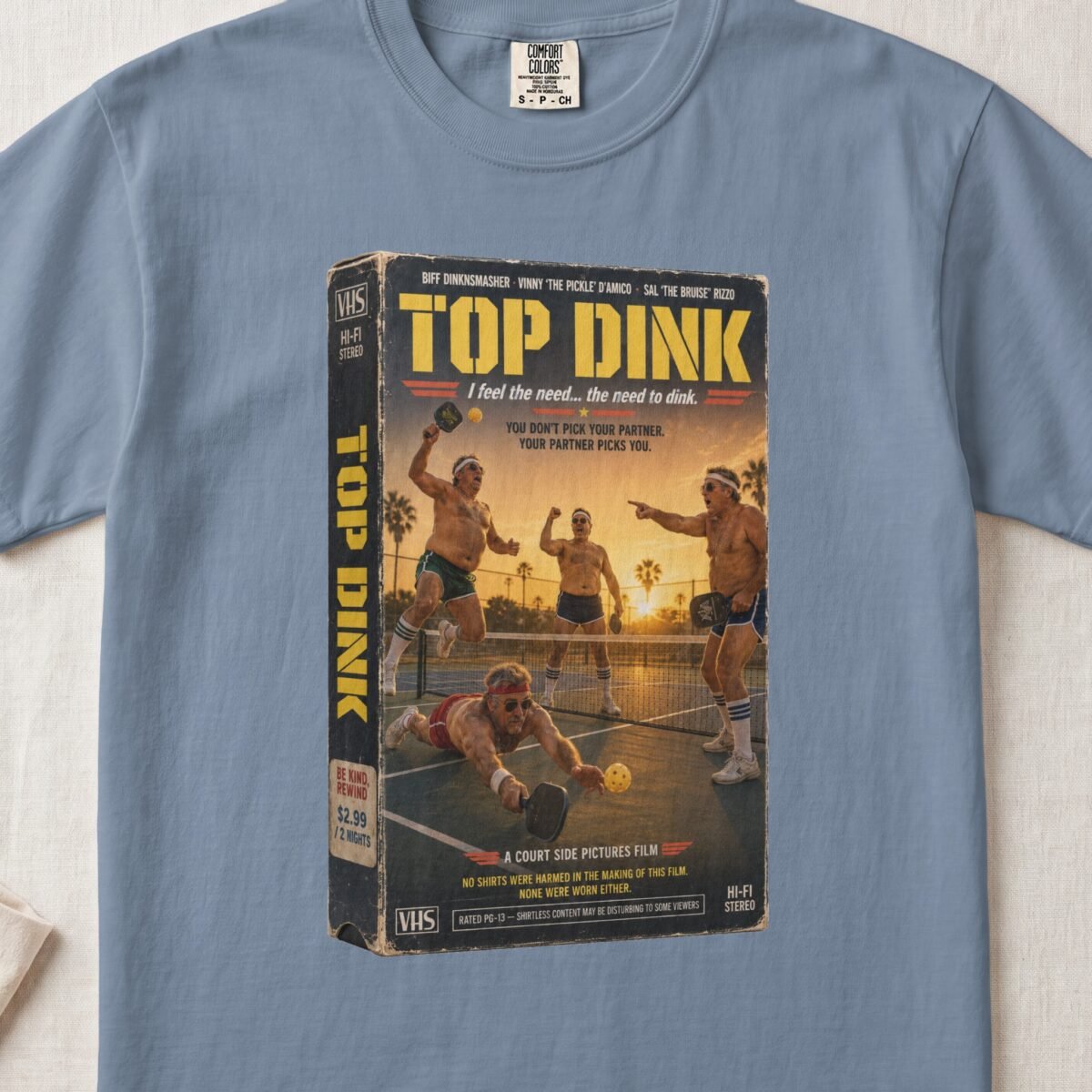
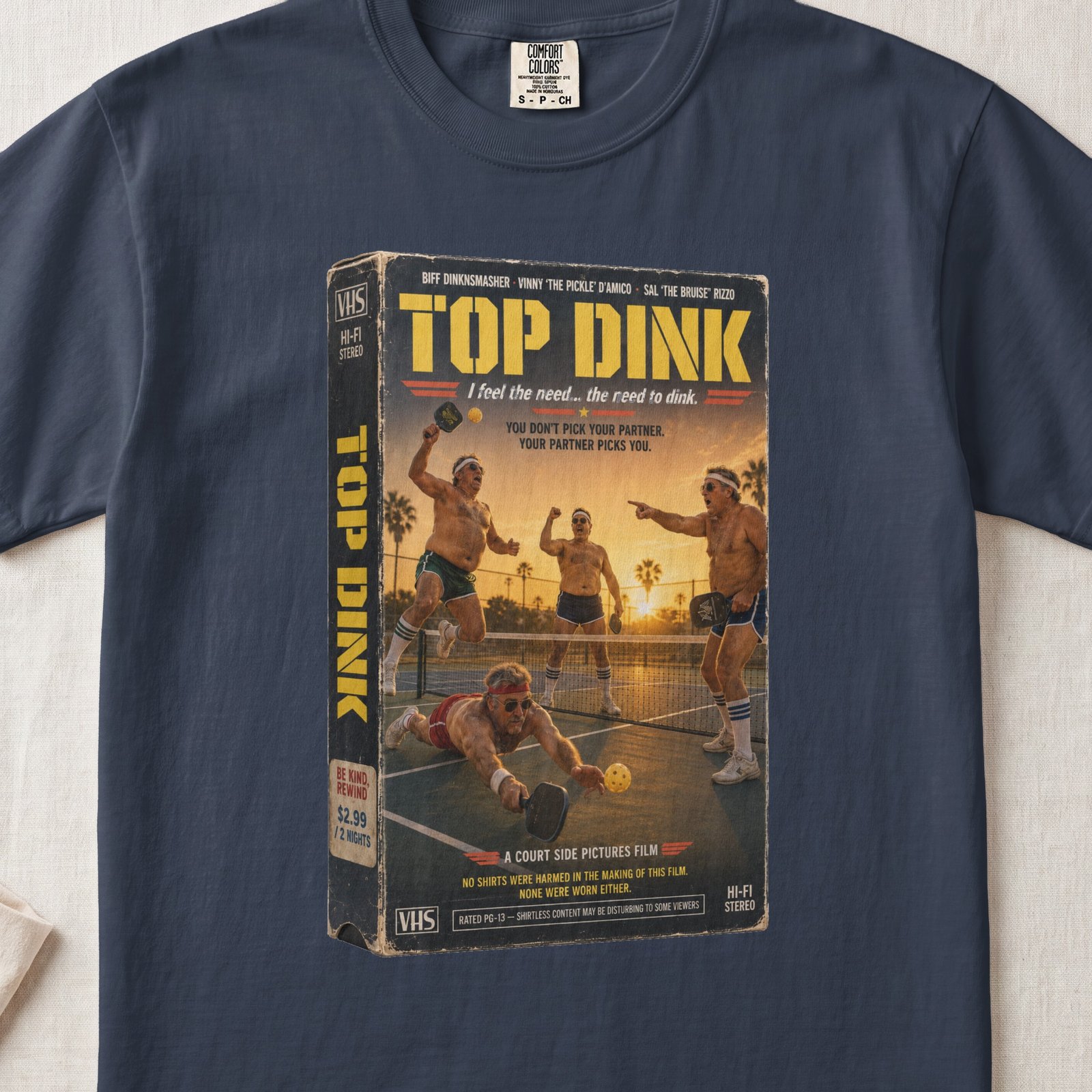
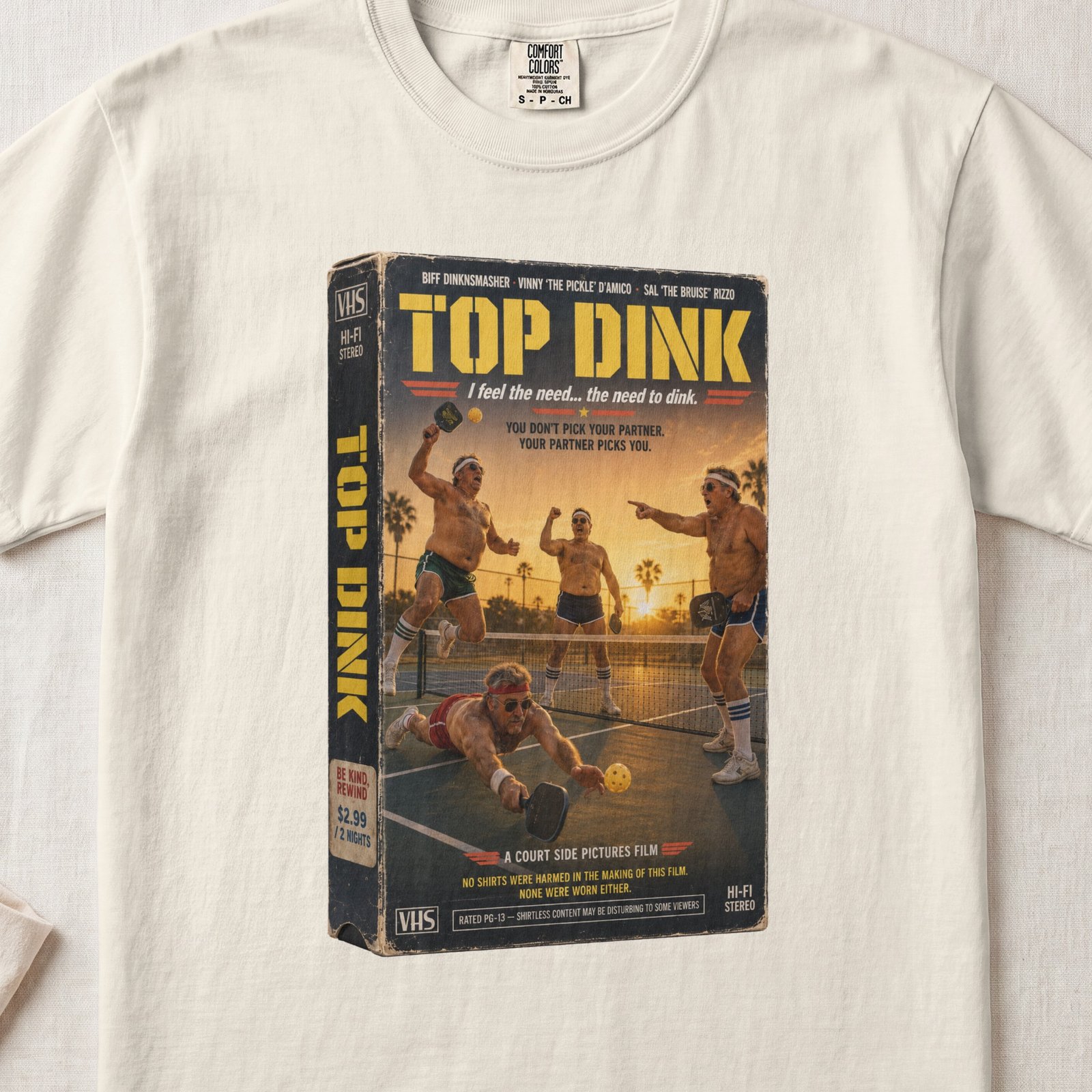
Four shirtless men on a sunset pickleball court. Aviator sunglasses. Headbands. The need to dink. Top Dink is a VHS action film on a Comfort Colors 1717.
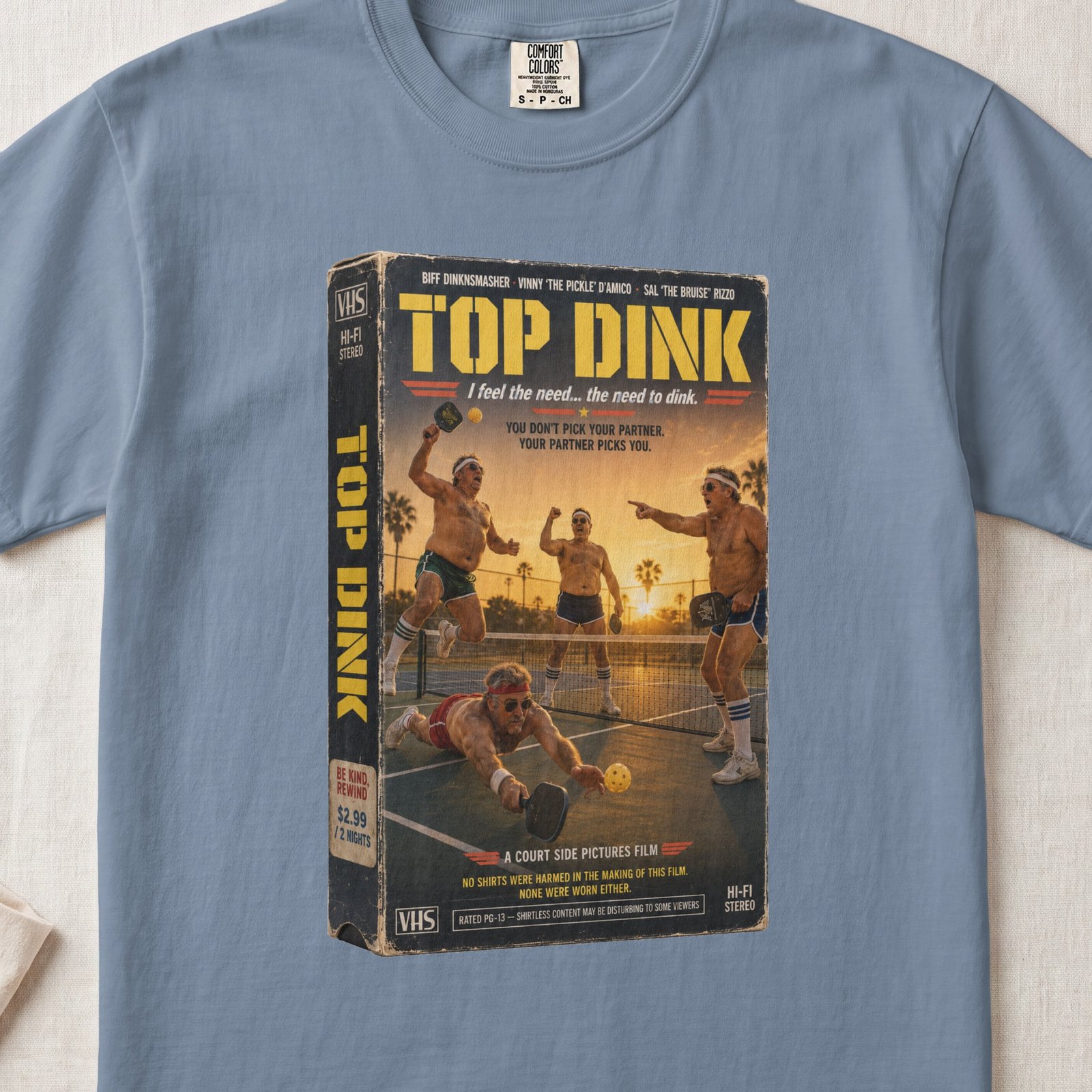
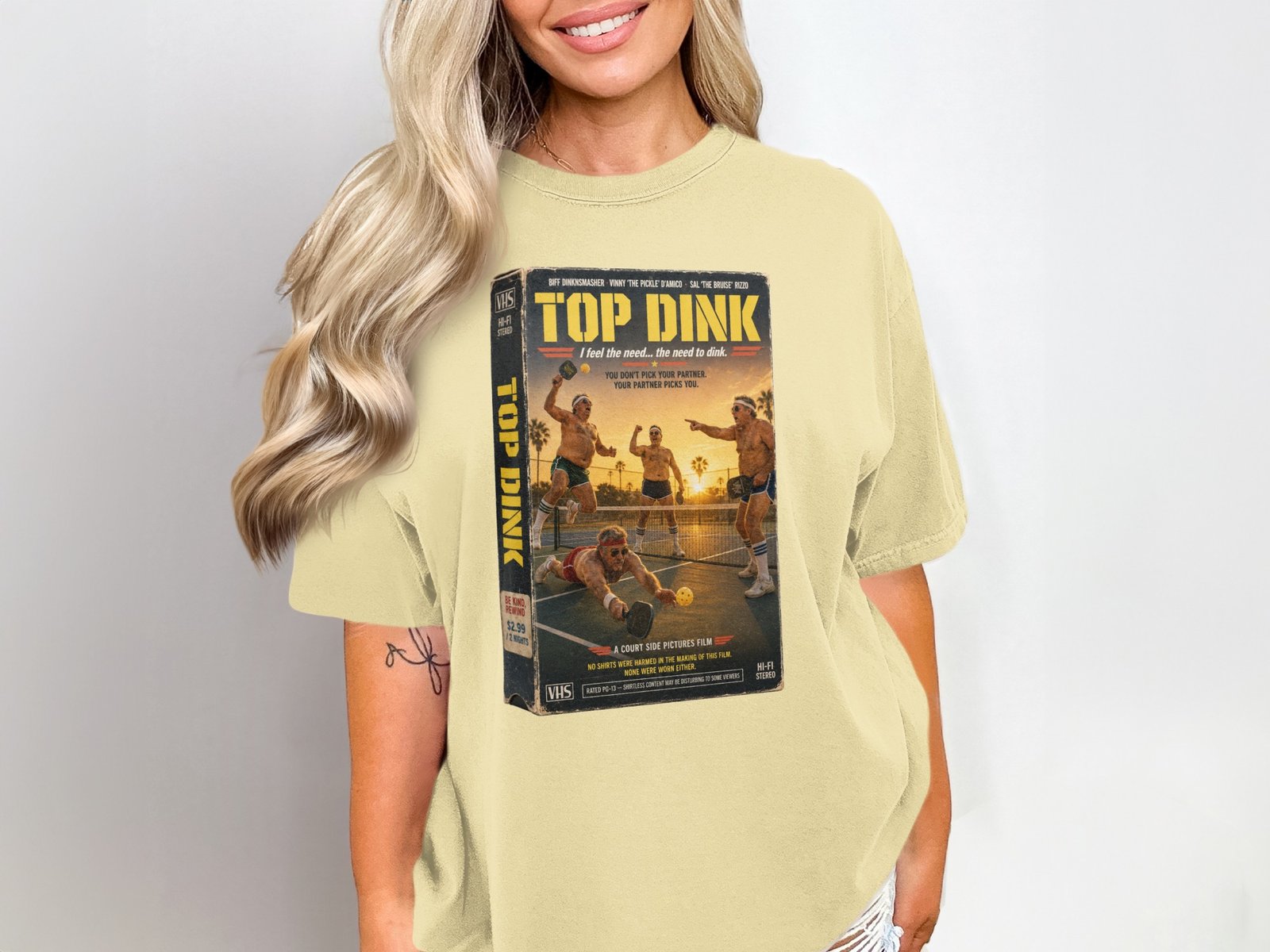
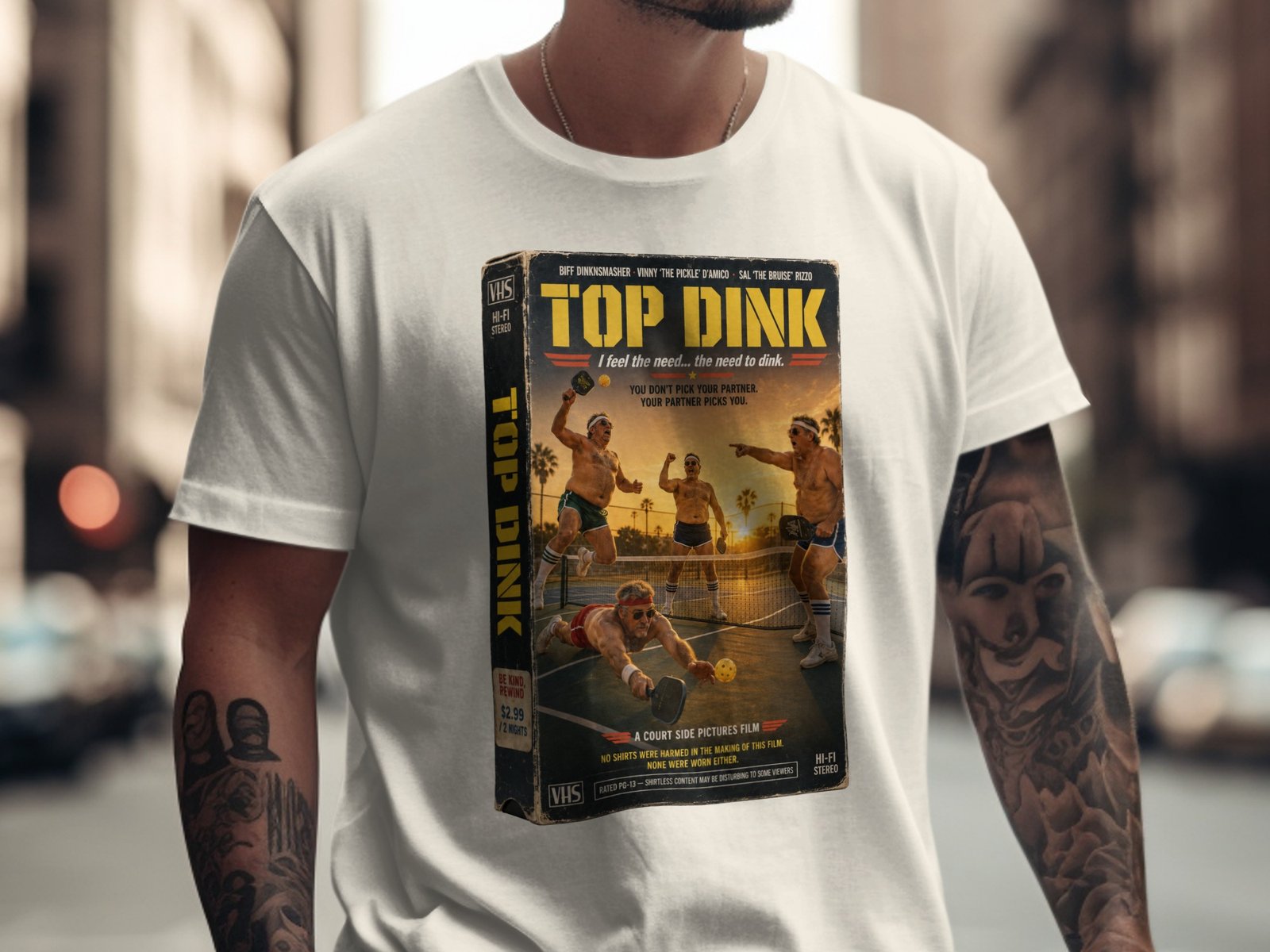
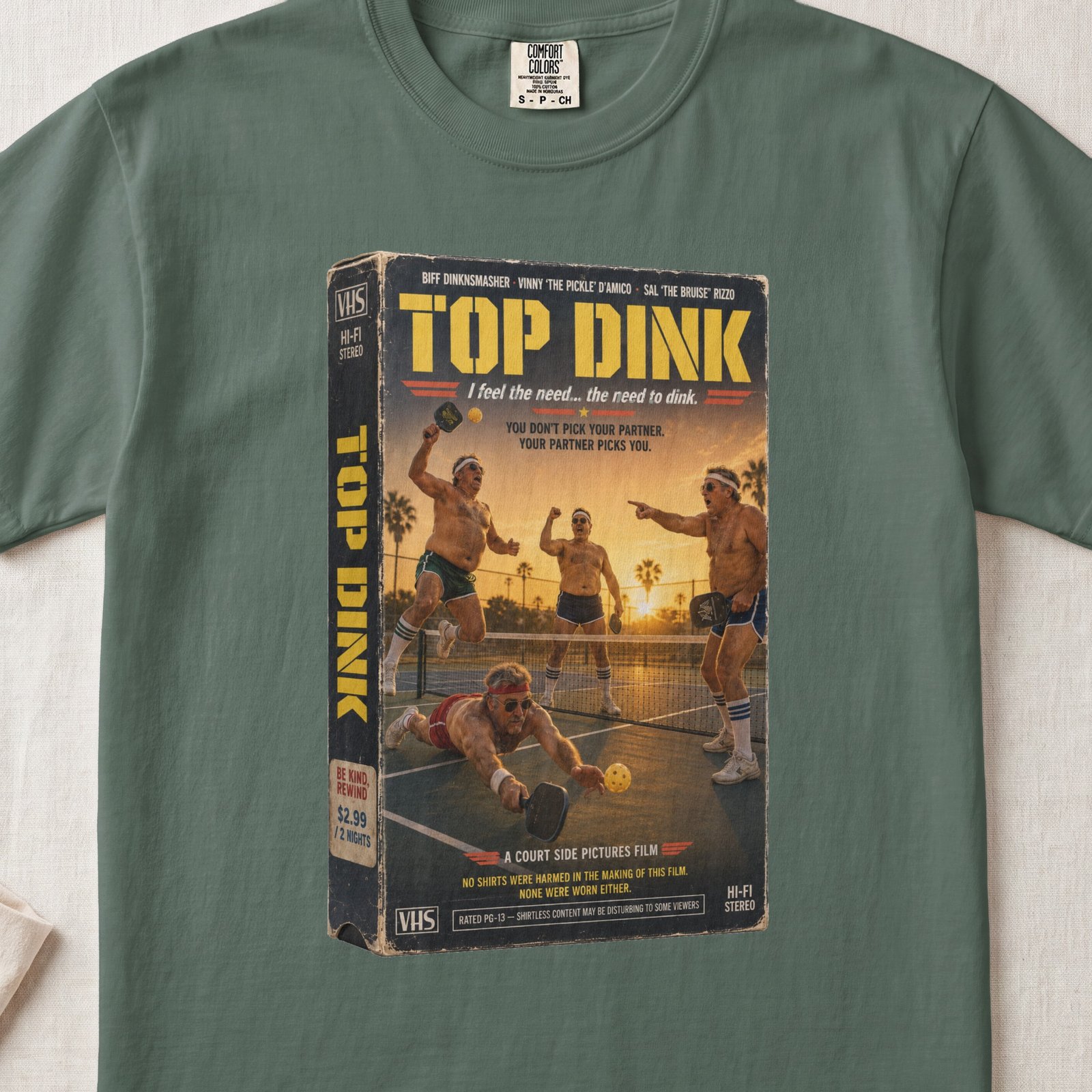
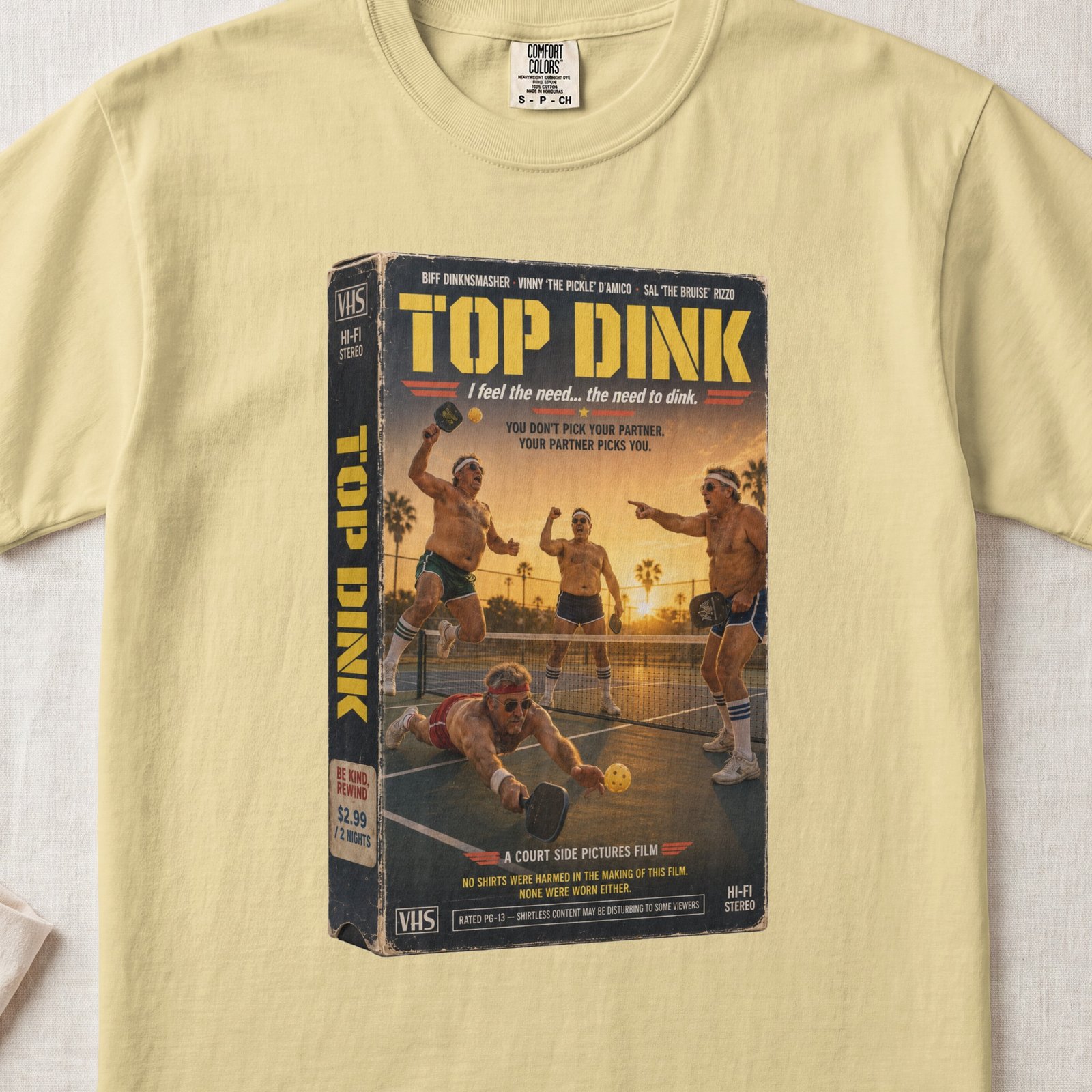
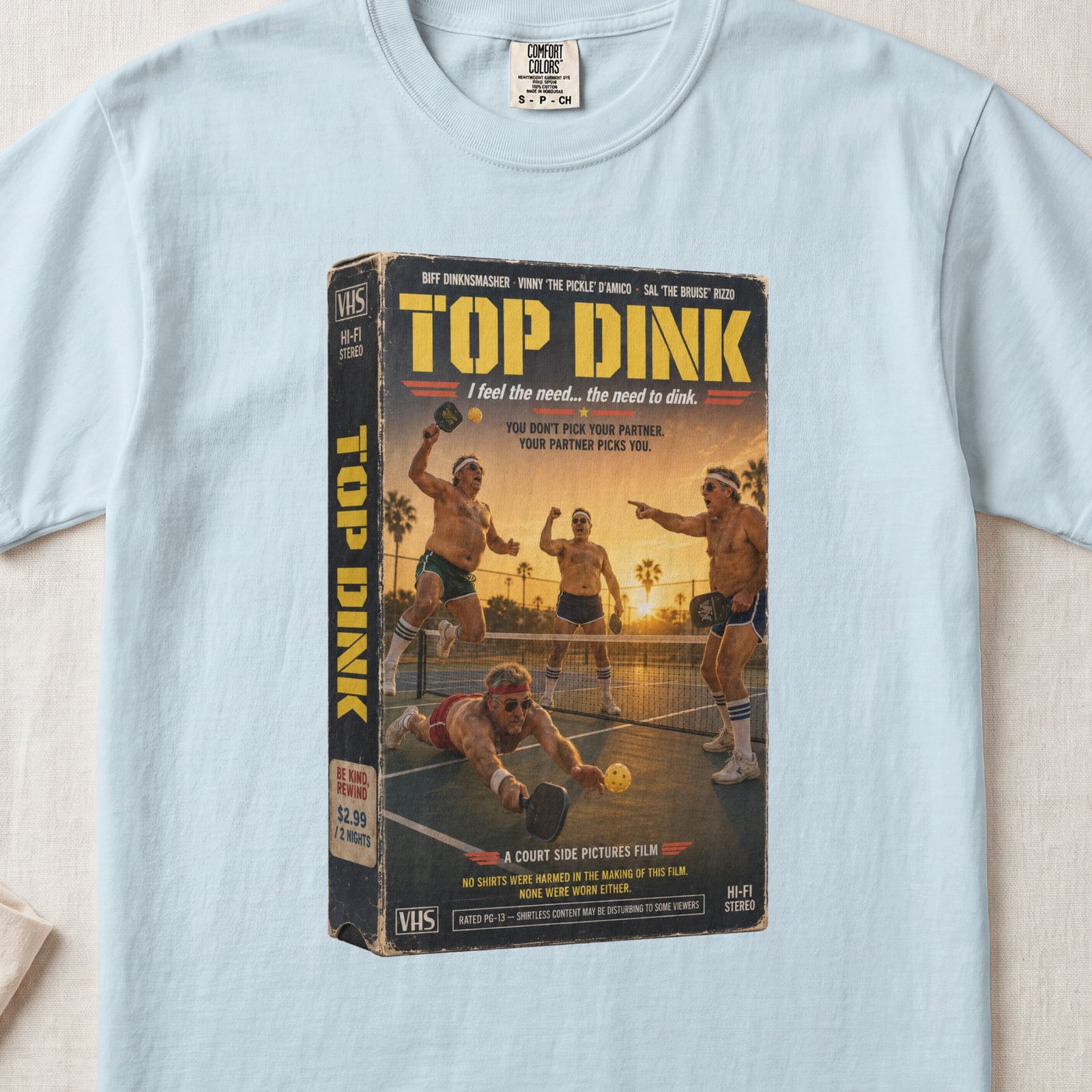
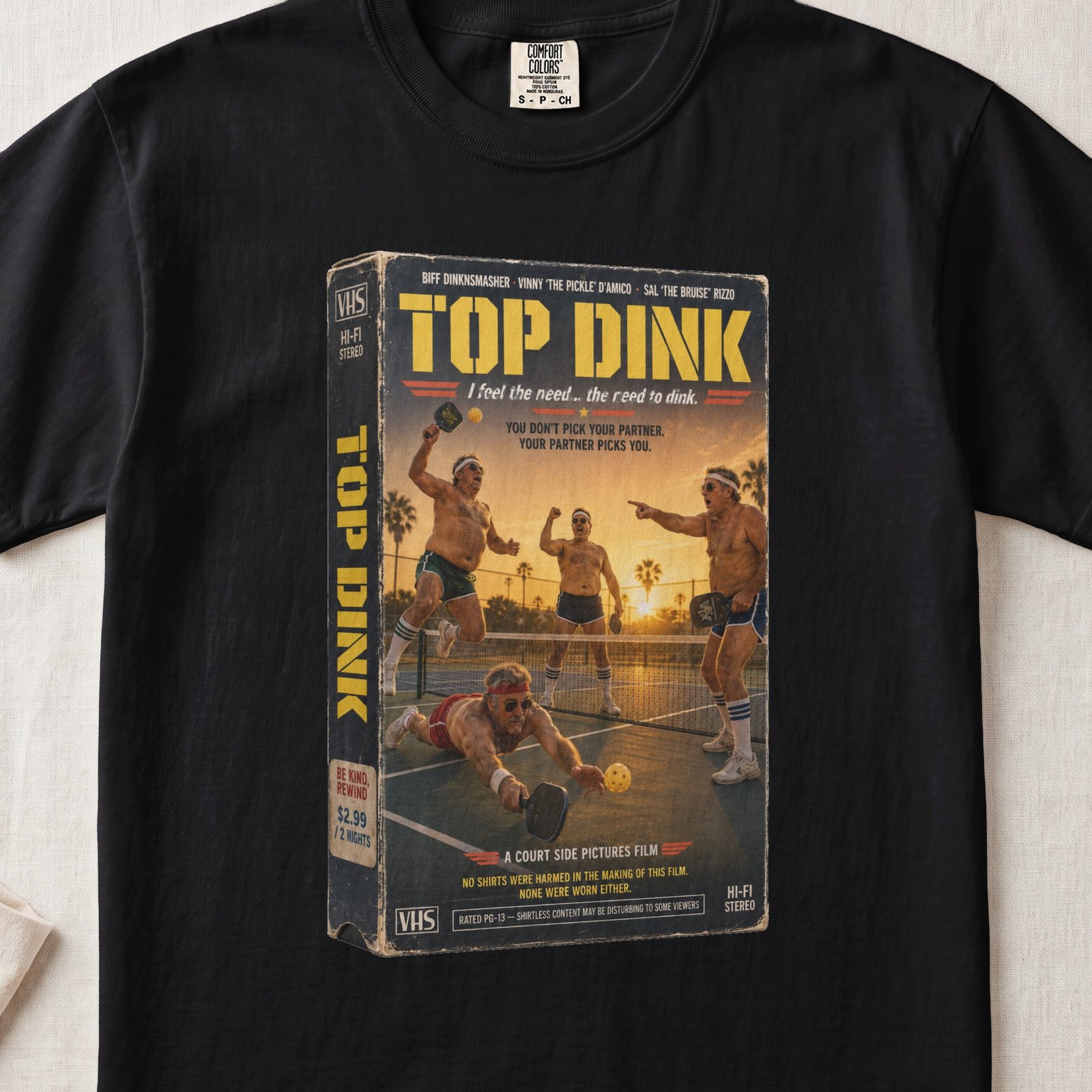
The cover is the most visually dramatic tape in the Court Side Pictures catalog. Golden hour backlighting through palm trees. A pickleball court that looks like it was built specifically for this shot. Three men standing in formation — Biff Dinknsmasher, Vinny “The Pickle” D’Amico, and Sal “The Bruise” Rizzo — shirtless, aviator sunglasses, headbands, tube socks, short shorts, holding paddles at their sides like pilots walking to the flight deck. And in the foreground, a fourth player fully horizontal in a diving lunge, paddle extended, ball in mid-flight, capturing the exact moment the point was either saved or surrendered. The military-style wings flanking the title. The sunset that makes the whole thing look like a recruitment poster for something you should probably think twice about joining. $2.99 for two nights. BE KIND REWIND.
The tagline runs in italics under the wings: “I feel the need.. the need to dink.” It takes the softest shot in the sport and gives it the language of compulsion — not a choice but a drive, something wired into the nervous system that overrides the impulse to play safe or hit hard. Below it, the line that shifts the VHS from comedy to something strangely earnest: “YOU DON’T PICK YOUR PARTNER. YOUR PARTNER PICKS YOU.” At the recreational level, partnership is convenience — whoever’s next on the rotation board. At the competitive level, partnership is chemistry. The player who picks you has watched you play, assessed your weaknesses, mapped their strengths against your gaps, and decided you’re the person they want beside them when the match tightens at 9-9. Being chosen by a serious doubles partner is one of the most flattering things that can happen to a pickleball player, and the fact that it happens between shirtless men at a public park at 6:30 in the evening does not diminish how genuinely it’s felt.
The shirtless pickleball phenomenon is real, regional, and surprisingly polarizing. In warm-weather states — Florida, Arizona, Southern California, Texas — outdoor courts in the late afternoon produce a reliable population of men who have decided that a shirt is not required equipment. The reasons range from practical (it’s 95 degrees) to philosophical (this is outdoor recreation, not a business meeting) to competitive (the tan lines are a status symbol that prove how many hours you’ve logged). Some facilities have responded with posted dress codes. Others have embraced it. The pickleball internet has opinions about it that range from genuine annoyance to affectionate mockery, and Top Dink lands squarely on the affectionate side — the shirtless player isn’t a villain, he’s a type. He’s the player who takes the sport seriously enough to dive for a ball but not seriously enough to wear proper athletic apparel while doing it. The bottom of the VHS box makes this explicit: “NO SHIRTS WERE HARMED IN THE MAKING OF THIS FILM. NONE WERE WORN EITHER.” And the rating: “RATED PG-13 — SHIRTLESS CONTENT MAY BE DISTURBING TO SOME VIEWERS.”
The doubles partnership dynamic on this cover runs deeper than the joke. When the tagline says your partner picks you, it’s describing a real selection process that intensifies as skill level rises. At the 3.0 level, any partner will do — you’re both learning, and the priority is repetition and fun. At 3.5, players start noticing compatibility: does your partner cover the middle, do they communicate during rallies, do they reset when you reset or speed up when you speed up? By 4.0, partnership becomes strategic — stacking preferences, shot tendencies under pressure, whether you’re both comfortable with a soft game or one of you needs to play with more pace to feel in control. The best partnerships in pickleball aren’t between two players with the same skills. They’re between two players whose instincts complement each other under stress. Mixed Doubles Misery captures what happens when partnership becomes obsessive — a horror film about the partner who’ll never let you leave. Top Dink captures what happens when partnership is earned — the selection, the trust, the sunset walk to the court like a team heading into something that matters.
This shirt is for the group. Not one person — the group. The three or four players who have a standing session at the same courts every week, who text each other when the weather looks questionable, who have inside jokes about specific rallies from months ago that they’ll reference until one of them moves away. They play shirtless because it’s August and the courts face west and the sun doesn’t care about dress codes. They play with intensity because the games between people who know each other’s tendencies are the best games the sport produces. And they’ll buy this shirt together, or one of them will buy it for the group, and it becomes the official team uniform for a team that doesn’t compete in anything except the weekly argument over who buys the water.
If someone in the group is getting this as a birthday or holiday gift, the move is to coordinate — all four buy the same shirt, wear it to the next session unannounced, and let the moment happen. The flying formation on the VHS cover is the photo they’ll recreate on the court and post on Instagram with no caption because the pickleball community will recognize the reference and supply the commentary. Top Dink also works as a standalone gift for the player who takes the sunset session personally — the one whose phone background is a photo of the courts at golden hour, who knows the exact minute the sun drops below the tree line and adjusts their schedule accordingly. Their court isn’t a facility. It’s a set.
Top Dink is the VHS that turns the Court Side Pictures catalog into something cinematic. Dink Fiction treats the soft game with crime-film gravitas — two men in suits holding paddles like weapons. Top Dink treats it with action-film awe — four men in nothing, holding paddles like destiny, backlit by a sunset that makes recreational sports look like a calling. Blazing Paddles brought the showdown to a dusty western town. One Flew Over the Pickleball Net brought it to a rec center after midnight. Each tape finds a different genre to hold the same truth: these people care about this sport more than the sport requires, and the caring is the point.
Printed on a Comfort Colors 1717 garment-dyed heavyweight tee with water-based DTG ink — sizing and care details here.
How Do I Know If I Am a 3.5 Pickleball Player
A 3.5 pickleball player has moved past the basics and can sustain rallies with purpose. The benchmarks: you can consistently get your serve and return in, you understand court positioning well enough to get to the kitchen line after most returns, you can execute a third shot drop that lands in the kitchen at least half the time, and you can sustain a dink rally of ten or more exchanges without popping the ball up. If you can do all four, you’re probably at 3.5. If you can do two and are working on the other two, you’re between 3.0 and 3.5.
The difference between a 3.0 and a 3.5 comes down to intent. A 3.0 player hits the ball back over the net. A 3.5 player hits it to a specific spot for a specific reason. Their drives have a target. Their dinks have a plan — cross-court to open the middle, then redirect down the line when the opponent shifts. They don’t always execute the plan, but the plan exists, and when it works they understand why. The shift usually happens after six months to a year of regular play, though players with racquet sport backgrounds — tennis, table tennis, racquetball — sometimes arrive at 3.5 within weeks because the hand-eye coordination and court awareness transfer directly.
The most useful tool for calibrating your level is playing with people you don’t normally play with. Your regular group creates a comfort zone where the tendencies are familiar and the outcomes feel predictable. Playing at a different facility or entering a USA Pickleball sanctioned tournament exposes the skills you’ve been compensating around. If you can hold your own against unfamiliar 3.5-rated opponents, the number is accurate. If the games feel dramatically different from your usual sessions, the gap is in the habits your regular group lets you get away with. The Top Dink crew didn’t get chosen for sunset sessions by accident — someone watched them play against strangers and decided their game held up.
-
Kitchen Crunch
$39.99 Select options This product has multiple variants. The options may be chosen on the product page -
Smack Shot
$39.99 Select options This product has multiple variants. The options may be chosen on the product page -
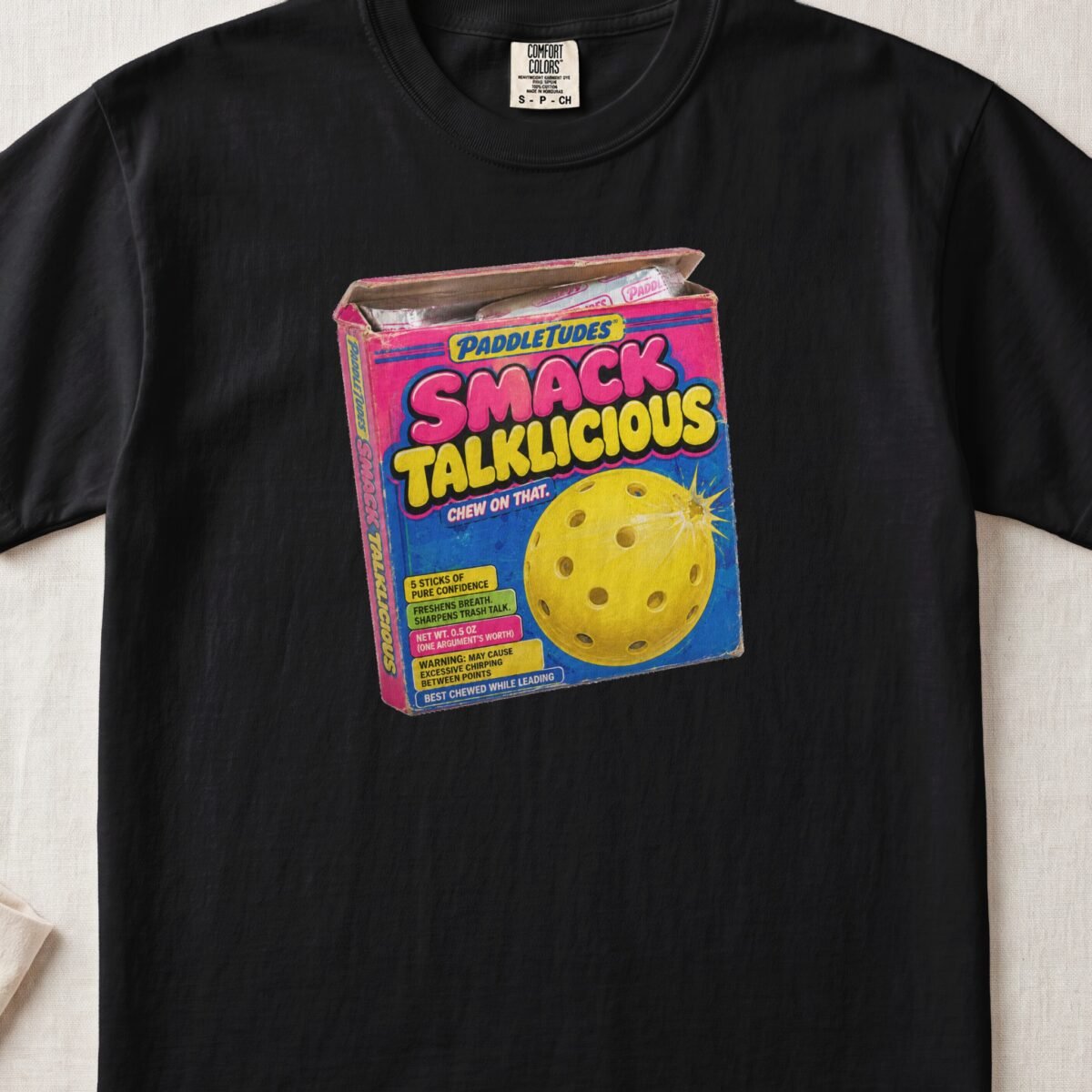
Smack Talklicious
$39.99 Select options This product has multiple variants. The options may be chosen on the product page