Retro Comfort Colors 1717
Net Warriors
$39.99
- Comfort Colors 1717 heavyweight cotton
- Original design · printed to order
- U.S. print partners
Net Warriors — The Retro Robot Battle Tee That Turned Pickleball Into a Head-to-Head War Machine
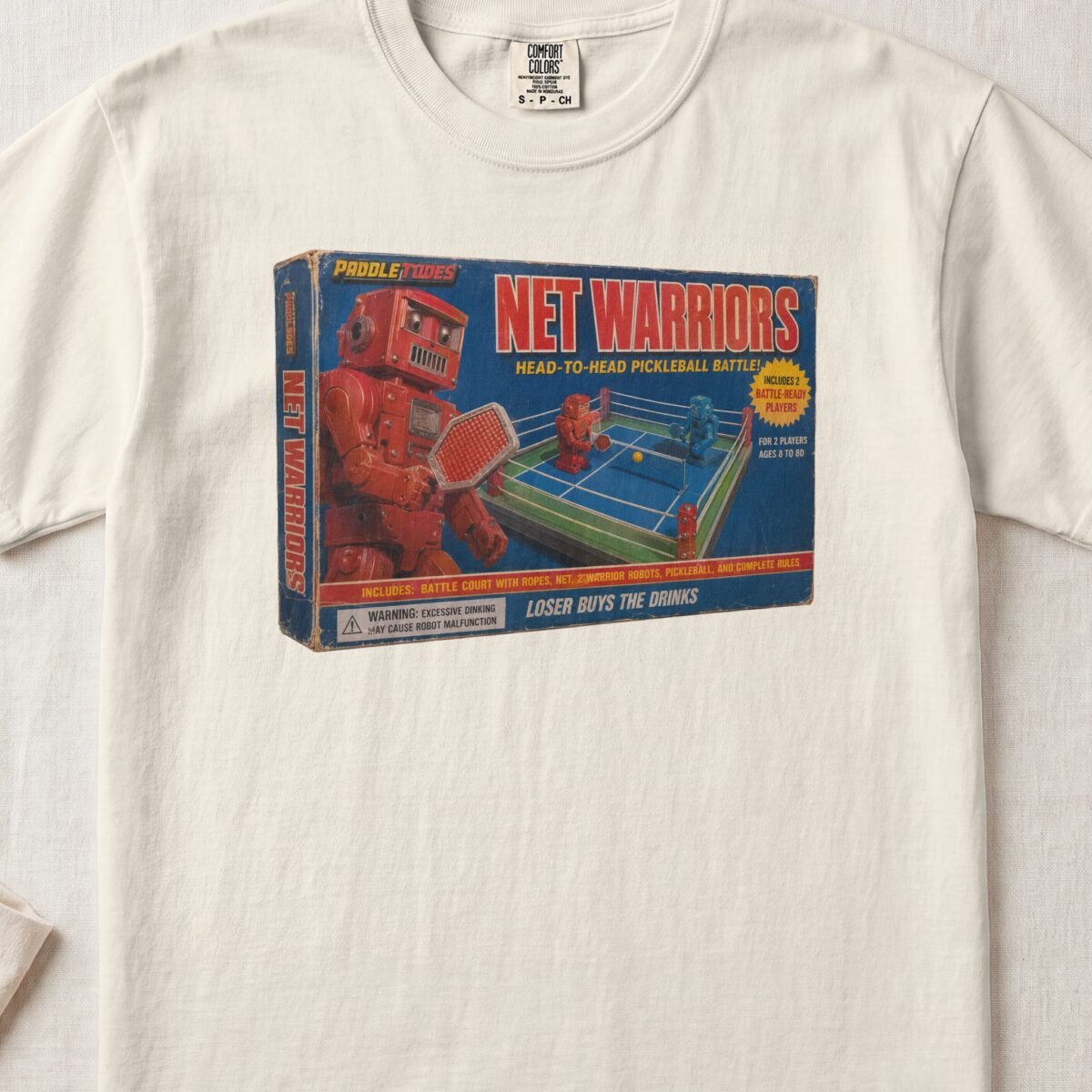
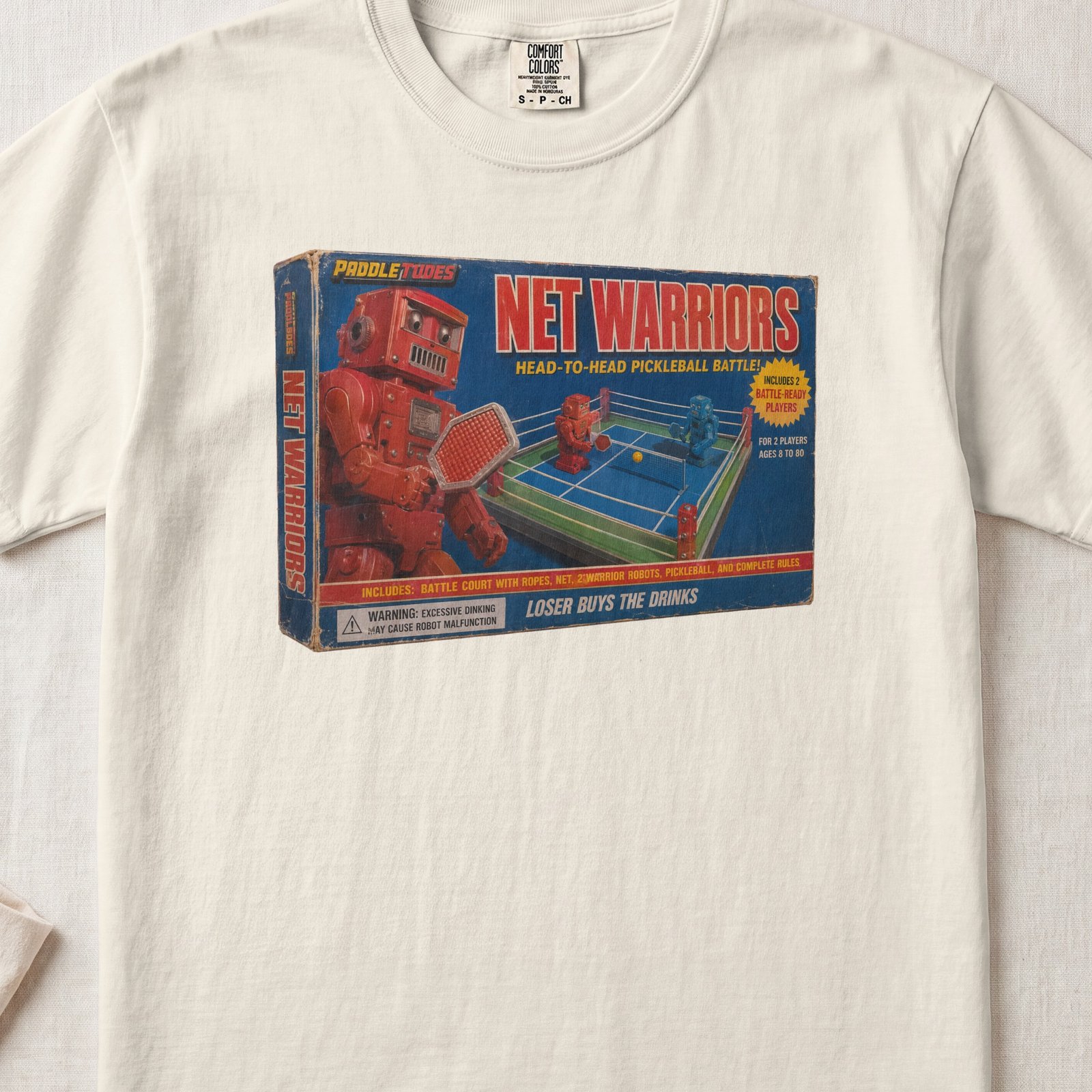
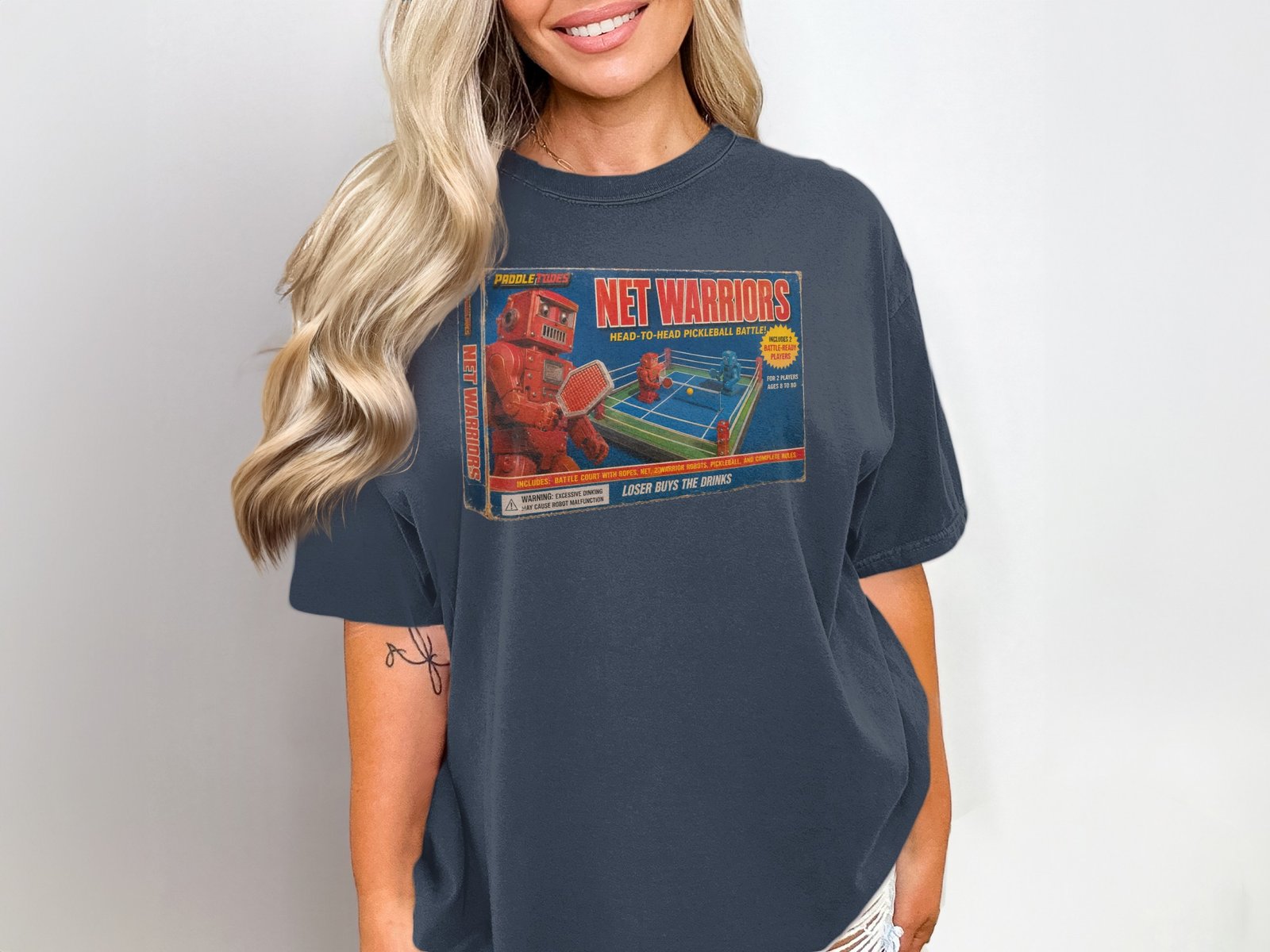
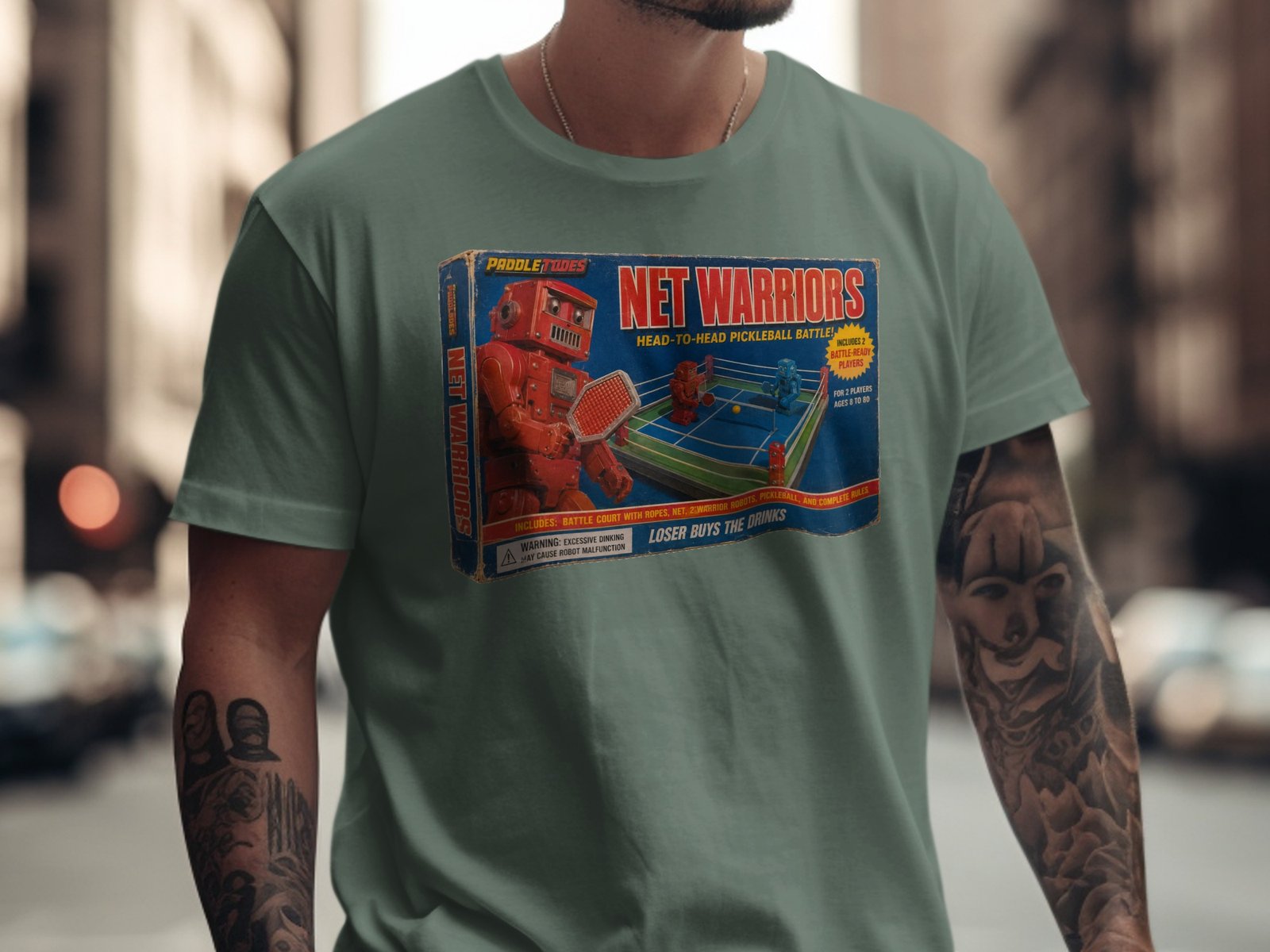
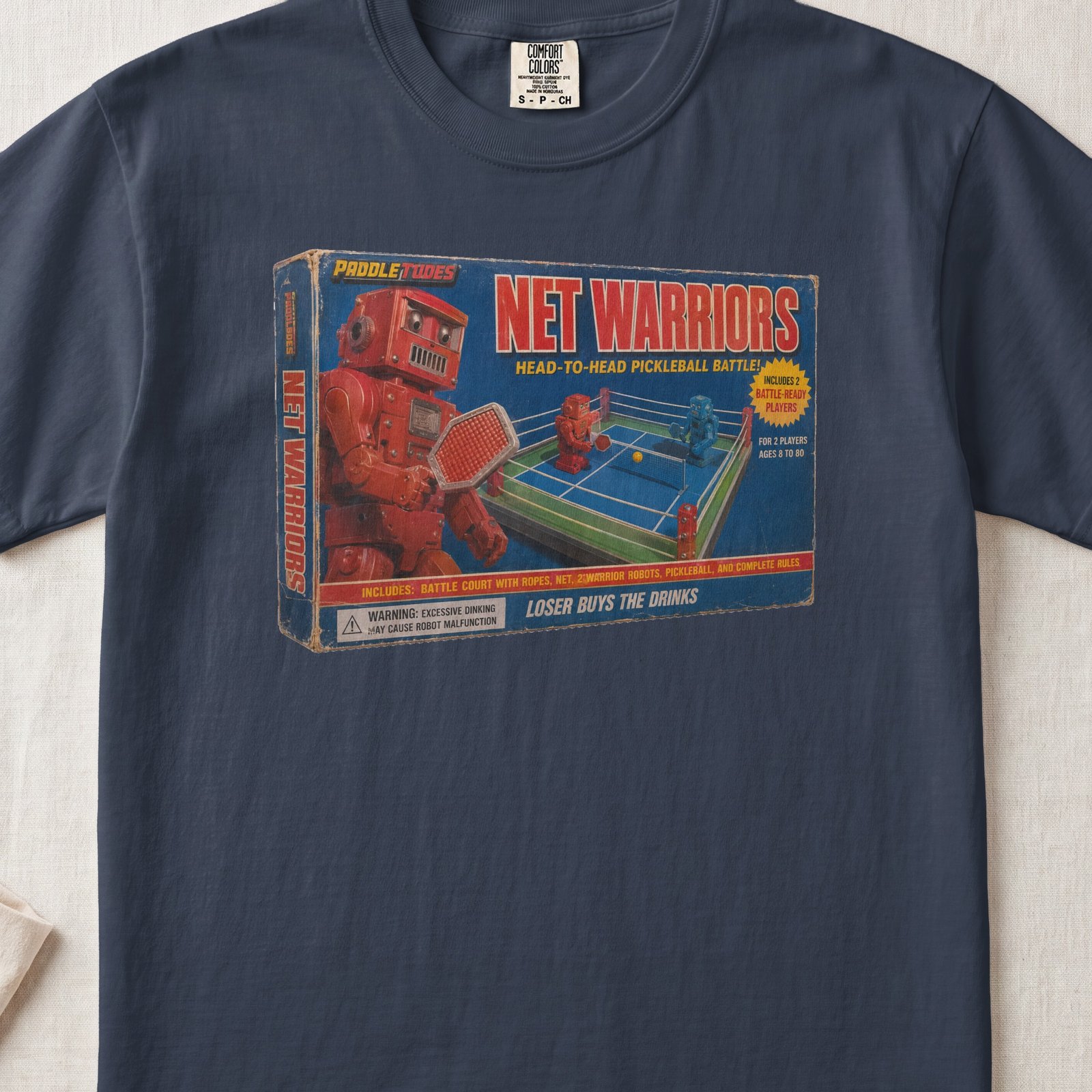
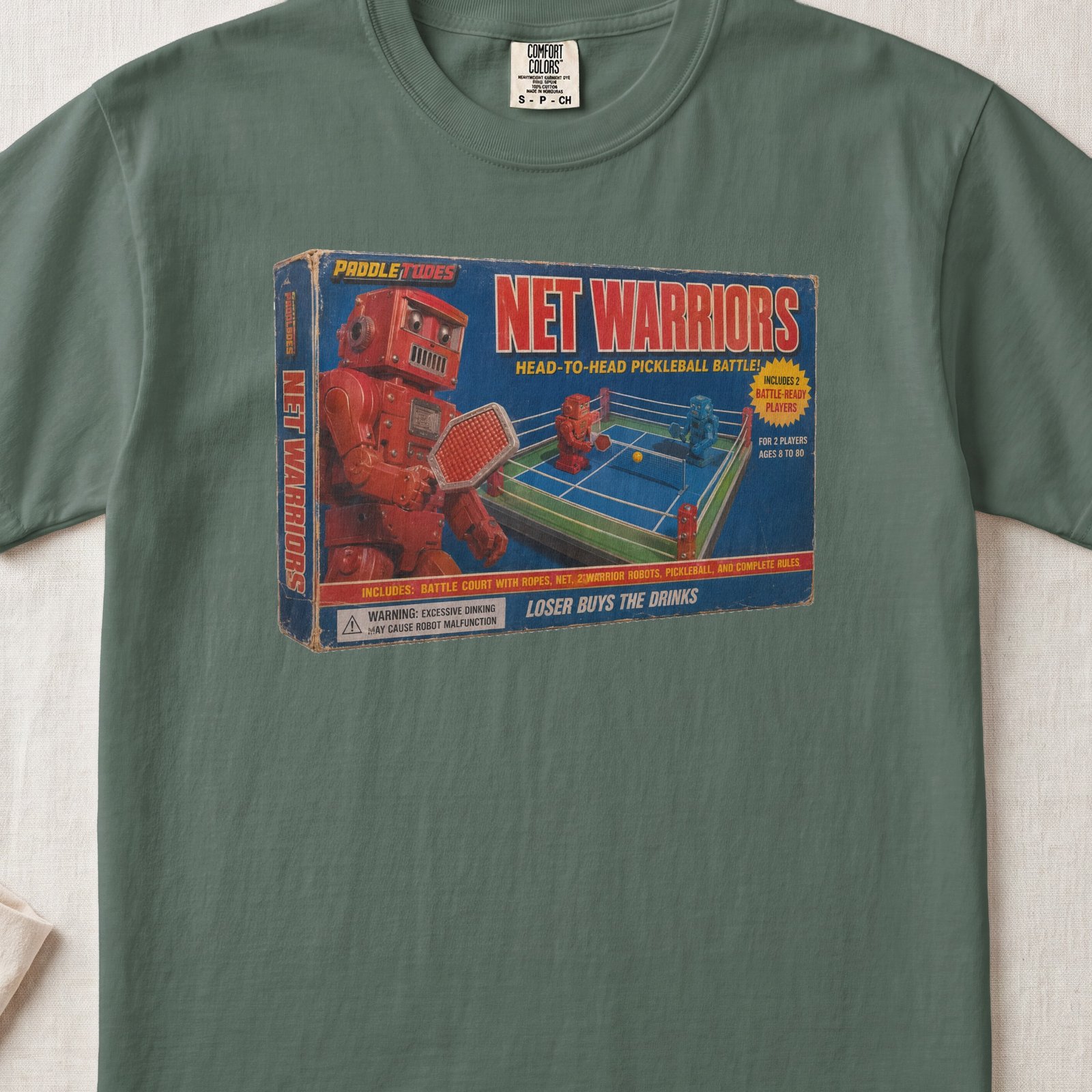
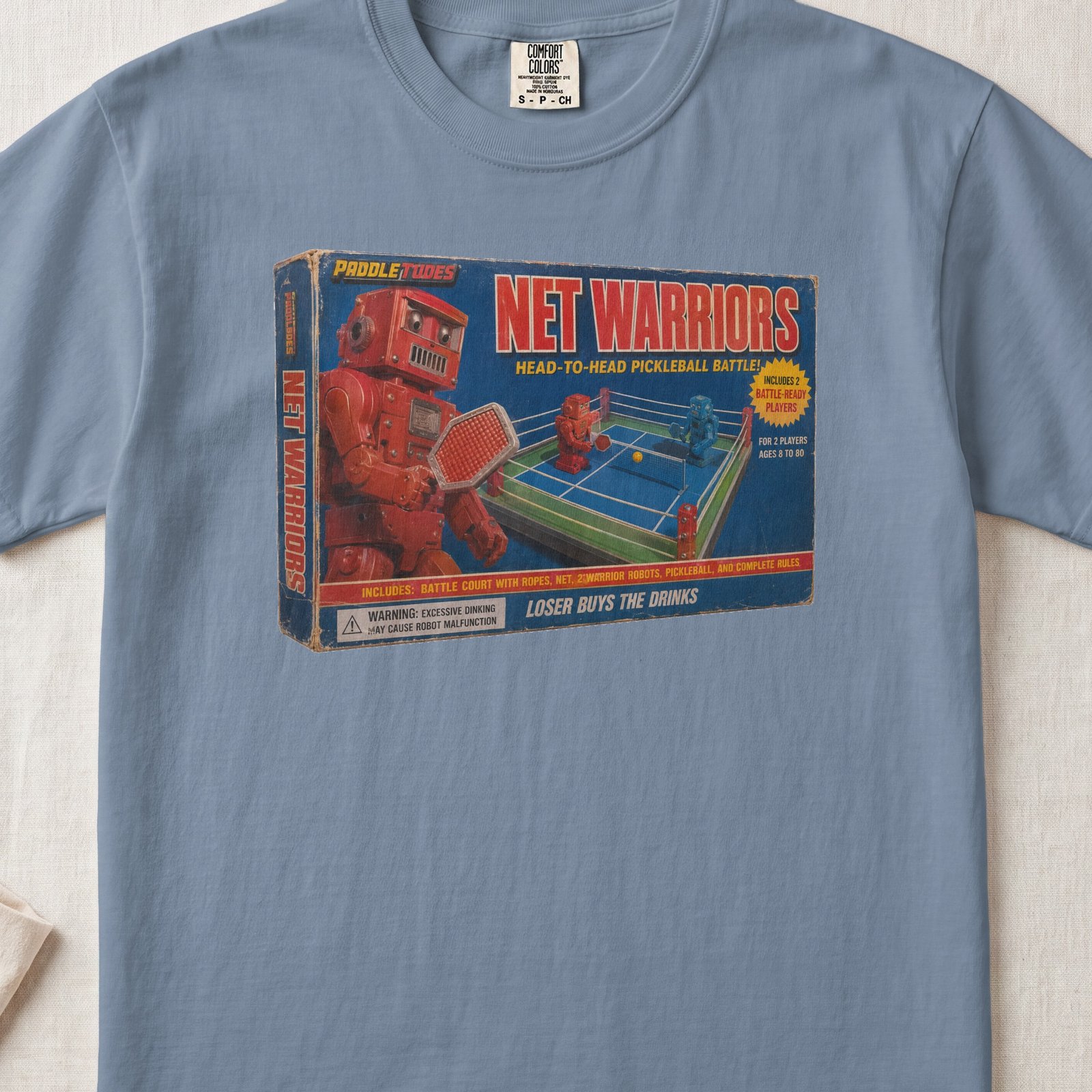
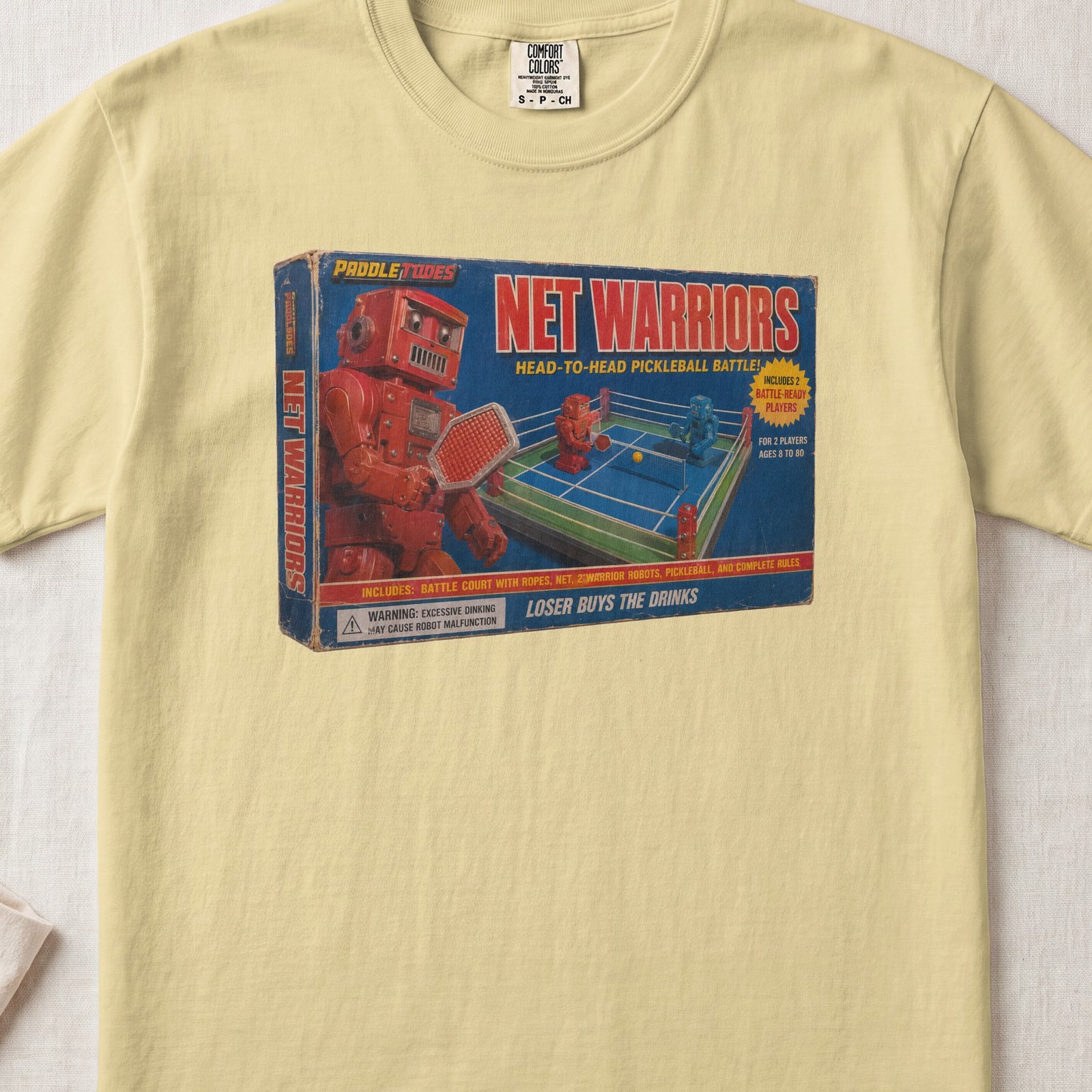
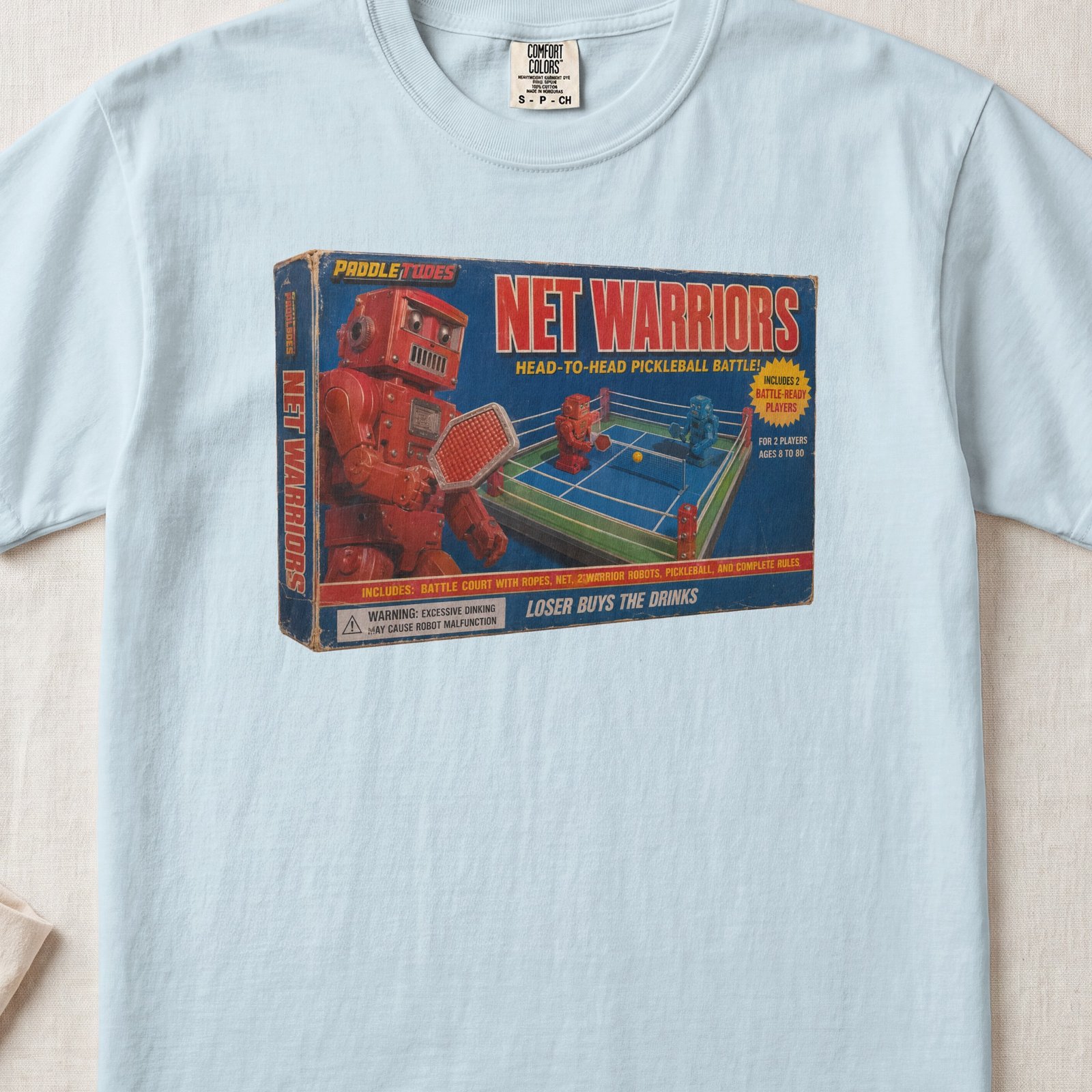
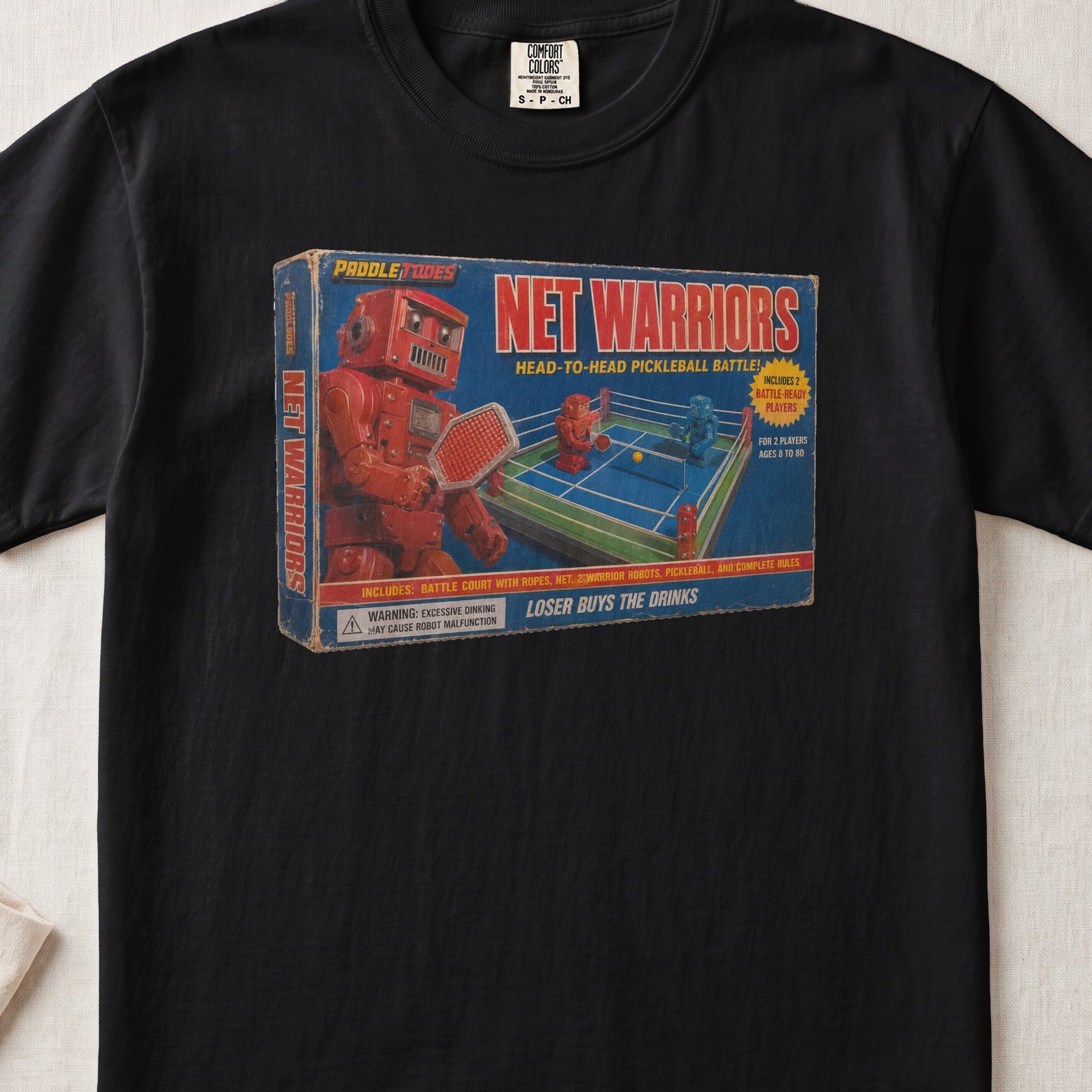
Net Warriors is a fake robot battle toy that looks like it sat on a Toys “R” Us shelf between Rock ‘Em Sock ‘Em Robots and every other head-to-head combat game your parents wouldn’t let you play with at full volume. Two warrior robots — one red, one blue — face off across a miniature pickleball court with paddles raised and zero interest in a friendly dink rally. This retro graphic tee takes the vintage robot toy format and fills it with everything competitive pickleball players argue about at the net.
The design commits to the bit completely. The Paddletudes logo sits at the top left like a real toy brand. The tagline reads “Head-to-Head Pickleball Battle!” in the same oversized font every toy company used when they wanted you to believe a piece of plastic could deliver genuine combat. The starburst promises “Includes 2 Battle-Ready Players.” The age range — “For 2 Players Ages 8 to 80” — tells you exactly who this is for, and the answer is everyone who remembers what it felt like to sit on the floor and smash two robots into each other until someone’s head popped off.
The fine print is where the design earns its place in the retro graphic tee collection. “Includes: Battle Court With Ropes, Net, 2 Warrior Robots, Pickleball, and Complete Rules.” That reads like a real toy product listing from 1983. Below it: “Loser Buys The Drinks.” And the warning label — the part that separates a good retro parody from a great one — reads: “Warning: Excessive Dinking May Cause Robot Malfunction.” Every line on this design functions as both a pickleball joke and an authentic vintage toy reference. That dual layer is what makes AlmostSeenOnTV’s retro line uncopyable. Designs like Smack Talklicious and Breaking Balls work the same way — fake products with real-feeling copy that rewards a second and third look.
The robot battle toy format is the right container for net play because the kitchen line in pickleball is already a war zone. Two players standing eighteen inches apart, exchanging volleys at reflex speed, reading paddle angles, and waiting for someone to blink — that’s a head-to-head combat game. Rock ‘Em Sock ‘Em Robots was invented by Marvin Glass and Associates in 1964 and became one of the best-selling toys of the decade because the concept was pure: two opponents, one arena, someone’s head pops up when they lose. Net Warriors borrows that purity and maps it onto the kitchen line. Red robot versus blue robot. Forehand versus backhand. The only difference is the robots don’t argue about line calls afterward.
Your doubles partner who turns every net exchange into a personal mission and won’t stop talking about the hands battle they won three games ago — this is their gift and it doesn’t need explaining. Hand it to them. They’ll read every line on the design before they even put it on. The person who wears this shirt played with robot toys as a kid, plays competitive pickleball as an adult, and still believes that head-to-head combat is the purest form of sport. The court is smaller now. The stakes are exactly the same.
The red and blue robots matter too. Every competitive environment uses that color split — home and away, corner and corner, player one and player two. The robots on this design aren’t teammates. They’re opponents. And the pickleball court between them isn’t a shared space. It’s a battlefield with a net in the middle and a drink on the line.
What Is the Kitchen Line in Pickleball?
The kitchen line in pickleball is the boundary of the non-volley zone, a seven-foot area on each side of the net where players cannot hit volleys. Any shot taken out of the air while standing in or touching the kitchen zone is a fault, regardless of how the point is going. The kitchen rule is what makes pickleball’s net play unique among racquet sports.
The kitchen line is where competitive pickleball actually happens. Recreational rallies might bounce around the baseline, but at the 3.5 level and above, both teams race to establish position at the kitchen line after every serve and return. The player who controls the line controls the point. Net play at the kitchen is a combination of soft dinking, patient resets, explosive speed-ups, and hands battles that can last ten or fifteen shots. The rules of the USA Pickleball official rulebook are specific about what constitutes a kitchen violation, including momentum carrying you into the zone after a volley.
Net Warriors captures the intensity of kitchen line play through the robot battle format — two machines built for combat, locked into position on opposite sides of the net, exchanging shots until one of them malfunctions. The warning label on the design says “Excessive Dinking May Cause Robot Malfunction.” At the kitchen line, that’s not a joke. That’s a scouting report.
Why Is Net Play Important in Pickleball?
Net play is important in pickleball because the team that controls the non-volley zone wins the majority of points at every level of competitive play. The closer you are to the net, the sharper your angles, the shorter your opponent’s reaction time, and the more pressure you put on every shot they attempt.
A player standing at the baseline has to hit the ball thirty feet to clear the net with enough depth to be effective. A player at the kitchen line has to move the ball three feet to create an unreturnable angle. The geometry of the court rewards proximity to the net, which is why every coaching resource from Pickleheads to the PPA Tour’s training content emphasizes the transition from baseline to kitchen as the foundational skill above all others.
In doubles, net play becomes a team sport within a team sport. One player dinks cross-court while the other reads the return and decides whether to speed up, reset, or poach. The communication between partners at the kitchen line separates teams that win tournaments from teams that go home in pool play. The Net Warriors robots don’t communicate. They just battle. But the players who wear this shirt to league night know that real net play requires both the aggression of a warrior robot and the patience of a player who can dink thirty times without losing discipline.
What Are Retro Graphic Tees?
Retro graphic tees are t-shirts featuring designs inspired by the visual language of past decades — the typography, color palettes, illustration styles, and packaging formats of the 1970s through the 1990s. The best retro graphic tees recreate the design standards of that era so precisely that the shirt looks like an artifact rather than a reproduction.
What makes the retro graphic tee format work in 2026 is the gap between mass nostalgia and original intellectual property. Most vintage-inspired shirts are either licensed reproductions of real brands or generic throwback text on a basic tee. The AlmostSeenOnTV approach inverts that formula. Every design is a fully original fake product — a cereal box, a tonic bottle, a VHS tape, a robot battle toy — that never existed but looks like it did. Net Warriors uses the toy robot format specifically because that design language triggers instant recognition for anyone who grew up in the era of battery-powered competition.
The heavyweight garment-dyed Comfort Colors blank adds to the vintage feel. A brand-new shirt that already feels like something you’ve owned for years matches the design’s intent. If someone asks where you got it, the explanation takes longer than the compliment, and that’s the whole point.
Printed on a Comfort Colors 1717 garment-dyed heavyweight tee with water-based DTG ink — sizing and care details here.
-
Electric Pickleball
$39.99 Select options This product has multiple variants. The options may be chosen on the product page -
Shoot The Dink
$39.99 Select options This product has multiple variants. The options may be chosen on the product page -
Smack Shot
$39.99 Select options This product has multiple variants. The options may be chosen on the product page