Retro Comfort Colors 1717
Lite Court
$39.99
- Comfort Colors 1717 heavyweight cotton
- Original design · printed to order
- U.S. print partners
Lite Court: Retro 80s Toy Nostalgia Meets the Pickleball Court on a Vintage Graphic Tee
You circled it in the Sears Wish Book. Three times — once in red crayon, once in blue, and once more in black marker just in case anybody in the house still wasn’t clear on the situation. Page 127, right-hand side, between the Etch A Sketch and the Simon. You didn’t want the Simon. You didn’t want the Etch A Sketch. You wanted the one that glowed.
It was October when you first saw it. Sixty-three days until Christmas morning. You counted every one of them.
Christmas Morning, 1978
You knew what it was before you tore the paper. The box had a shape that couldn’t be anything else — flat and wide, heavier than a board game, lighter than the rock tumbler you’d asked for last year and used exactly twice before it became a shelf ornament in the basement. Your mother was standing in the doorway of the living room with a coffee mug and a bathrobe and an expression you didn’t have a name for yet, because you were seven and the only word you knew for what she was feeling was happy, though it was more than that. It was always more than that.
Your father was on the floor. Not the couch — the floor. Cross-legged on the carpet, still in his pajamas, pretending to read the instructions because reading the instructions was what fathers did, even when the instructions were six sentences long and the first one said “Insert pegs into screen.” He studied those six sentences like a man reviewing blueprints for something load-bearing, because that was his way of sitting next to you without rushing you. Rushing you was the one thing he would never do on a Christmas morning.
The pegs came in a bag. Eight colors. You dumped them all onto the carpet and the beagle — the old one, the one with the gray muzzle who slept in the hallway and followed your mother from room to room like a short, furry parole officer — walked directly through the pile and scattered half of them under the couch. Your sister said a word she’d learned at school. Your father pretended not to hear it. Your mother took a sip of coffee and smiled the way mothers smile when the chaos is exactly the right kind.
You slid the black paper behind the screen. Picked up the first peg — yellow, because yellow was always first — and pushed it through. It took more force than you expected. The paper resisted, then gave, and the peg clicked into the grid with a small, definite sound that meant something is about to happen.
It took forty-five minutes to finish. Some kind of clown face, or a sailboat, or something that was definitely a clown face on the pattern sheet but looked more like a sailboat if you tilted your head and squinted with the confidence of a seven-year-old artist who has never once questioned his own work. The pegs weren’t always in the right holes. Some were the wrong color because you’d run out of red and used orange instead. One entire section in the upper left was nothing but green because your sister had helped, and green was her favorite, and she didn’t care about the clown or the sailboat or the pattern — she just liked green.
Then your father said, “Ready?”
He turned off the table lamp. Your mother hit the overhead from the doorway. The tree was already unplugged because your father had a thing about fire hazards that bordered on personal theology. The living room went dark — every-corner, can’t-find-your-socks dark — and you reached behind the screen and pushed the switch.
The Lite-Brite lit up.
It wasn’t perfect. The clown-sailboat had gaps where pegs were missing and hot spots where you’d doubled up and a whole quadrant of unauthorized green that had nothing to do with the original design. But in the dark, with the light pushing through those tiny colored holes, none of it mattered. It glowed. The whole thing glowed. And in the reflected light of something you’d built with your own hands, on a carpet, on Christmas morning, in your pajamas, you saw your father’s face. The way the colors hit his chin, his cheekbones, the lines around his eyes that you didn’t know were lines yet because you were seven and fathers didn’t age. He was looking at your creation — the lopsided, wrong-colored, half-green disaster on the screen — the way you’d want someone to look at everything you’d ever make for the rest of your life.
Like it was enough. Like you were enough.
You didn’t have a word for that feeling. You still don’t. But you kept it. You kept it the way kids keep things — not in a box, not in a photo, but somewhere behind the ribs, in whatever part of you holds the things that happened before you were old enough to know they were important.
Where the Pegs Went
The Lite-Brite lasted longer than most Christmas toys. It survived January, which was more than the rock tumbler ever managed. It sat on your desk through the winter, then your dresser through the spring, then a shelf in the closet next to the vintage board games and the puzzle with the missing corner piece. The black paper ran out first. Then the pegs started disappearing — into the carpet, into the vacuum, into the beagle, who ate at least four of them across three separate incidents and showed absolutely no remorse. By the following Christmas, it was in a box in the basement, replaced by whatever you’d circled in the next Sears Christmas catalog, which you don’t remember, because you remember everything about the Lite-Brite and almost nothing about whatever came after.
The decades did what decades do. The toys went to garage sales or attics or the particular kind of gone where you can’t point to when exactly something left because it didn’t leave — it just stopped being there. The carpet got replaced. The living room got rearranged, then renovated, then sold to a family you’ve never met who have no idea that a seven-year-old once made a clown-sailboat glow on that floor. The tree stand is gone. The bathrobe your mother wore is gone. Your sister lives in another state and doesn’t remember the green pegs but will absolutely deny saying that word on Christmas morning.
And your father. Your father is somewhere on the spectrum between still here and sitting on the floor is no longer an option and not here anymore, but you see his face every time someone looks at something you’ve made like it matters. You don’t need to say which. Everybody reading this already knows which one it is for them. And whichever it is, the feeling is the same: the glow went out. Not all at once — it never goes all at once — but slowly, the way a Lite-Brite dims when you start pulling pegs one at a time until the screen is mostly dark and the picture only makes sense if you remember what it looked like when it was full.
Then the Court Lights Came On
You started playing pickleball the way most people start — someone told you to try it, you said that’s not a real sport, and three weeks later you owned two paddles and a bag and had opinions about court surfaces. But the moment that got you — the one that stopped you mid-rally on a public court and made something shift behind your ribs, in that place — happened on a Tuesday night in late summer.
You’d stayed for one more game. Then one more after that. Then one more after that, because this sport turns “one more” into a philosophy. The sun went down and you didn’t notice. Then somebody hit the switch on the court lights.
The court lit up. Not daylight-lit. Glowed. The white lines on green, the net cutting the space in half like a geometric proof, the yellow ball in the air catching the light at the top of its arc. Everything outside the court disappeared — the parking lot, the trees, the neighborhood, all of it swallowed by the dark. And you were standing in the middle of something bright, something you’d pieced together point by point all summer, and it was glowing the same way a lopsided clown-sailboat made of plastic pegs glowed on a carpet in 1978.
Your doubles partner was laughing about a shot you’d missed. The couple across the net was arguing about the score the way people argue when they’re so happy they need something small to fight about. And you were standing there, paddle in hand, in the dark, in the light, feeling something you hadn’t felt in decades — that specific, unrepeatable thing that happens when something you’ve built lights up and someone you care about is standing close enough to see the colors.
You didn’t say anything. You just let it happen.
A Toy That Never Existed, for a Feeling That Never Stopped
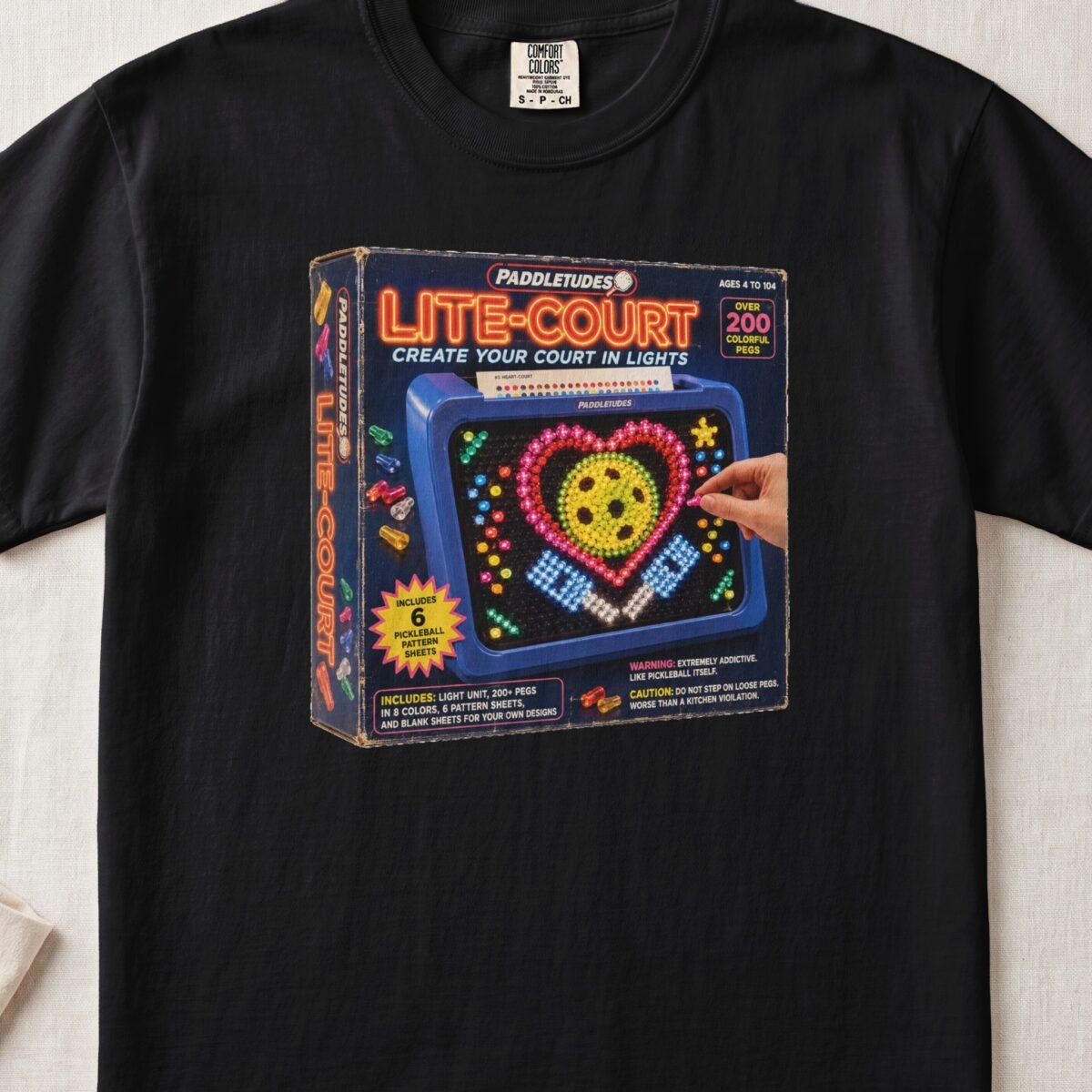
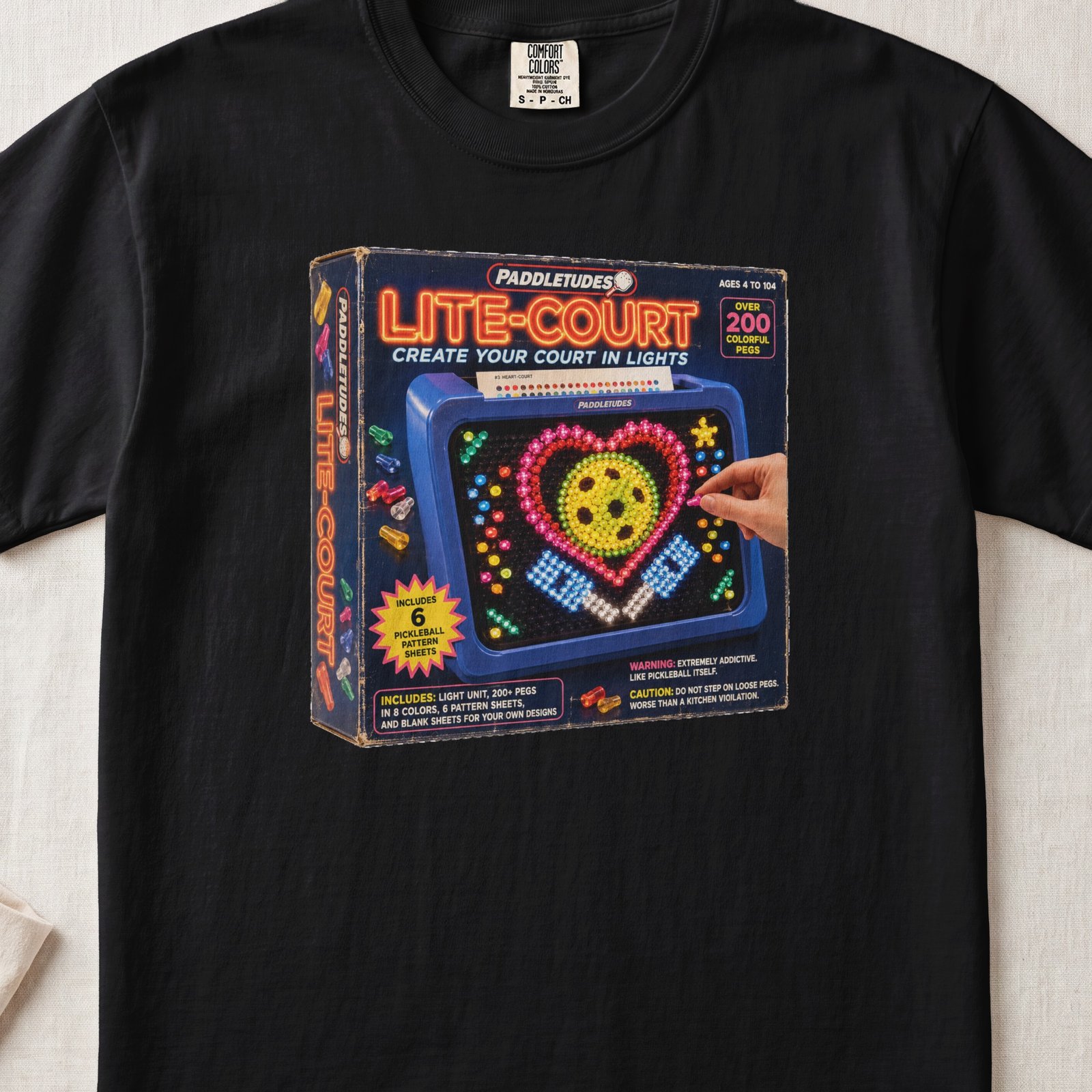
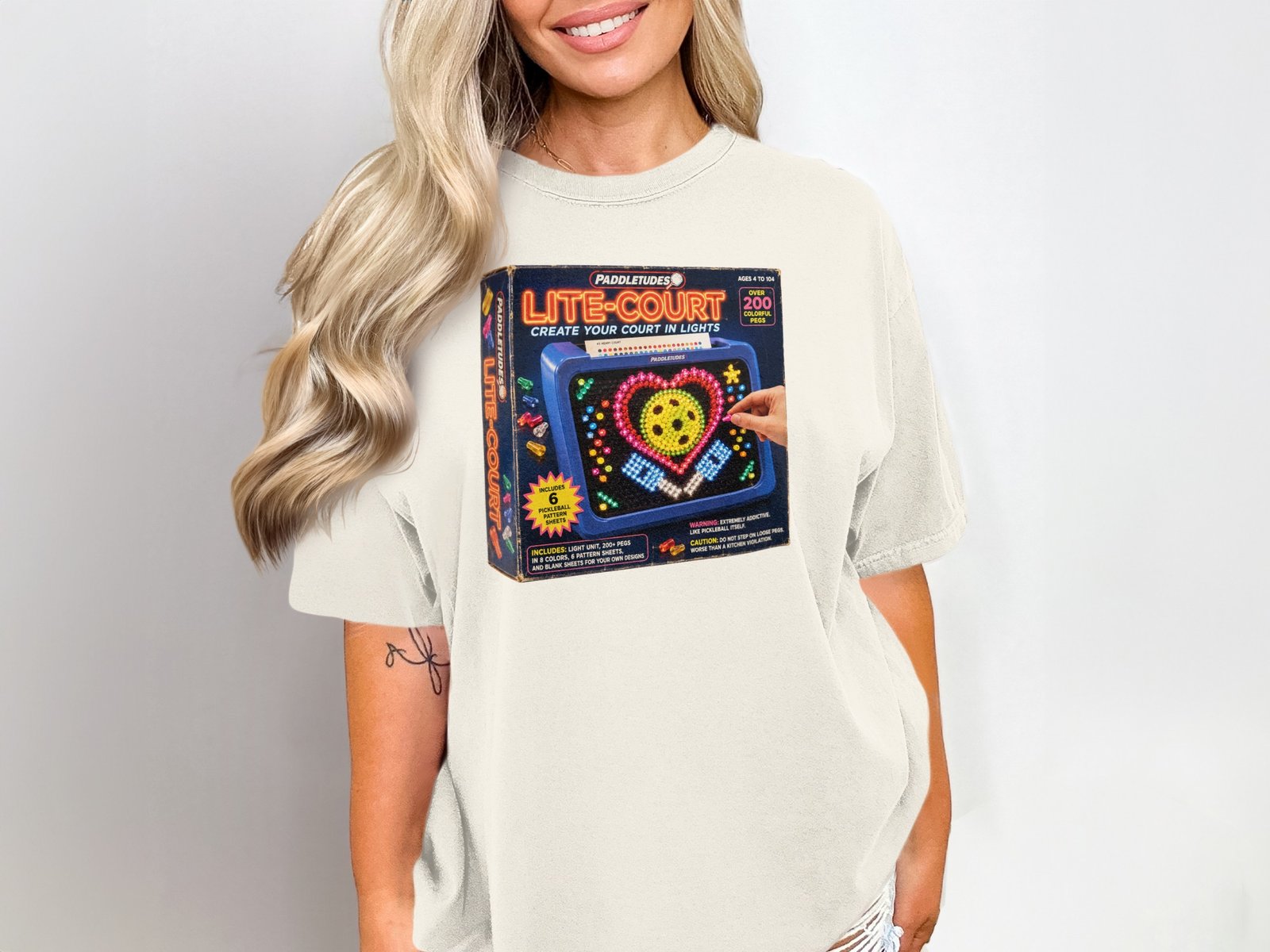
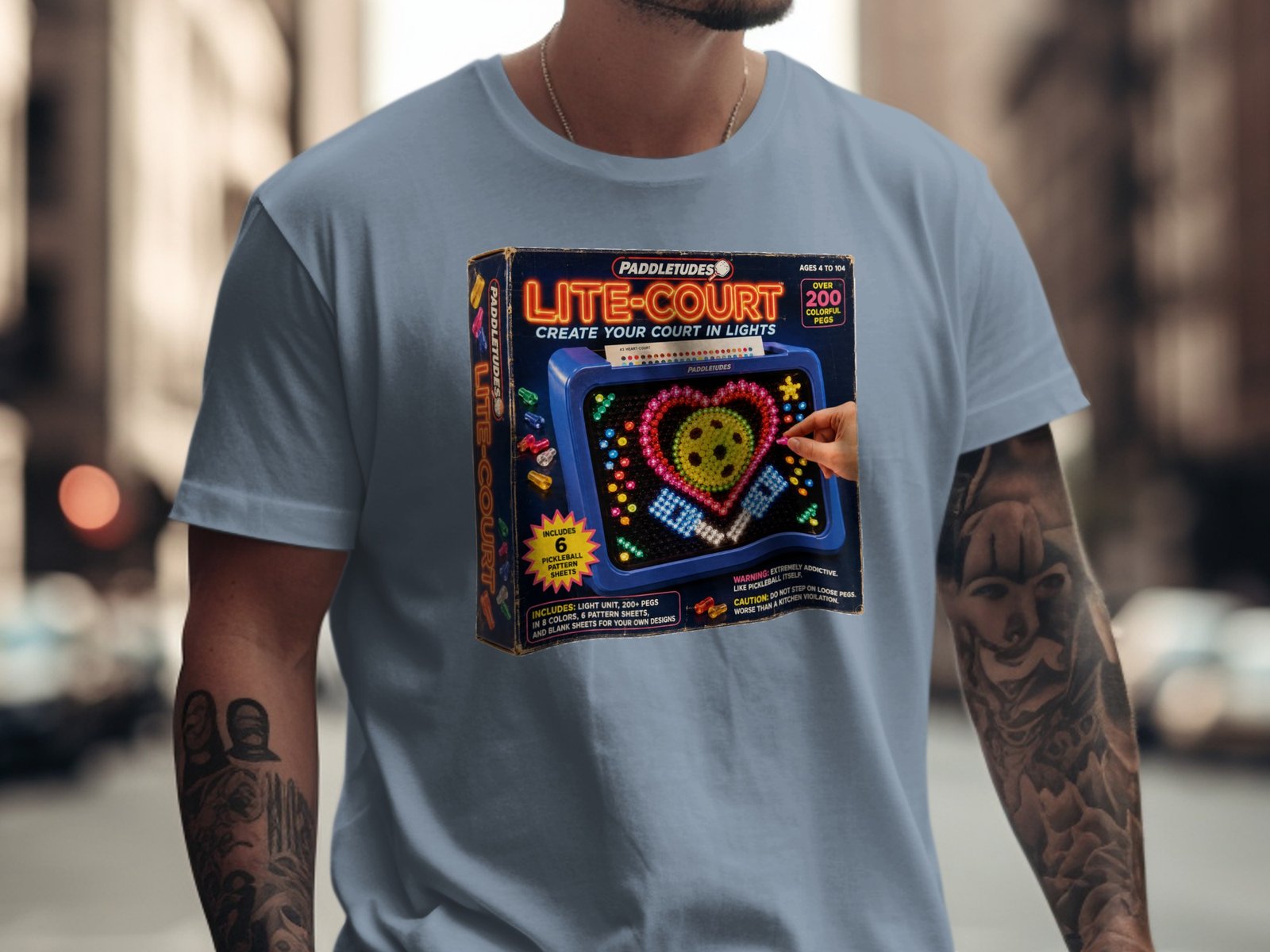
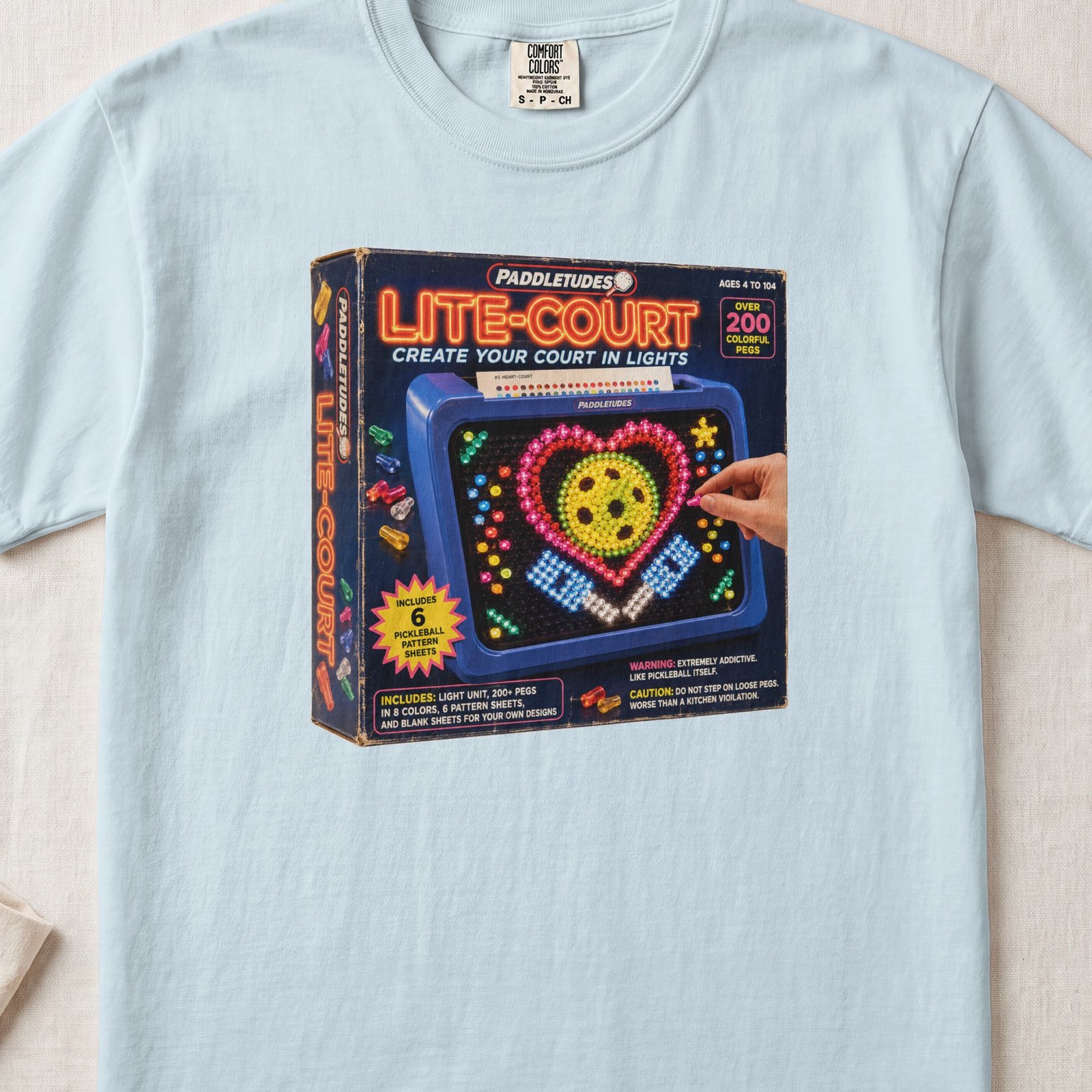
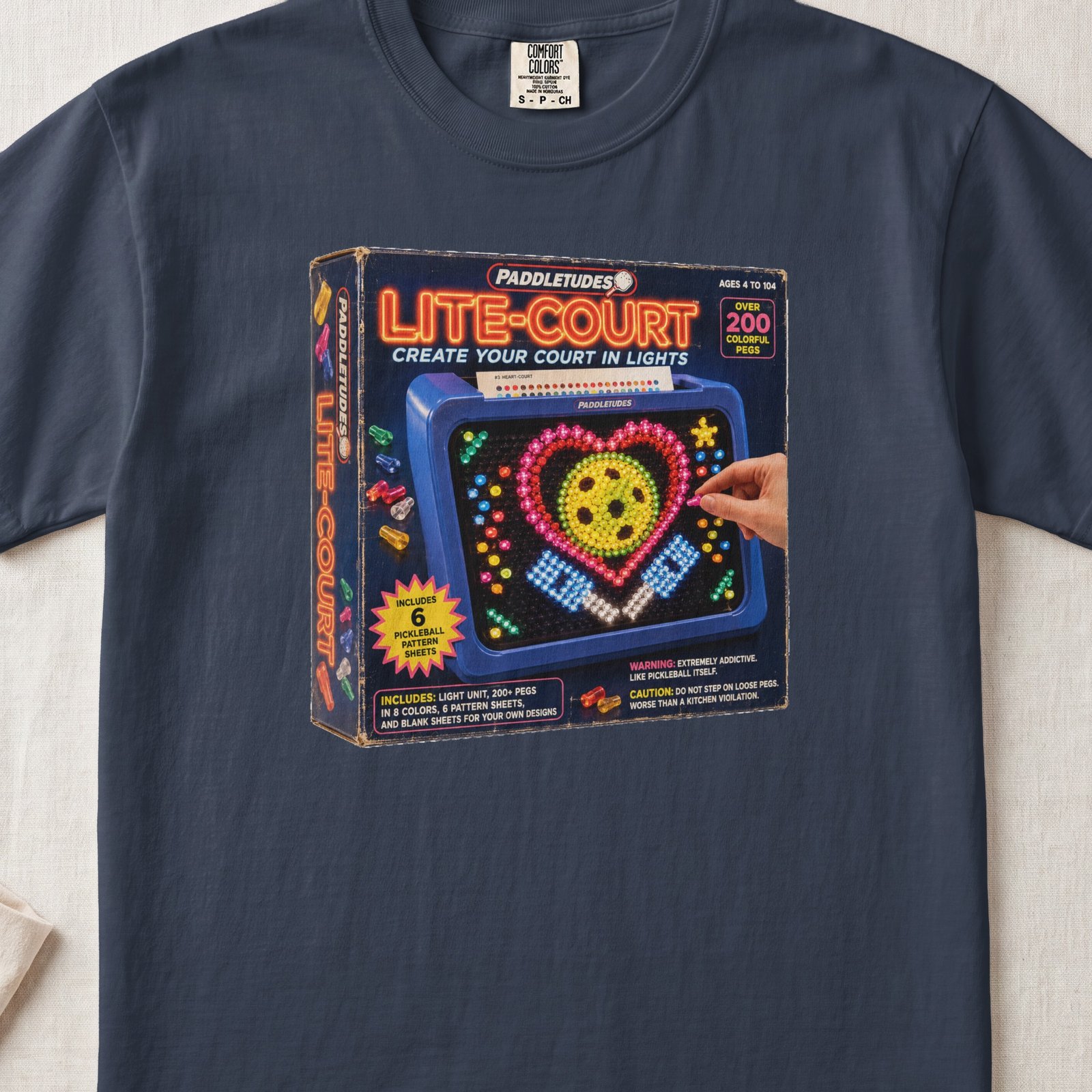
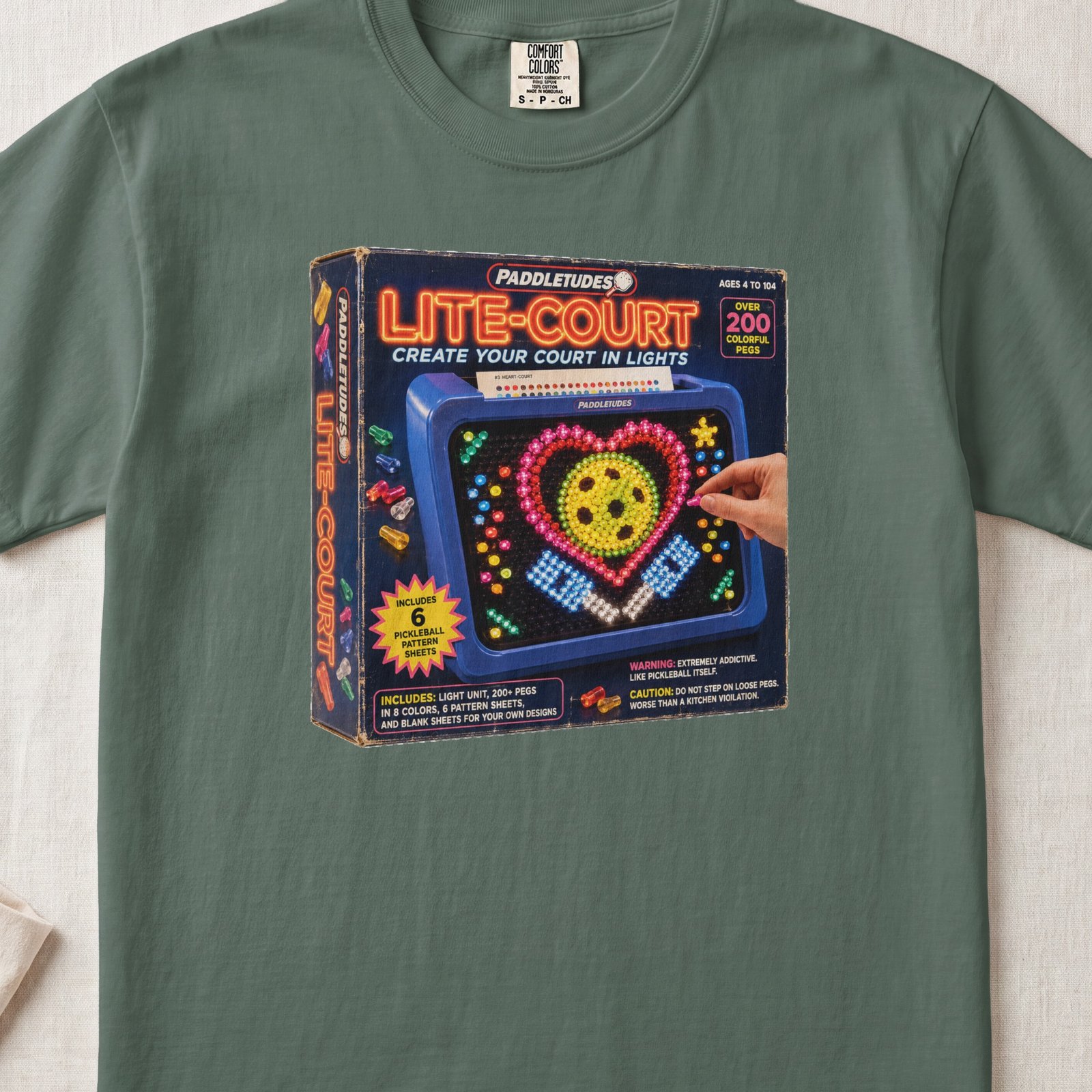
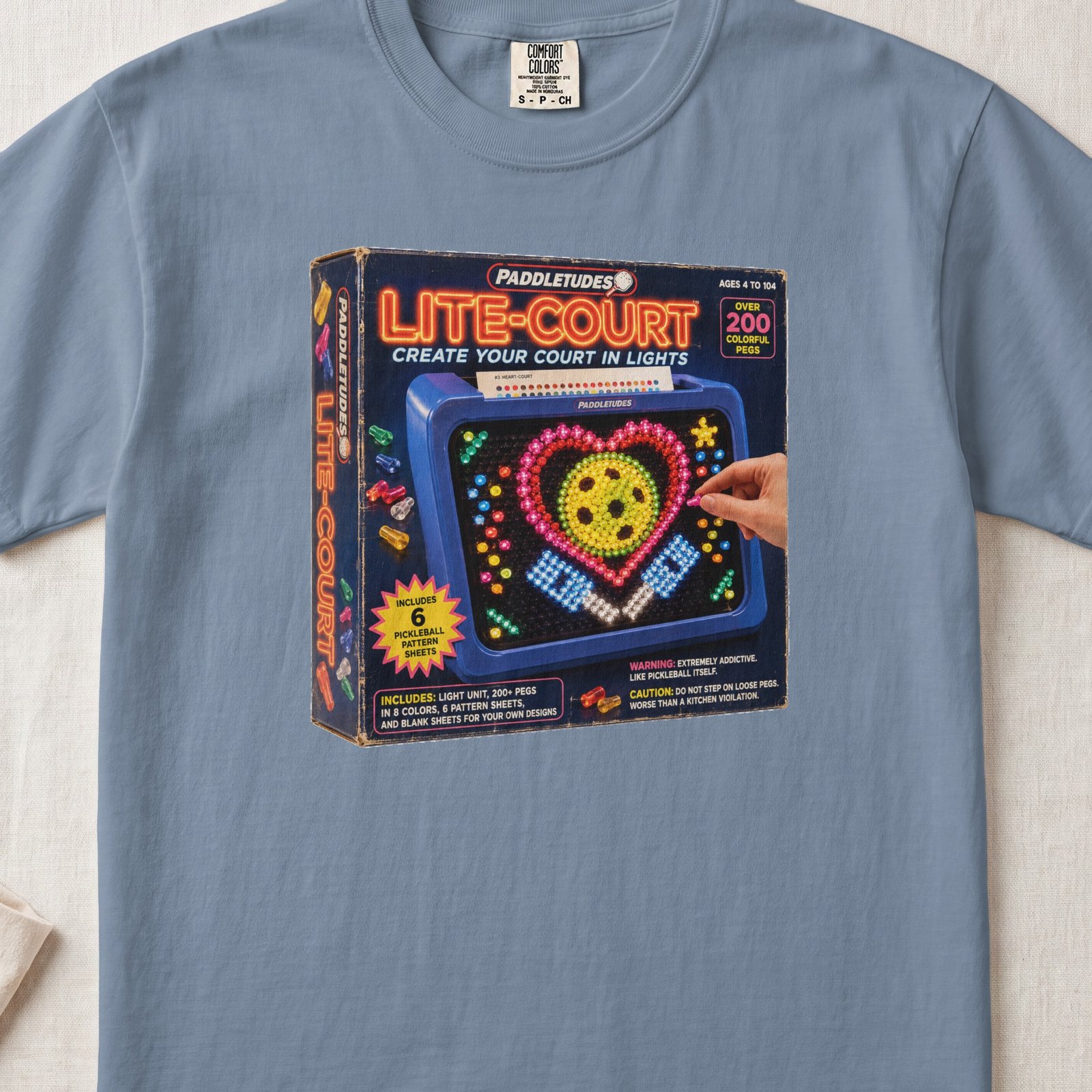
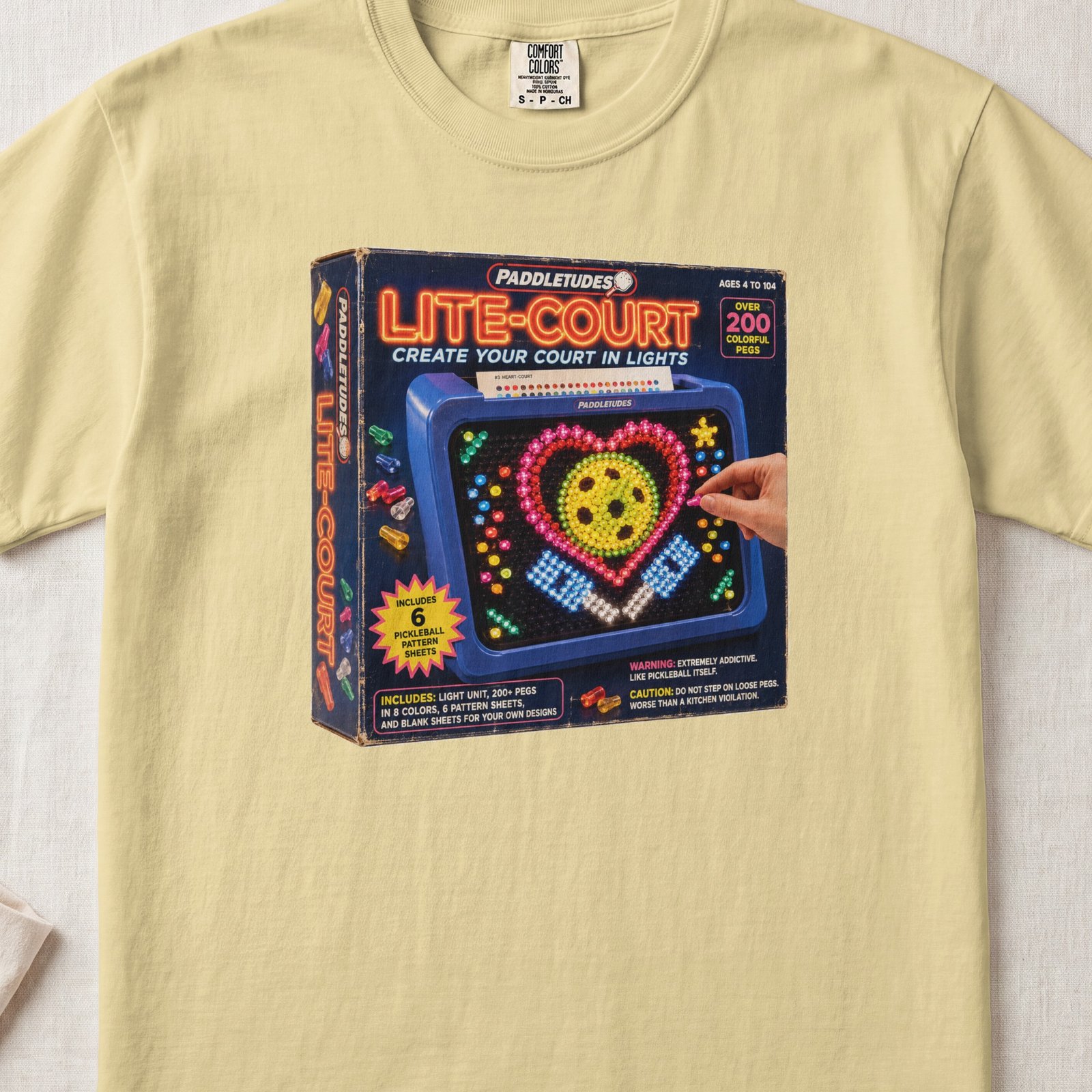
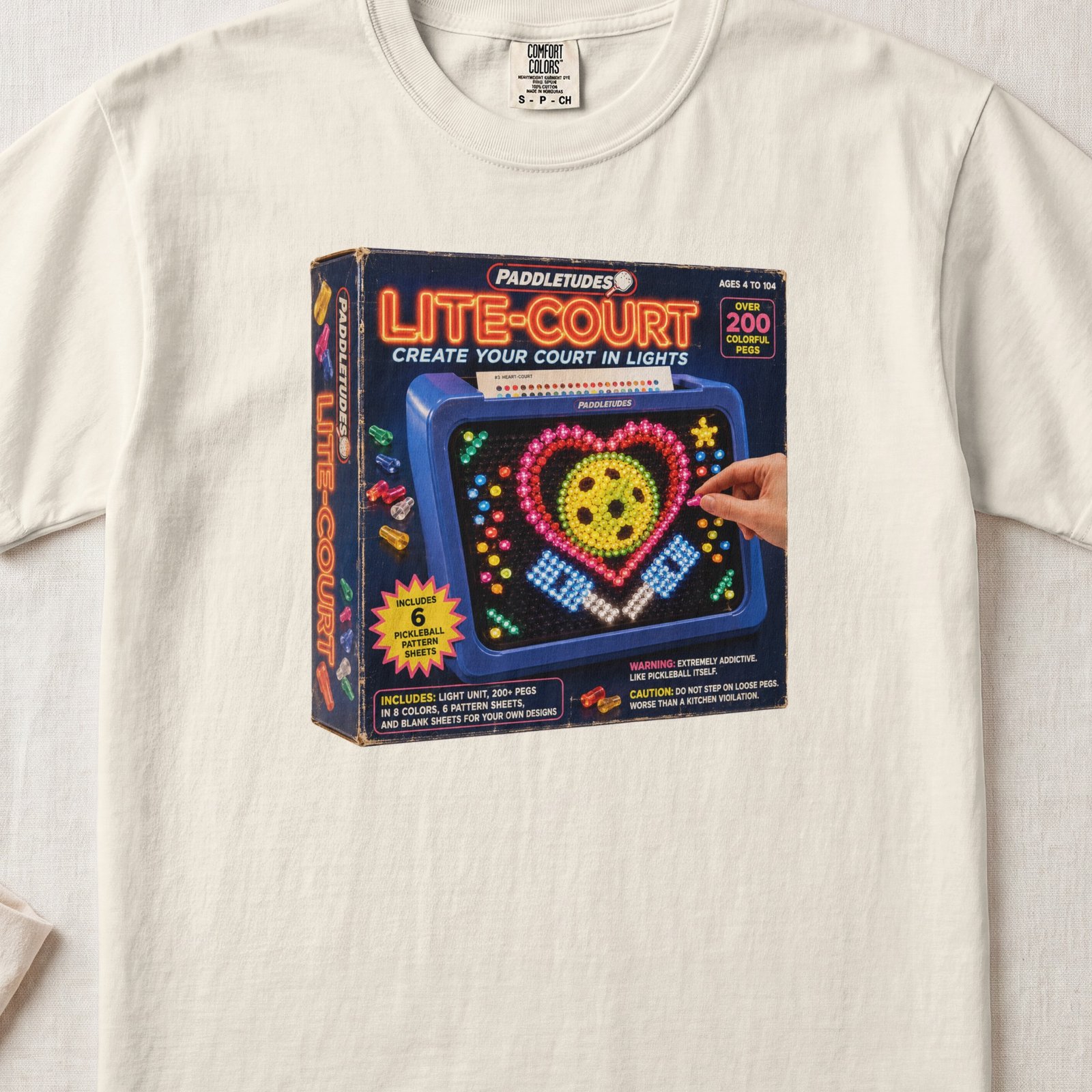
This shirt is a Lite-Brite. A pickleball Lite-Brite — boxed and branded by Paddletudes in the exact packaging that would have sat on the shelf at any toy store in 1982, right next to the real one. It’s called the Lite-Court. “Create Your Court in Lights.” Over 200 colorful pegs in 8 colors, 6 pickleball pattern sheets, and blank sheets for your own designs. Ages 4 to 104 — because some toys shouldn’t have an upper limit, and some feelings don’t. The warning reads Extremely Addictive. Like Pickleball Itself. The caution — the fine print every kid ignored and every parent read aloud — says Do Not Step on Loose Pegs. Worse Than a Kitchen Violation. And on the screen, glowing in pinks and yellows and greens, is a pickleball inside a heart. Because that’s what this sport is, when you strip away the scoring and the strategy and the arguments about line calls. It’s something you build. Something that glows. Something worth looking at in the dark.
You’ll wear this to the courts and somebody will see it and their face will do something they didn’t plan. Their eyes will go somewhere else for a second — back to a living room, a carpet, a parent who sat on the floor. They might not say anything. They might just point at your chest and nod, because some memories don’t need words, and some shirts aren’t really about shirts. They’re about the thing that lights up when you stop trying to explain why you love something and just let yourself love it.
At thirty-nine ninety-nine, the Lite-Court costs about what the original did in 1978 — which means it’s one of the only things in your life that hasn’t gotten more expensive, more complicated, or harder to find. It’s nostalgia for a toy that never existed, on a vintage tee that feels like it’s always existed, for every person who ever lived their best life on a living room floor with someone they loved, building something that wasn’t perfect but was absolutely, completely theirs. The glow never went out. It was there the whole time. You just needed the court lights to find it again.
Printed on a Comfort Colors 1717 garment-dyed heavyweight tee with water-based DTG ink — sizing and care details here.
-
Court Operation
$39.99 Select options This product has multiple variants. The options may be chosen on the product page -
The Pickleball Family
$39.99 Select options This product has multiple variants. The options may be chosen on the product page -
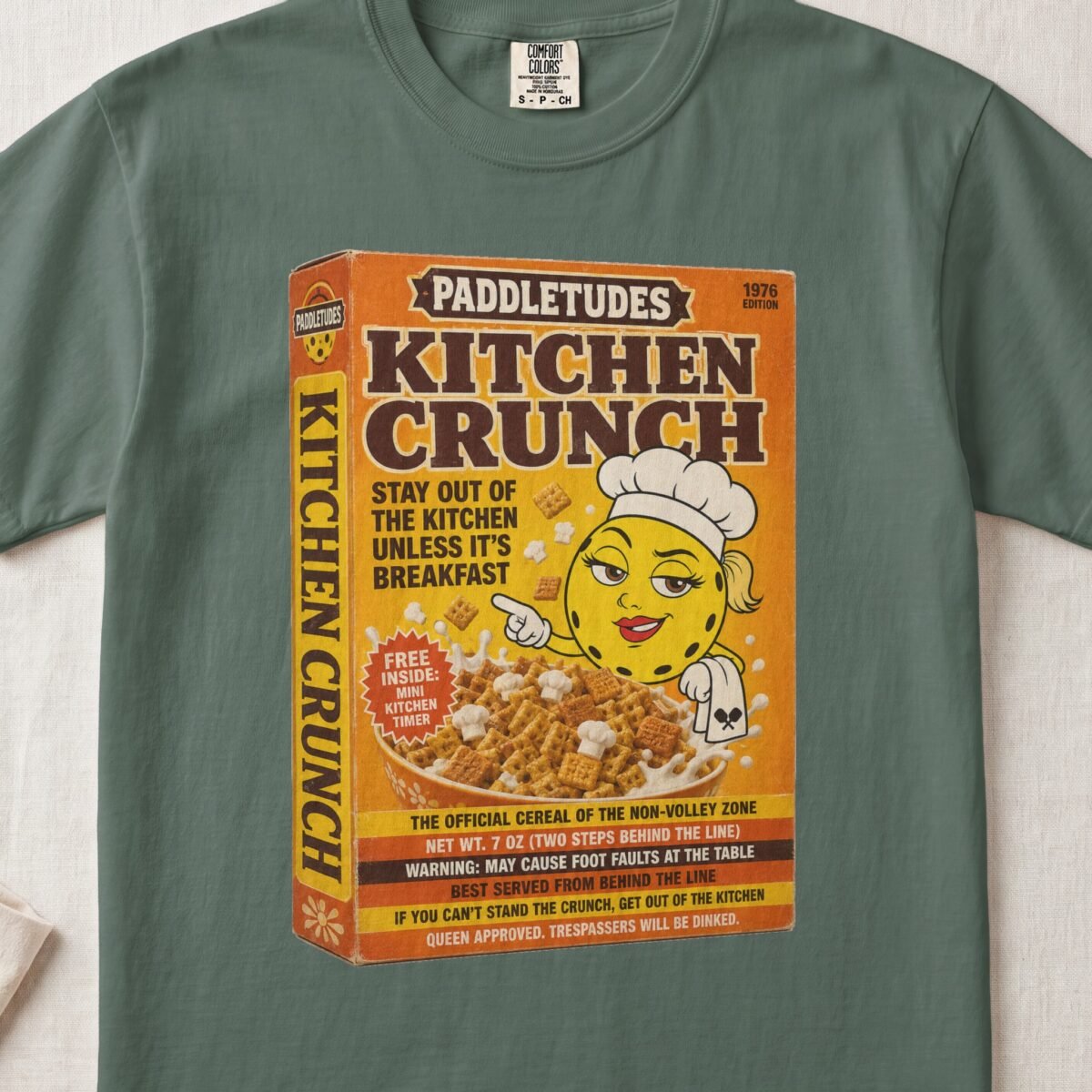
Kitchen Crunch
$39.99 Select options This product has multiple variants. The options may be chosen on the product page