Retro Comfort Colors 1717
Rec League Redemption
$39.99
- Comfort Colors 1717 heavyweight cotton
- Original design · printed to order
- U.S. print partners
Twenty Years in Rec Ball — A Retro Pickleball Shirt for the Lifer
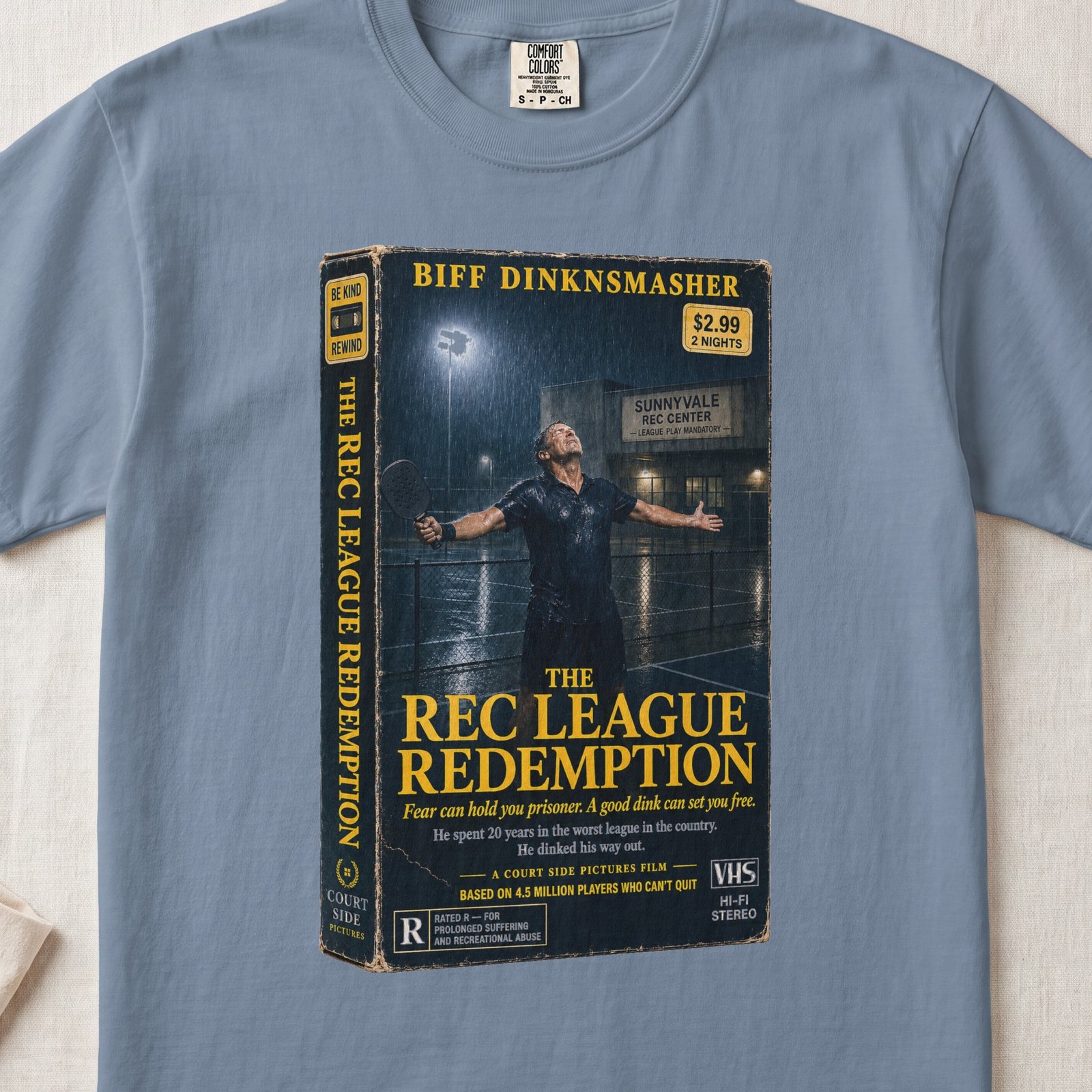
Twenty years in the worst league in the country. He dinked his way out. Rec League Redemption is a pickleball drama on a Comfort Colors 1717 — based on 4.5 million players who can’t quit.
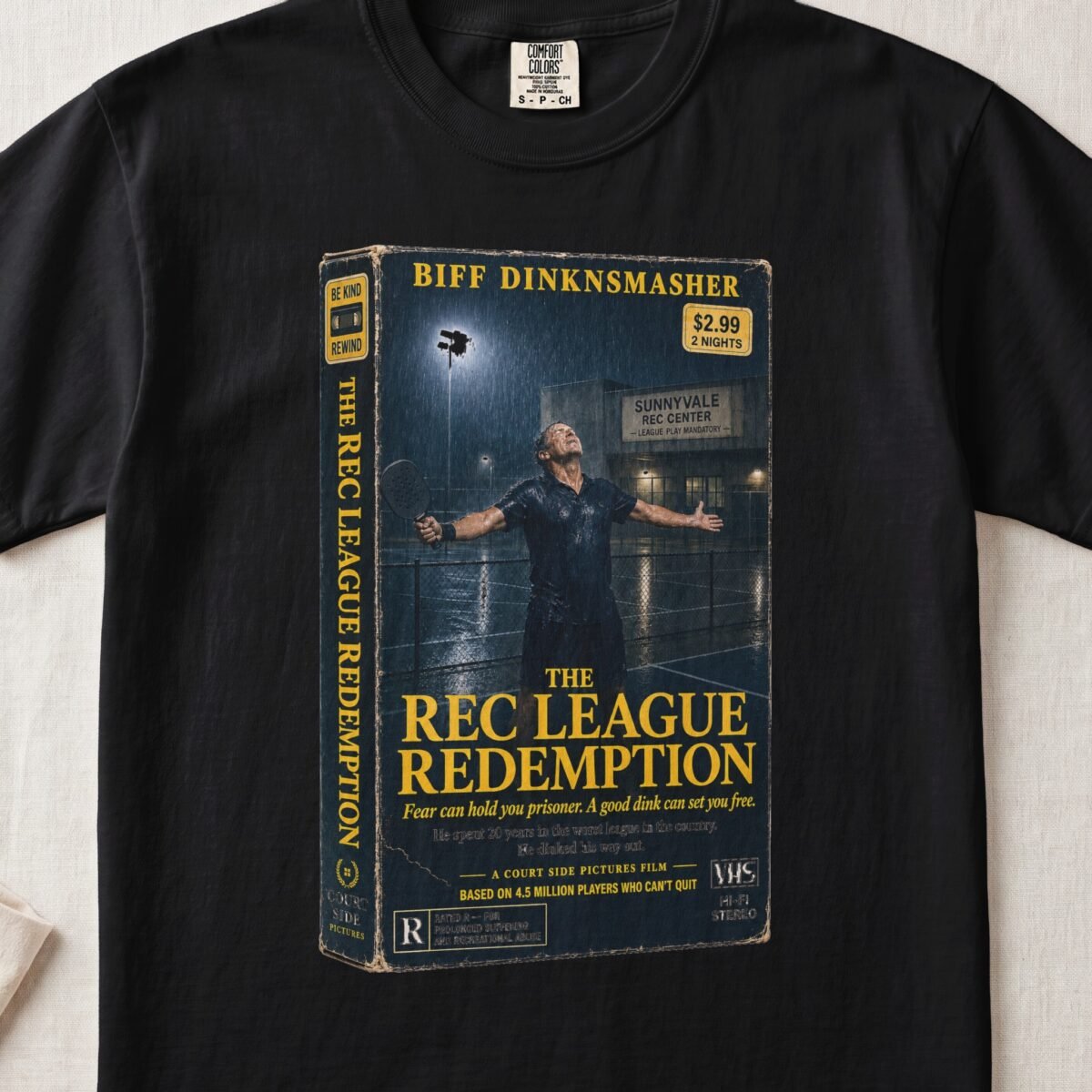
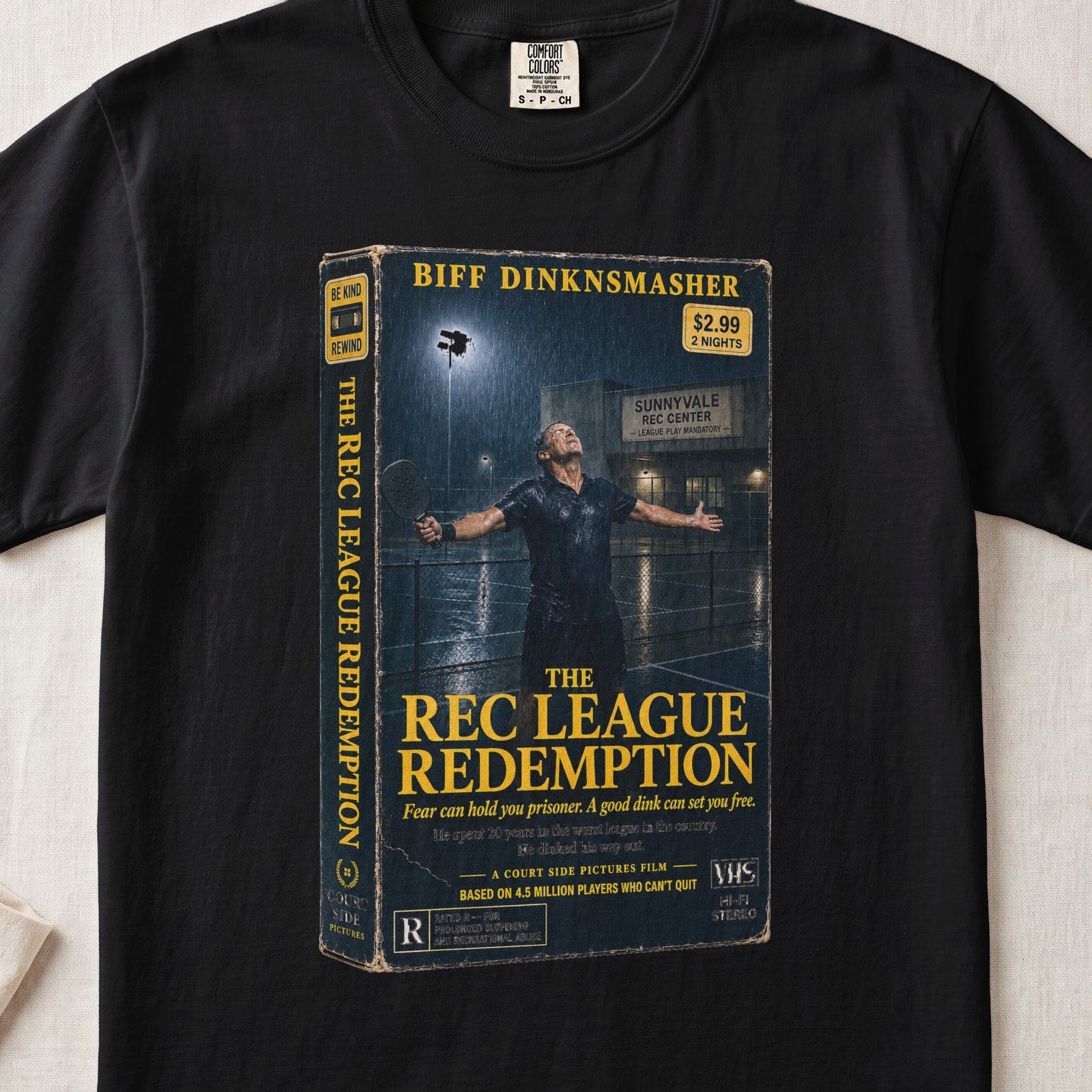
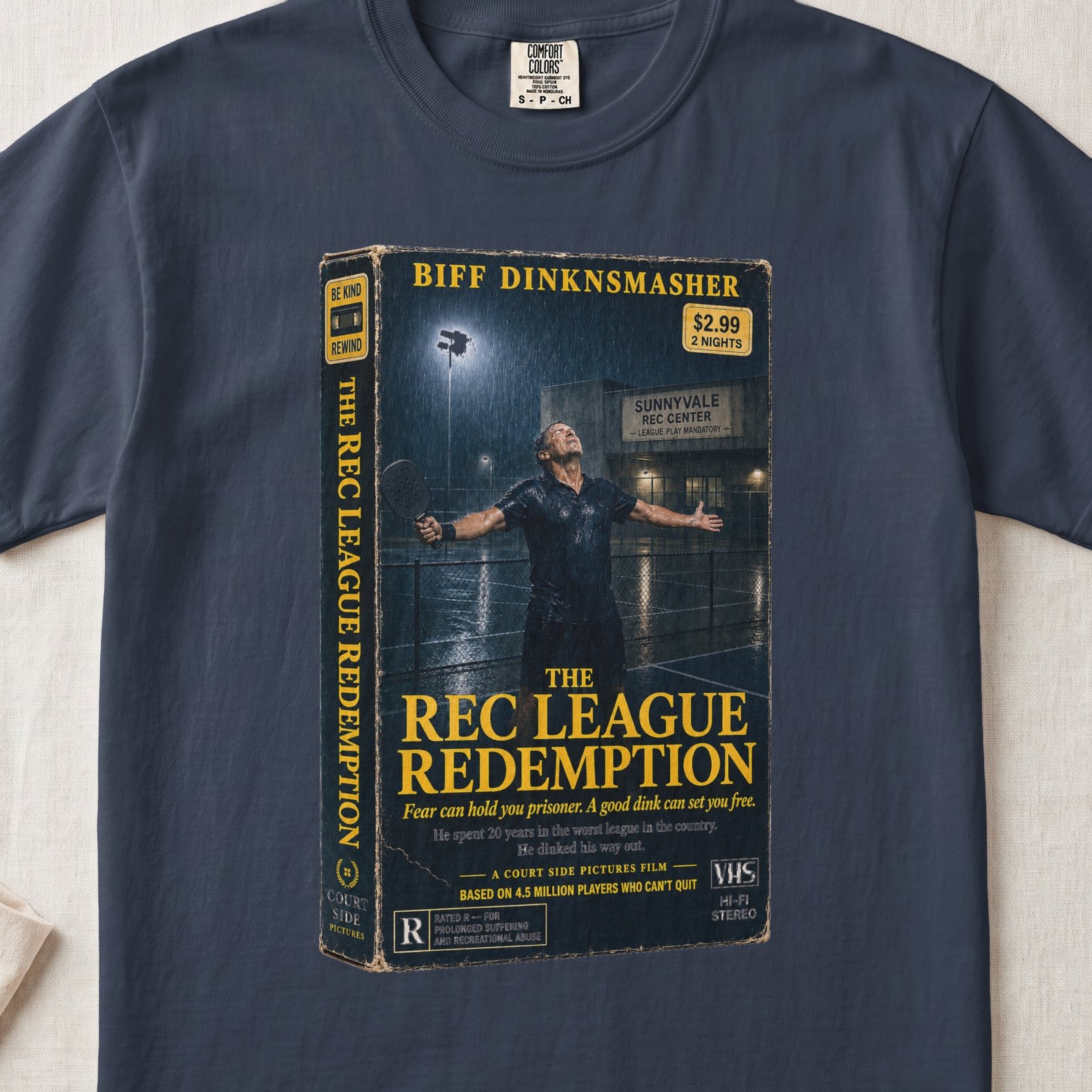
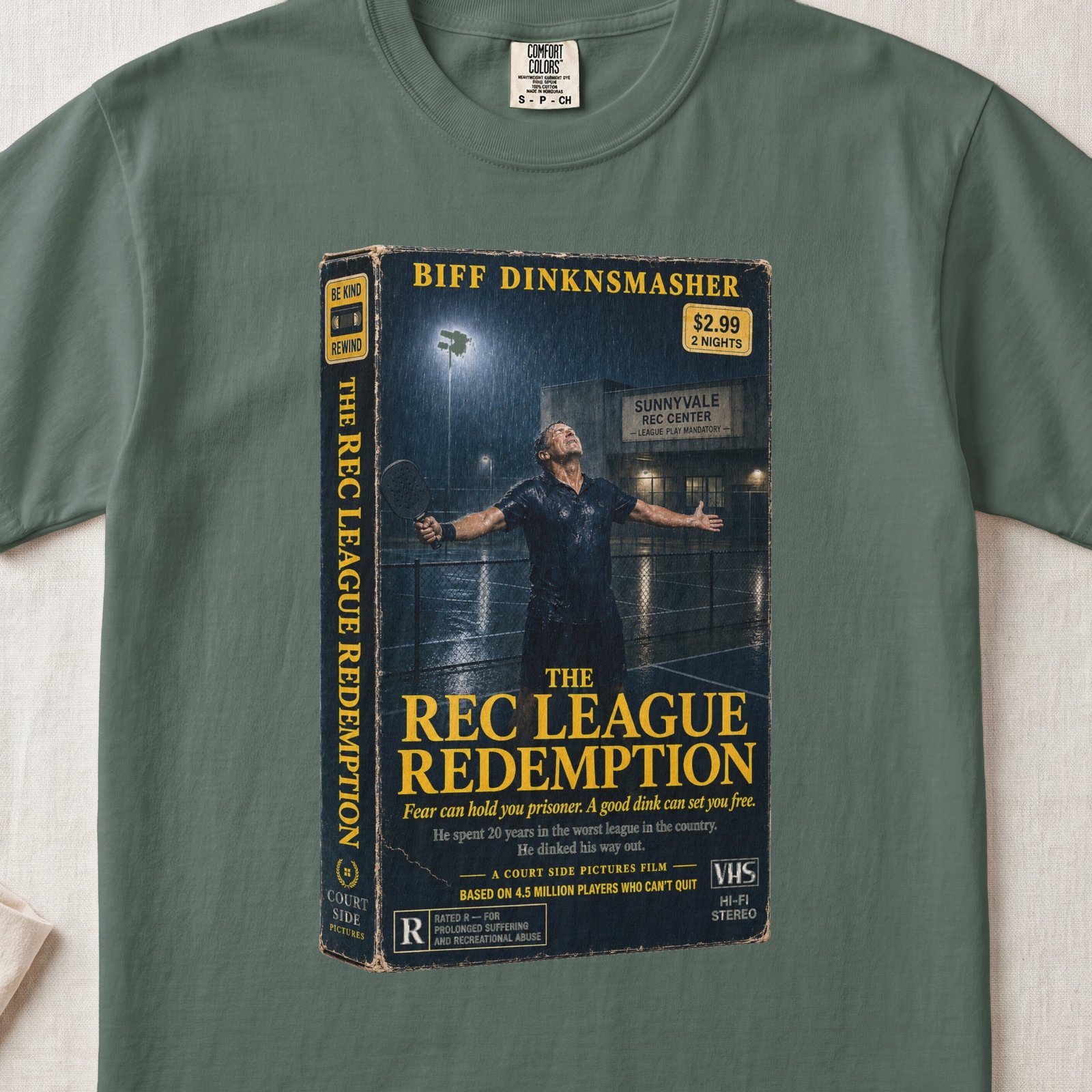
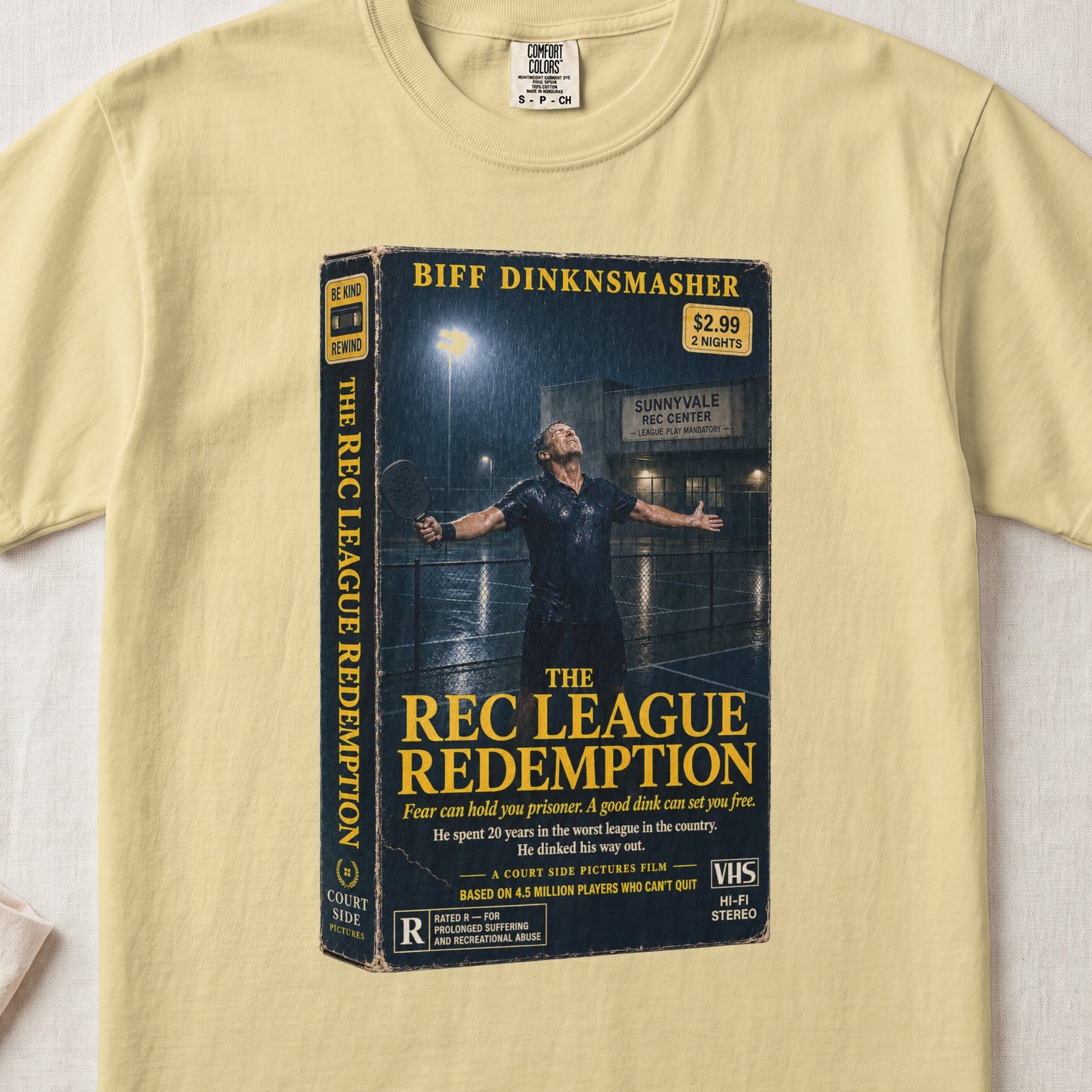
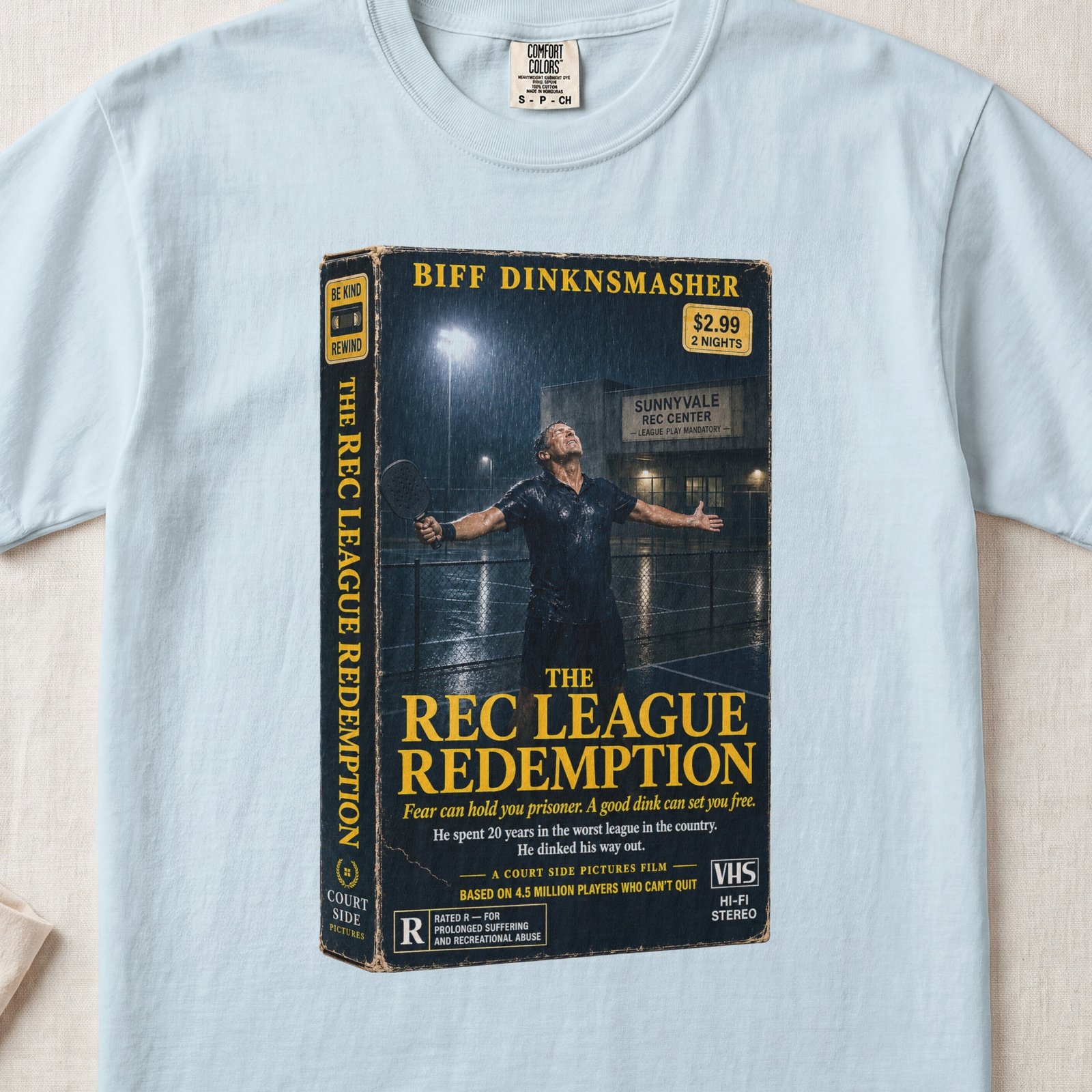
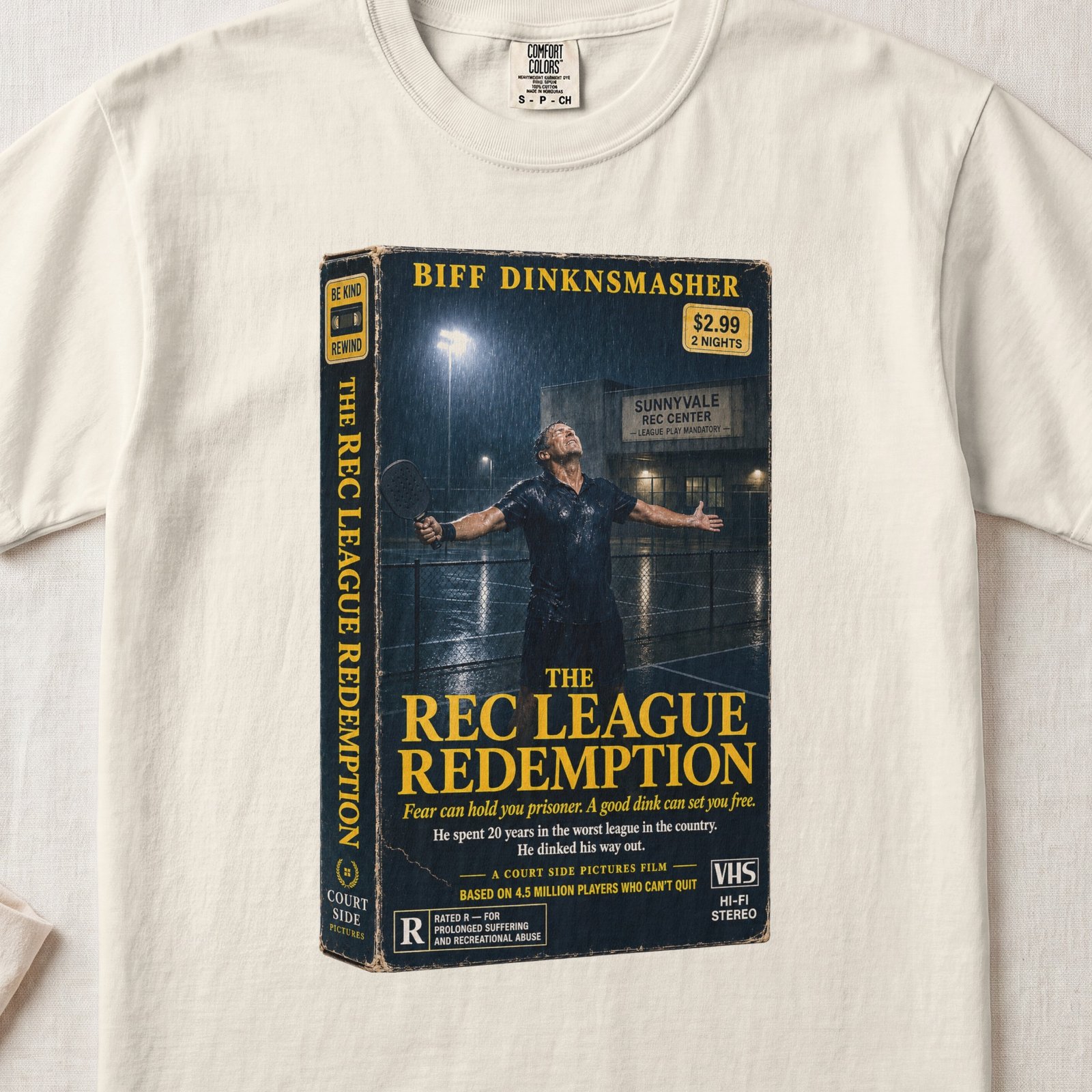
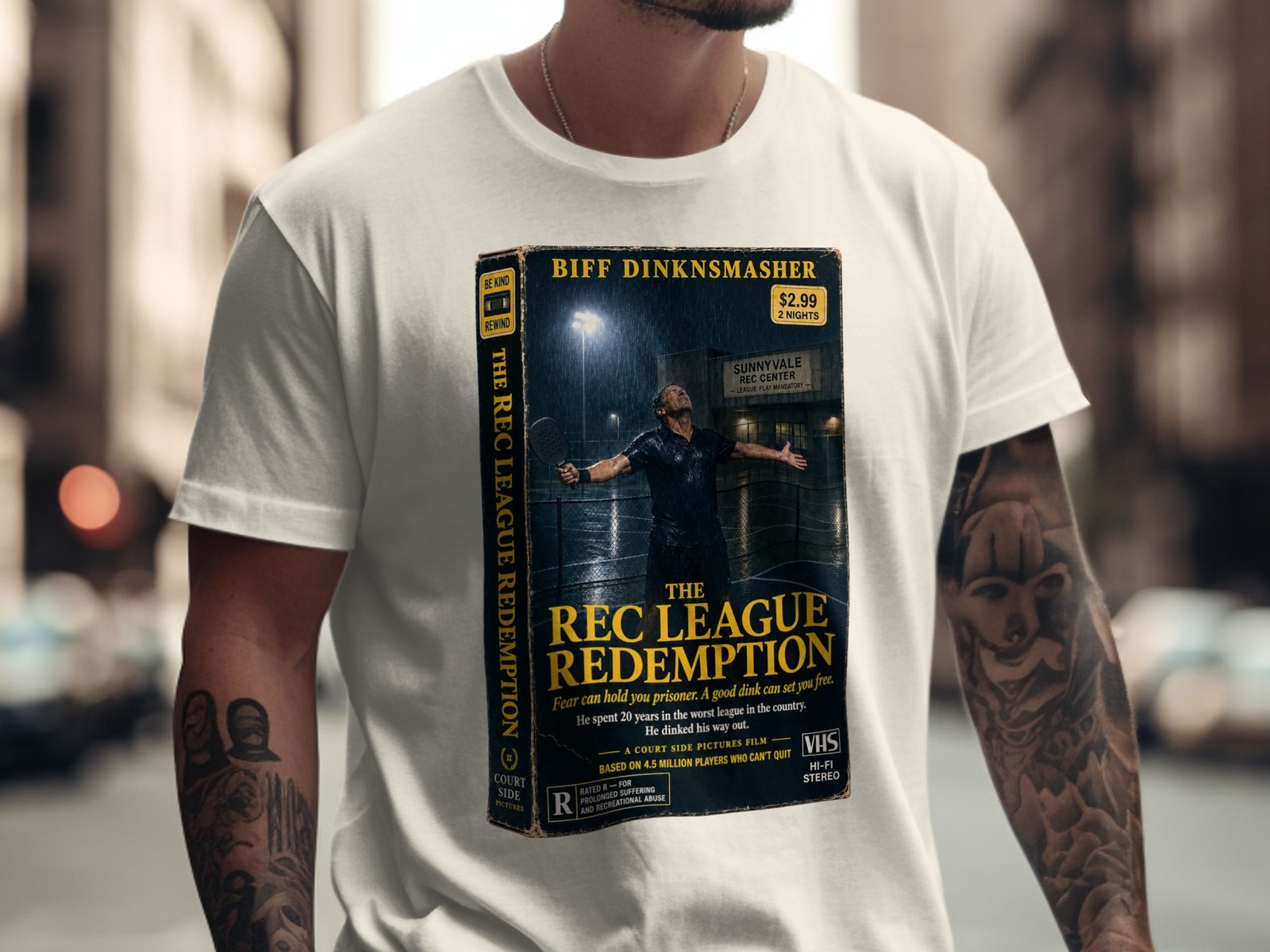
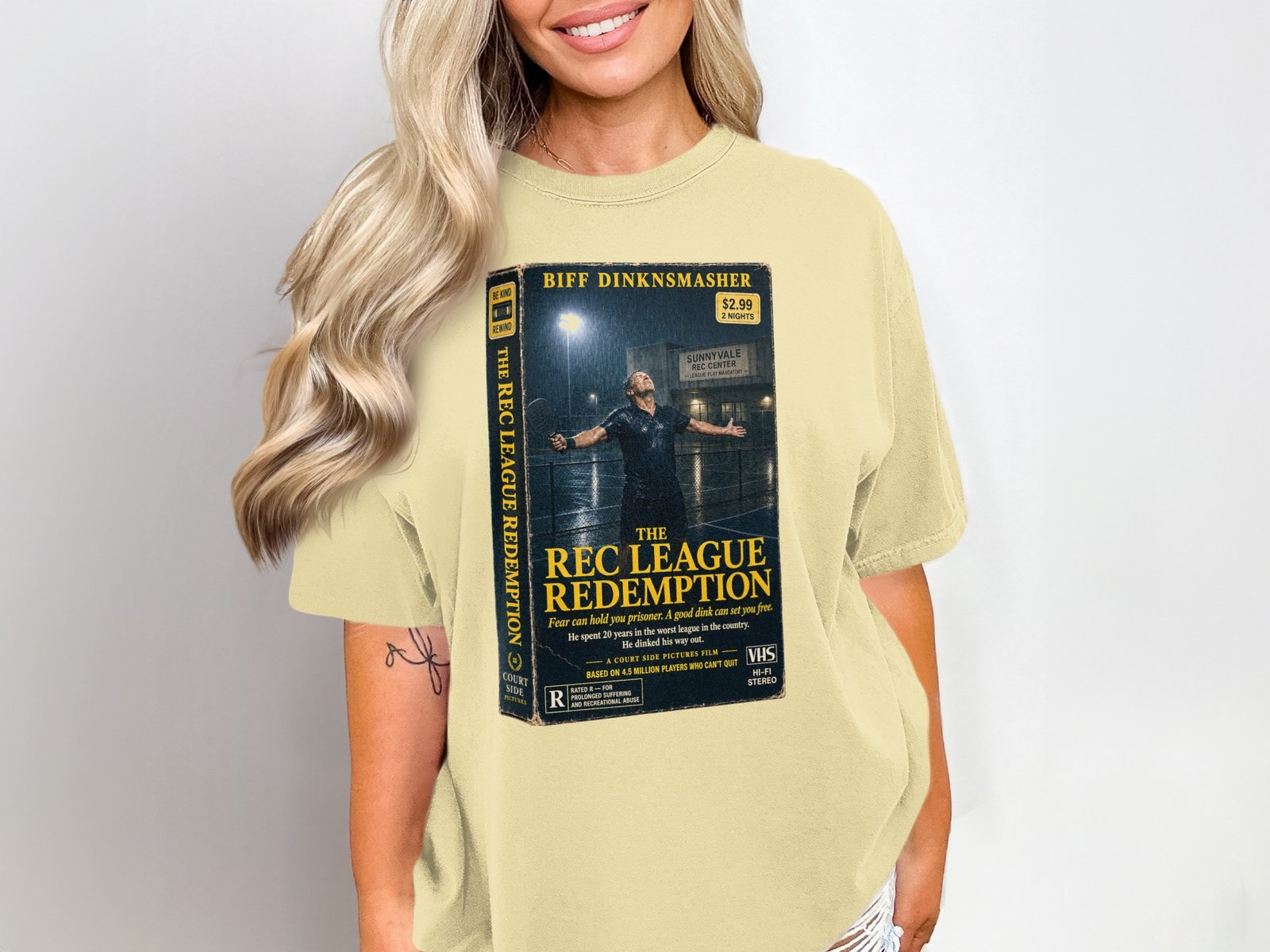
The cover is rain. Dark courts, floodlights cutting through the downpour, and a man standing at center court with his arms outstretched and his face turned upward like someone who just walked through a wall. He’s holding a paddle in his right hand. His shirt is soaked through. Behind him, the Sunnyvale Rec Center looms under a sky that hasn’t cleared in twenty years — and on the building’s sign, below the facility name, a line that reads “LEAGUE PLAY MANDATORY.” This is not an invitation. This is a sentence. Biff Dinknsmasher stars. A Court Side Pictures Film. Film festival laurels on the lower left corner, because this one won something. It won everything. It won the right to stand in the rain at the facility that tried to hold him and feel absolutely nothing except free.
The taglines tell the whole arc. “Fear can hold you prisoner. A good dink can set you free.” That’s the thesis — the realization that the soft game unlocks the exit from a competitive structure built on frustration, bad matchups, and the weekly obligation to show up at a facility you stopped enjoying three seasons ago. Below it, in a smaller typeface that reads like a confession: “He spent 20 years in the worst league in the country. He dinked his way out.” Twenty years. That’s a career. That’s longer than most marriages to the sport last. And the escape wasn’t quitting, wasn’t switching facilities, wasn’t finding a different hobby — it was getting better at the one skill that transforms pickleball from a fight into a game you control. The rating box at the bottom completes the story: “RATED R — FOR PROLONGED SUFFERING AND RECREATIONAL ABUSE.” The suffering is real. Recreational abuse is what it’s called when the league you voluntarily joined starts feeling like a job you can’t leave.
League pickleball looks different from the outside than it feels from the inside. From the outside, it looks like organized fun — structured play, consistent partners, scheduled matches, standings to track your progress. From the inside, after a few seasons, it can feel like a commitment that calcified around you while you weren’t paying attention. The partner you picked in season one because they were available is now your permanent assignment. The opponents you drew in the schedule this round include the team that argued every line call last season and hasn’t gotten less argumentative. The facility runs the league because it fills courts during off-peak hours, not because the format is optimized for your development as a player. The person wearing this shirt has been in that structure, has felt the walls close, and has either dinked their way to a higher division where the competition is cleaner, or has earned the peace that comes from realizing the league doesn’t own them — they can take their paddle and their DUPR rating and play wherever they want.
That rain scene on the VHS cover captures a moment every long-term league player recognizes even if they’ve never stood on a wet court in the dark. It’s the moment the obligation breaks. The Tuesday night drive to the facility stops feeling like a chore. The rotation you’ve been grinding through for three seasons suddenly includes a matchup you’re looking forward to instead of dreading. Something shifted — maybe the dink improved, maybe the partner changed, maybe the perspective adjusted — and the league that felt like a sentence starts feeling like a choice again. That’s the redemption. Not quitting. Not escaping. Choosing to stay because the game got good enough to justify the commitment. Standing in the rain with your arms out isn’t about freedom from pickleball. It’s about freedom inside it.
The gift angle for this shirt is narrow and that’s what makes it hit hard. This is for the player who’s been in the same league for three or more seasons — not the person who just signed up and is excited about it, but the person who has survived bad partners, lopsided matchups, scheduling conflicts, and at least one season where they seriously considered not coming back. They came back. They always come back. And somewhere in the middle of that grind, their game got quietly, genuinely better. Their dink tightened up. Their patience at the net improved. They stopped trying to overpower opponents and started outwaiting them. This shirt validates that arc. Wrapping it as a retirement gift for someone’s last season in a league they’ve played in for a decade — the one that ran its course and deserves a monument — is the kind of gift that gets framed instead of folded.
Rec League Redemption is the most cinematic entry in the Court Side Pictures VHS catalog, and the one that earned the festival laurels in the corner. One Flew Over the Pickleball Net tells the opposite story — a player who checked into the rec center for one game and never left, turning addiction into a lifestyle with no exit plan. Rec League Redemption has the exit plan. It’s just twenty years long. PickleShack captures the lighter side of facility culture — the snack bar, the socializing, the comedy of who gets the next court — while this tape captures the weight of it. And Soft Hands is the tonic that made the dink-based escape possible in the first place — the Dr. Paddletudes prescription for chronic hard hitting that the main character filled sometime around year fifteen.
Printed on a Comfort Colors 1717 garment-dyed heavyweight tee with water-based DTG ink — sizing and care details here.
Are Pickleball Leagues Worth It
Pickleball leagues are worth it for players who want structured competition, a consistent playing schedule, and a measurable way to track improvement — but the quality varies enormously by facility, format, and who’s running them. A well-organized league with balanced skill tiers, fair scheduling, and a culture that values both competition and sportsmanship can be the best thing in recreational pickleball. A poorly organized one can feel like a weekly obligation with no exit clause, which is roughly what the Sunnyvale Rec Center on this VHS cover is running.
Most leagues cost between $50 and $150 per season and run 8-12 weeks, typically one match night per week. Formats vary: some are doubles-only with fixed partners, some rotate partners each week, some separate by skill level using DUPR or self-reported ratings, and some throw everyone into the same bracket and hope for the best. The fixed-partner format produces the deepest partnerships and the most entertaining drama when the partnership isn’t working. The rotating format prevents drama but also prevents the kind of tactical chemistry that makes doubles genuinely rewarding. The best leagues offer both and let teams choose, which requires enough membership to fill multiple divisions — usually 40+ active players at a single facility.
The honest answer about whether a specific league is worth joining depends on three things: the skill calibration (are you playing against people at your level or spending eight weeks getting crushed by teams two tiers above you), the sportsmanship culture (do disputed calls get resolved reasonably or do they define the entire season), and whether the format rewards development or just rewards winning. A league that pushes you to improve your weakest shot — typically the third shot drop or the dink exchange — and pairs you with opponents who expose those weaknesses constructively is worth every dollar and every Tuesday night. A league where the same three teams dominate, the schedule feels arbitrary, and the only thing you get better at is tolerating frustration is the one Biff dinked his way out of. Both versions exist at most facilities. Asking current players which one they’re in before you sign up is the most valuable research you can do.
-
Court Operation
$39.99 Select options This product has multiple variants. The options may be chosen on the product page -
Breaking Balls
$39.99 Select options This product has multiple variants. The options may be chosen on the product page -
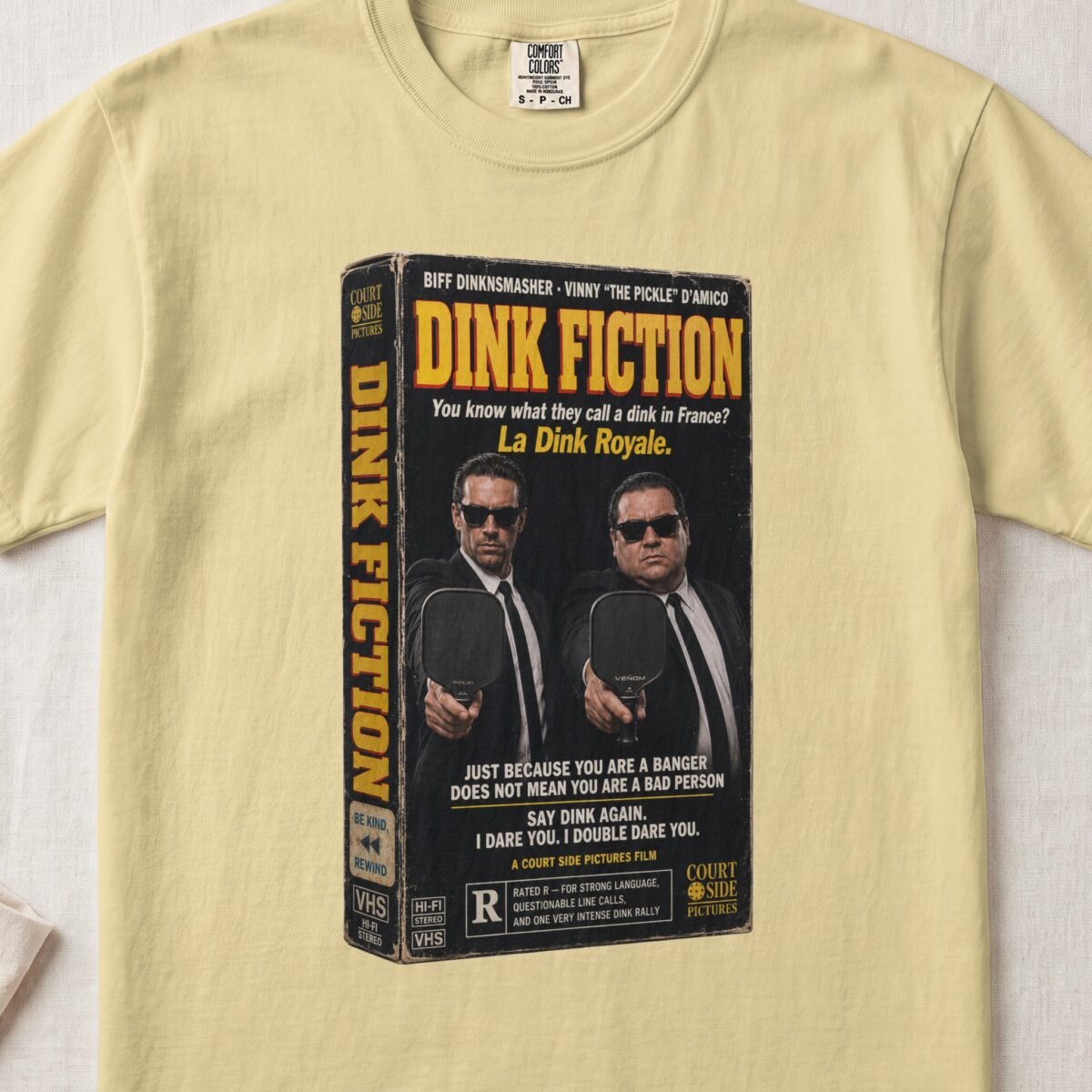
Dink Fiction
$39.99 Select options This product has multiple variants. The options may be chosen on the product page