Retro Comfort Colors 1717
Biff’s Locker Puzzle
$39.99
- Comfort Colors 1717 heavyweight cotton
- Original design · printed to order
- U.S. print partners
Biff’s Locker Puzzle — Retro Vintage Puzzle Box Nostalgia Meets the Pickleball Court on a Throwback Graphic Tee
The box went on the kitchen table the same way it always did — lid propped against the napkin holder, pieces dumped in a pile, edge pieces separated first because that’s how your mother taught you and your mother was never wrong about puzzles or anything else. It was a Saturday. It was raining. The coffee was on. And somewhere between sorting the corners and finding the first two pieces that clicked together, the rest of the world — the phone, the inbox, the list of things you were supposed to be doing instead of sitting at a kitchen table assembling something that had no practical value whatsoever — went quiet.
That was the tradition. Not the puzzle itself, but the table. The sitting. The two or three hours where nobody needed you to be anywhere except right here, hands moving slowly through a pile of cardboard pieces, looking for the one that fits. Your grandparents did it. Sunday afternoons, the card table set up in the den, a thousand pieces spread across the surface like a problem that could actually be solved if you were patient enough. Your grandfather worked the sky — always the sky, because the sky was the hardest part and he believed in doing hard things first. Your grandmother worked the border and told stories about people you’d never met while her fingers moved through the pile without looking, finding pieces by feel, the way musicians find notes.
They didn’t call it quality time. They didn’t call it anything. It was just what they did on Sundays — the same way Saturday was the barbershop and Monday was the garden and every day had a thing that held the week together. The puzzle was the slow one. The one that didn’t care about the clock. The one that said sit down, stay here, and put something together one piece at a time, and when it’s finished you’ll have a picture you can look at and say: I built that.
What a Thousand Pieces Teaches You
You don’t realize how much you miss the kitchen table until you’re sitting at one again with a puzzle in front of you and the coffee going and the rain doing its thing outside and your hands moving the way your grandmother’s moved — slowly, patiently, without looking, trusting that the right piece is in the pile somewhere and you’ll find it if you stop trying so hard.
A thousand-piece puzzle teaches you the same thing pickleball teaches you, which is the same thing your grandfather would have told you if he’d played pickleball instead of spending Sundays in the den: the picture doesn’t come together all at once. It comes together in sections. You get a corner. Then an edge. Then a small cluster in the middle that doesn’t connect to anything yet but looks promising. Some pieces you try fourteen times before they click. Some pieces you pick up and place on the first try and feel like a genius for approximately four seconds before the next piece humbles you completely. And every now and then — maybe once an hour, maybe twice if you’re lucky — two sections that have been sitting six inches apart for the entire afternoon suddenly connect, and the picture jumps forward in a way that makes you say something out loud to nobody in particular, because that’s what puzzles do. They make you talk to yourself. Just like pickleball.
The tradition is disappearing. You know it. The kitchen table has a laptop on it now, or a stack of mail, or nothing at all because nobody sits at the kitchen table anymore except to eat and sometimes not even then. The card table in the den is gone. The Sunday afternoon is gone. The slow, unhurried, hands-in-the-pile, sky-first, border-second, stories-about-people-you-never-met ritual of building something beautiful out of a thousand small pieces — that’s the thing this puzzle brings back. Not the picture on the box. The sitting.
Except This Time, the Picture Is Your Locker
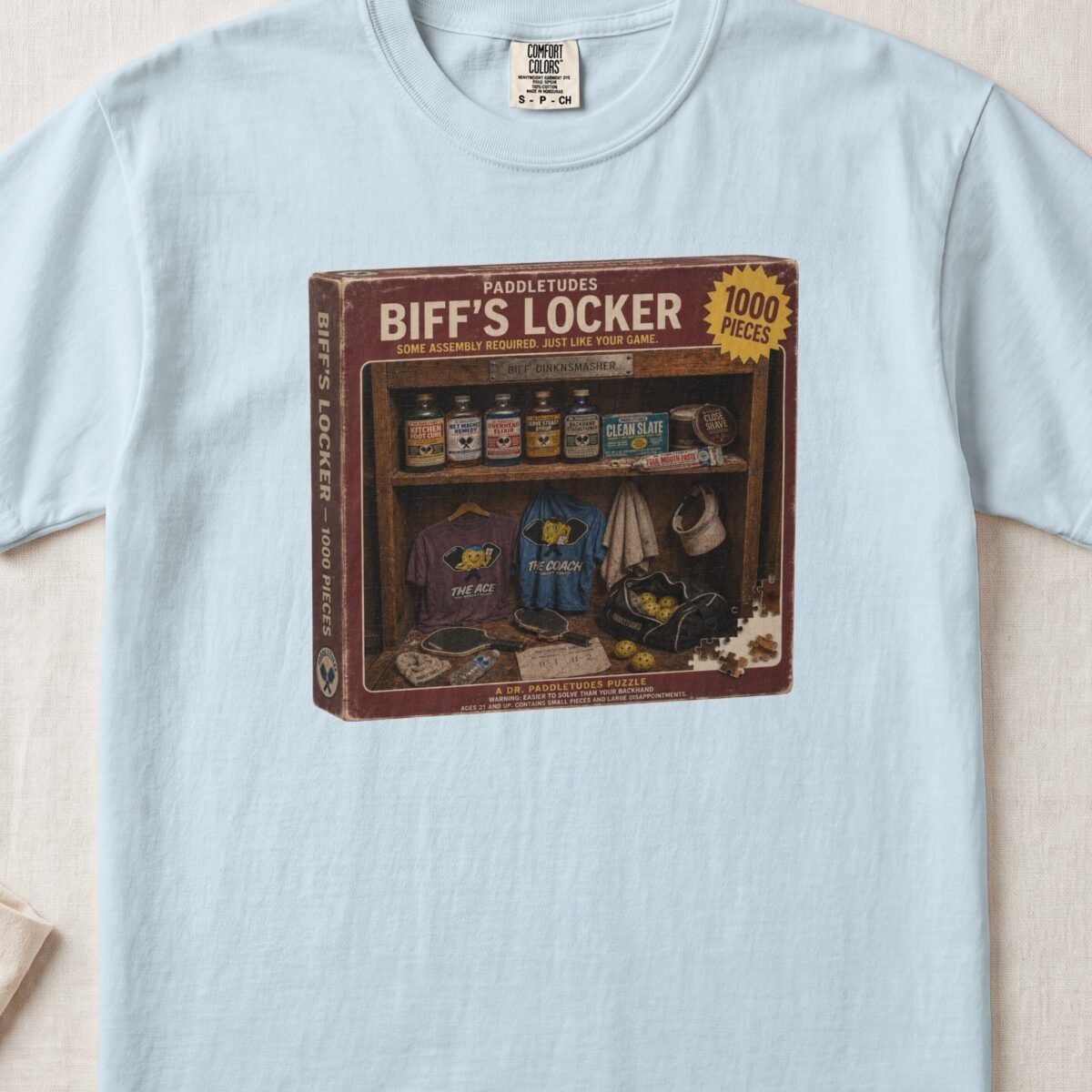
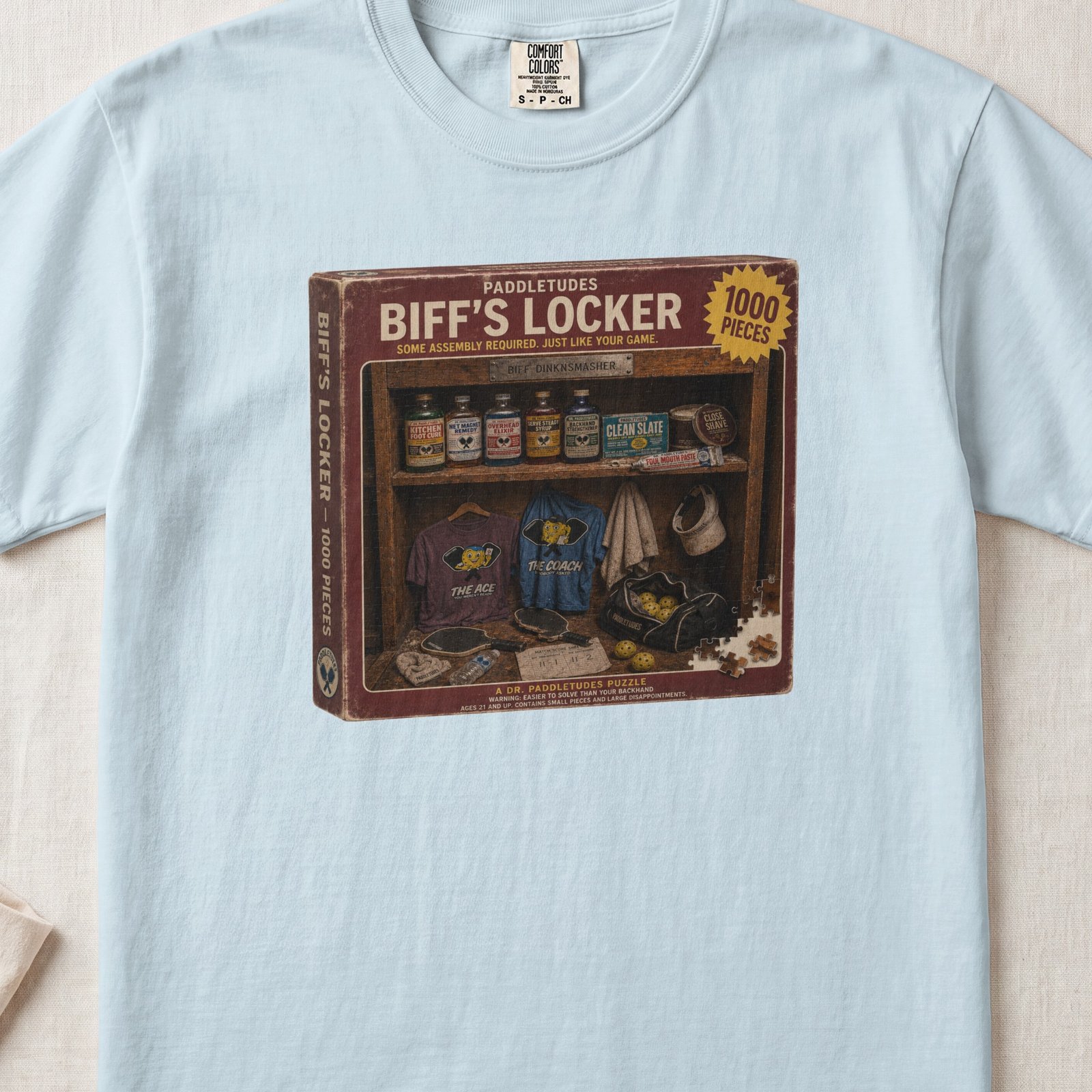
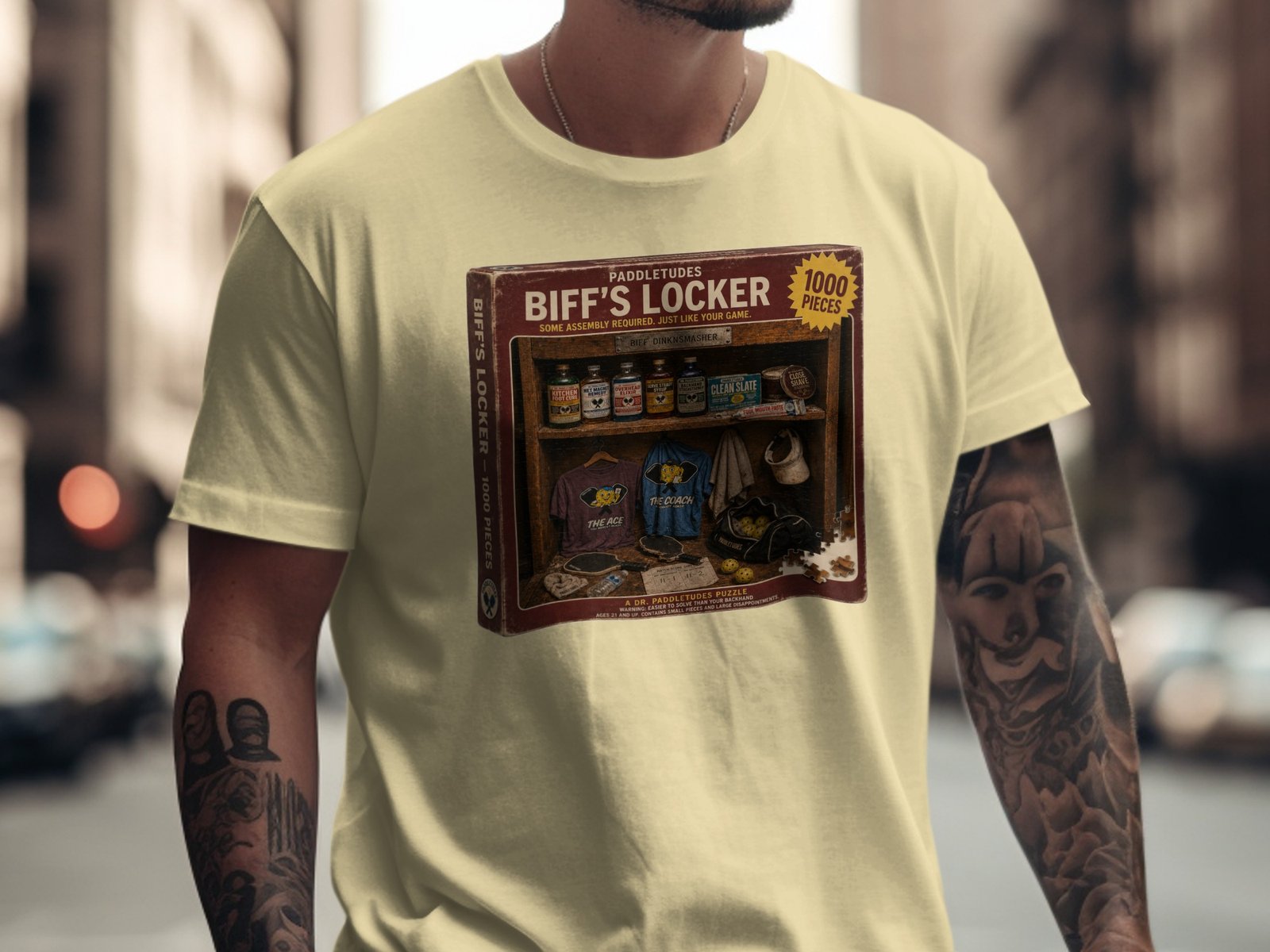
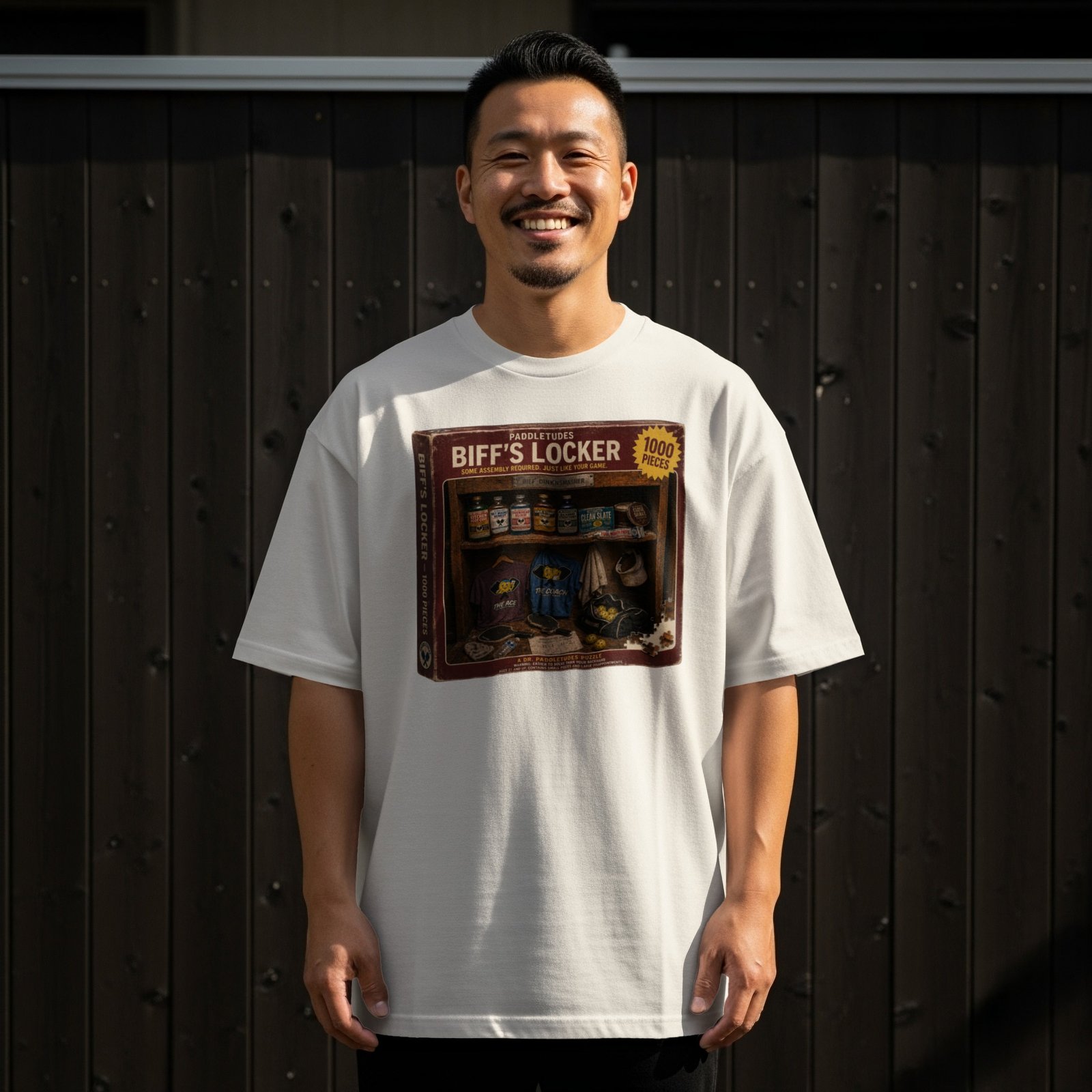
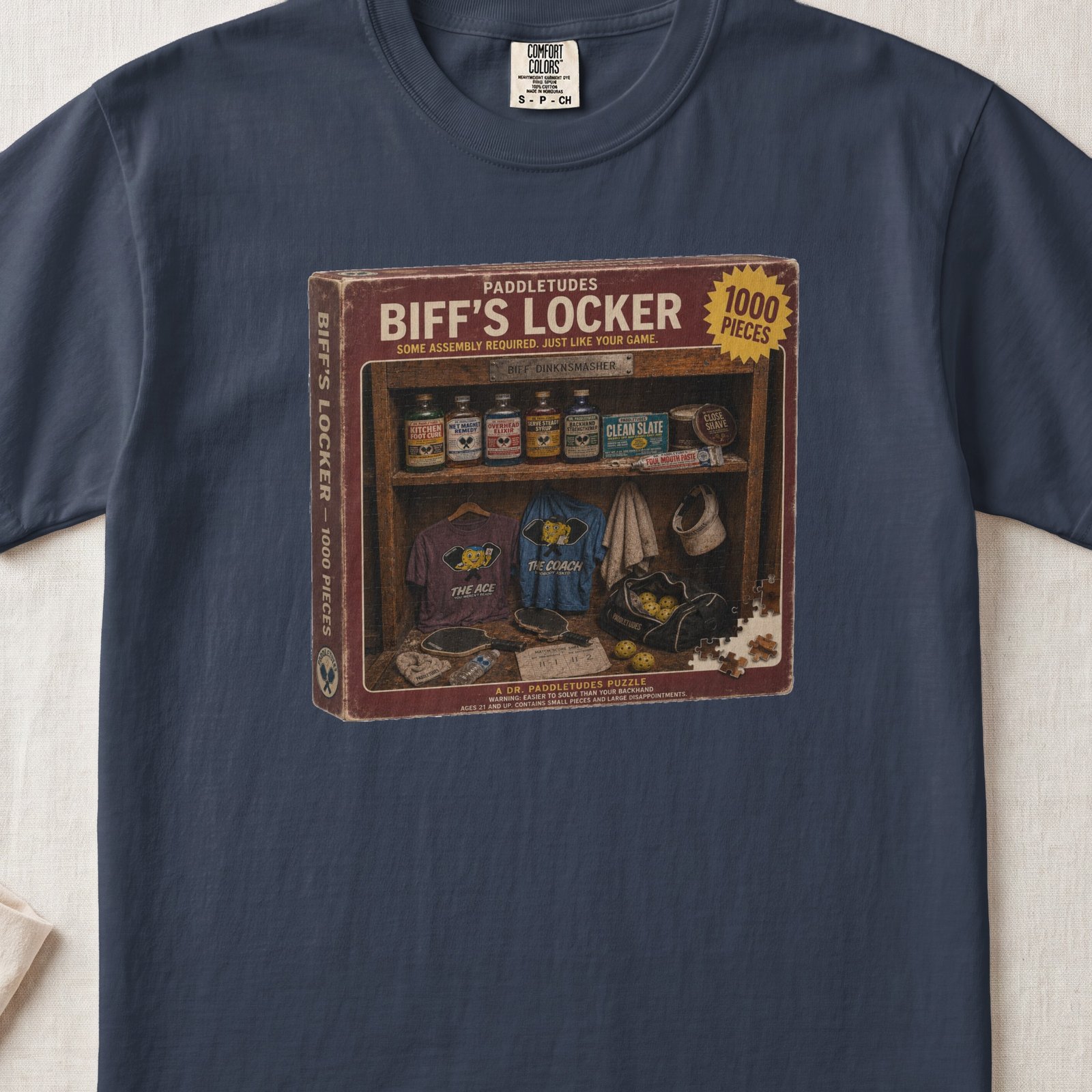
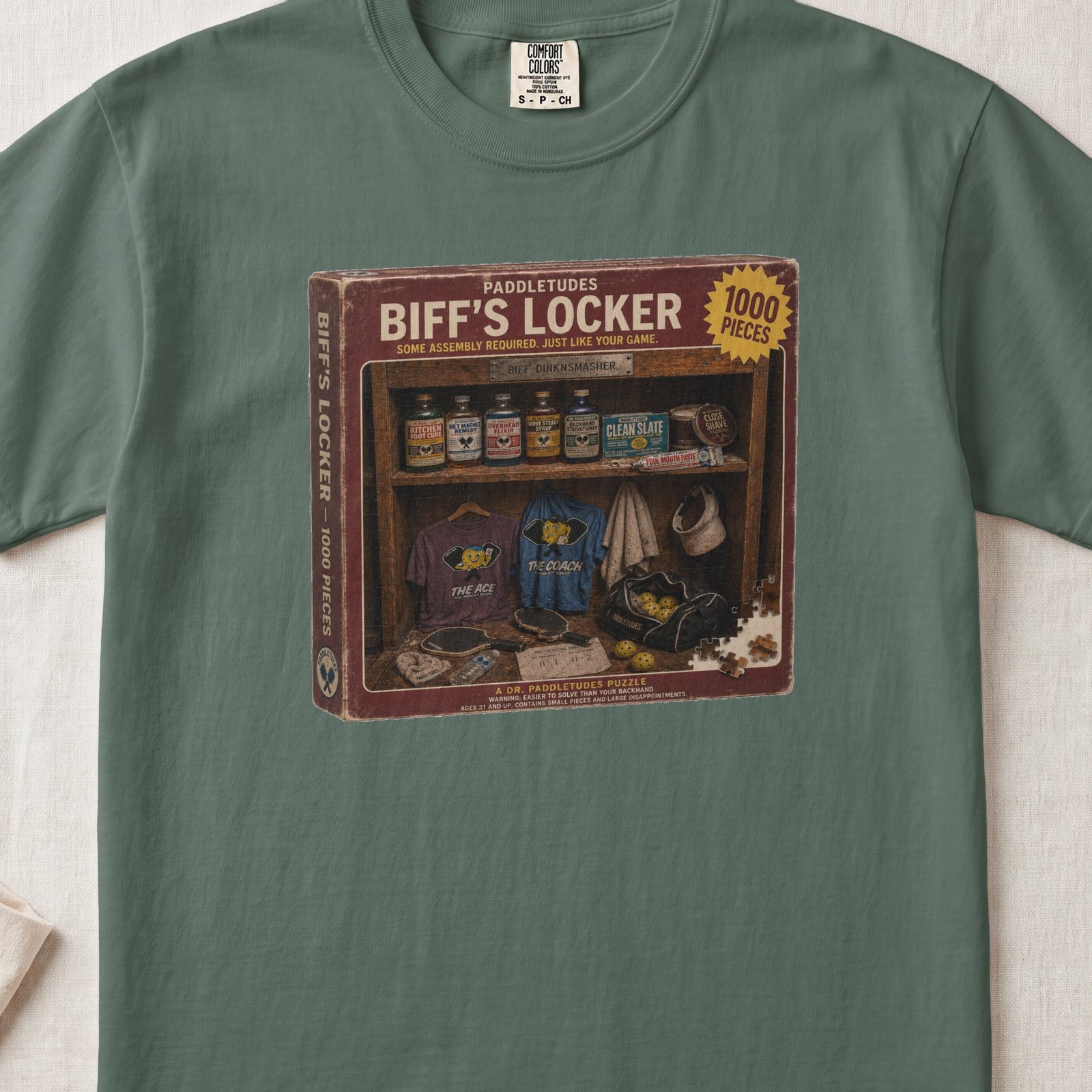
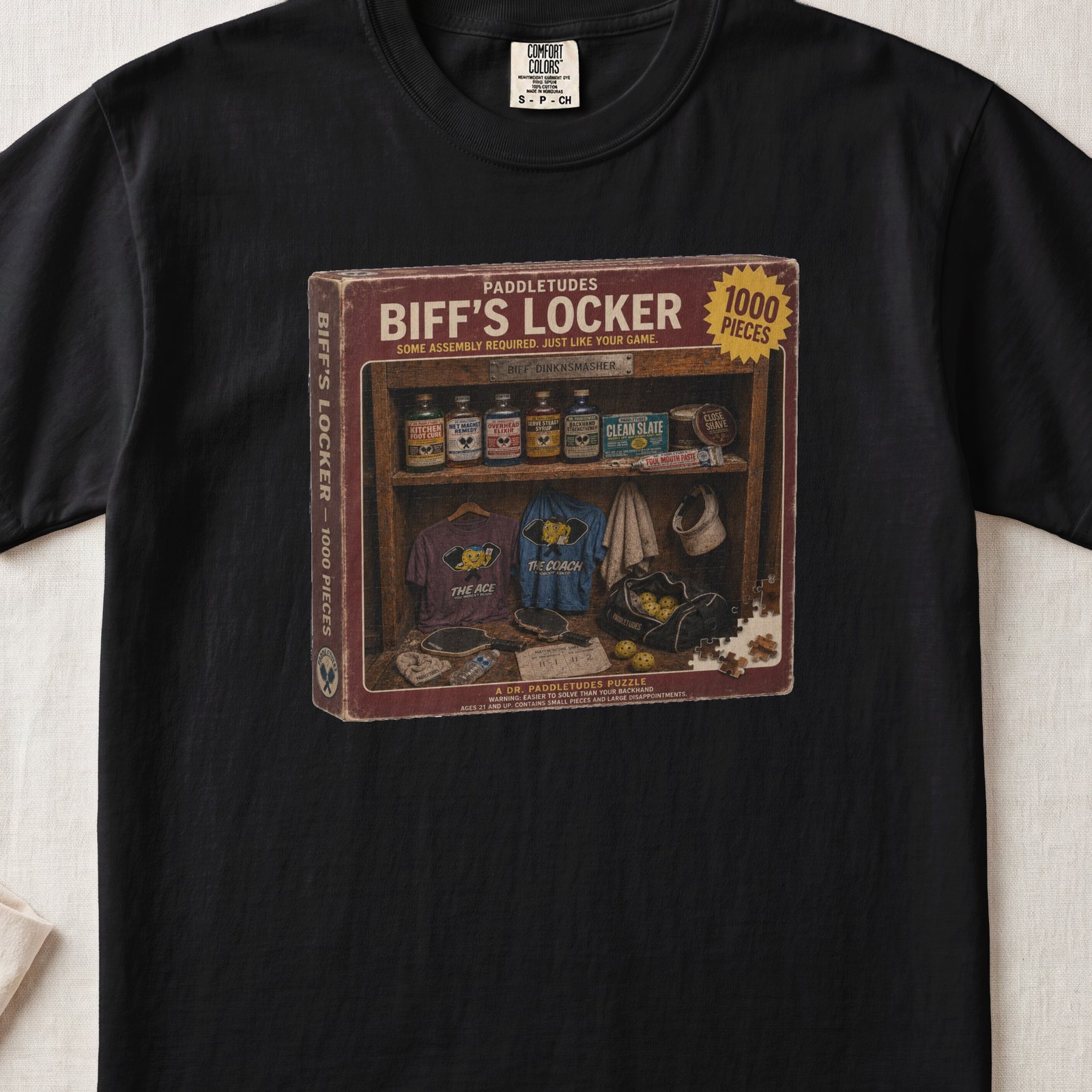
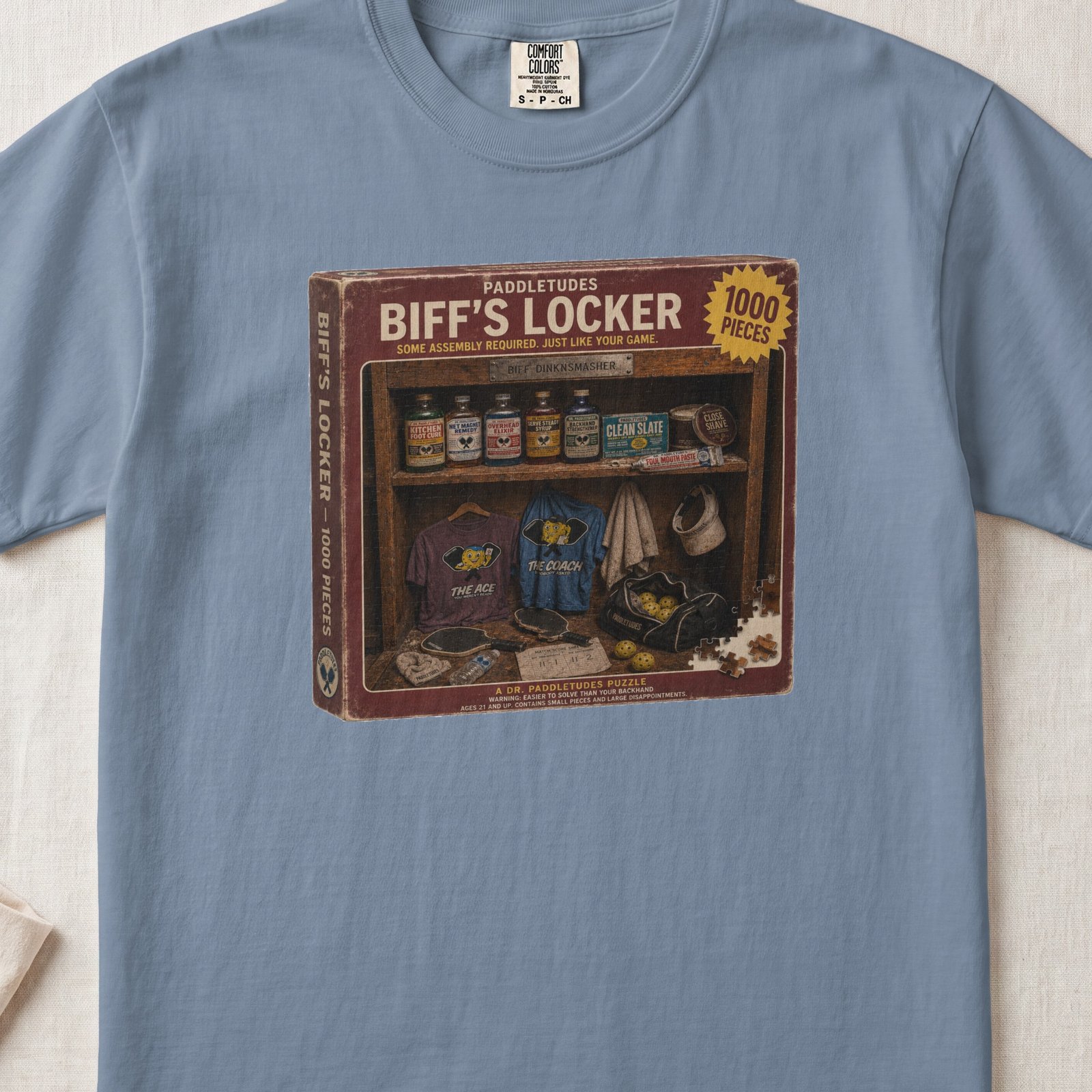
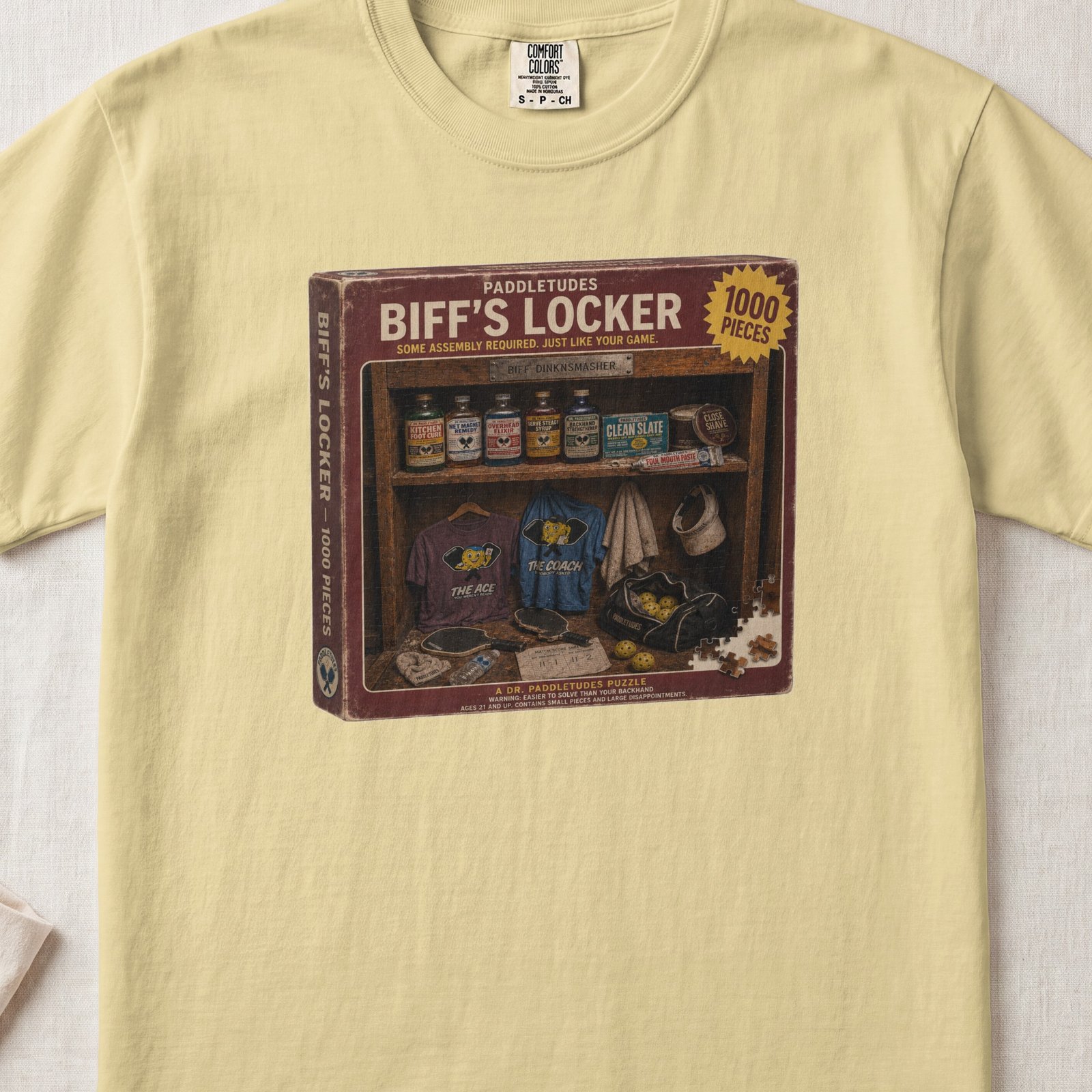
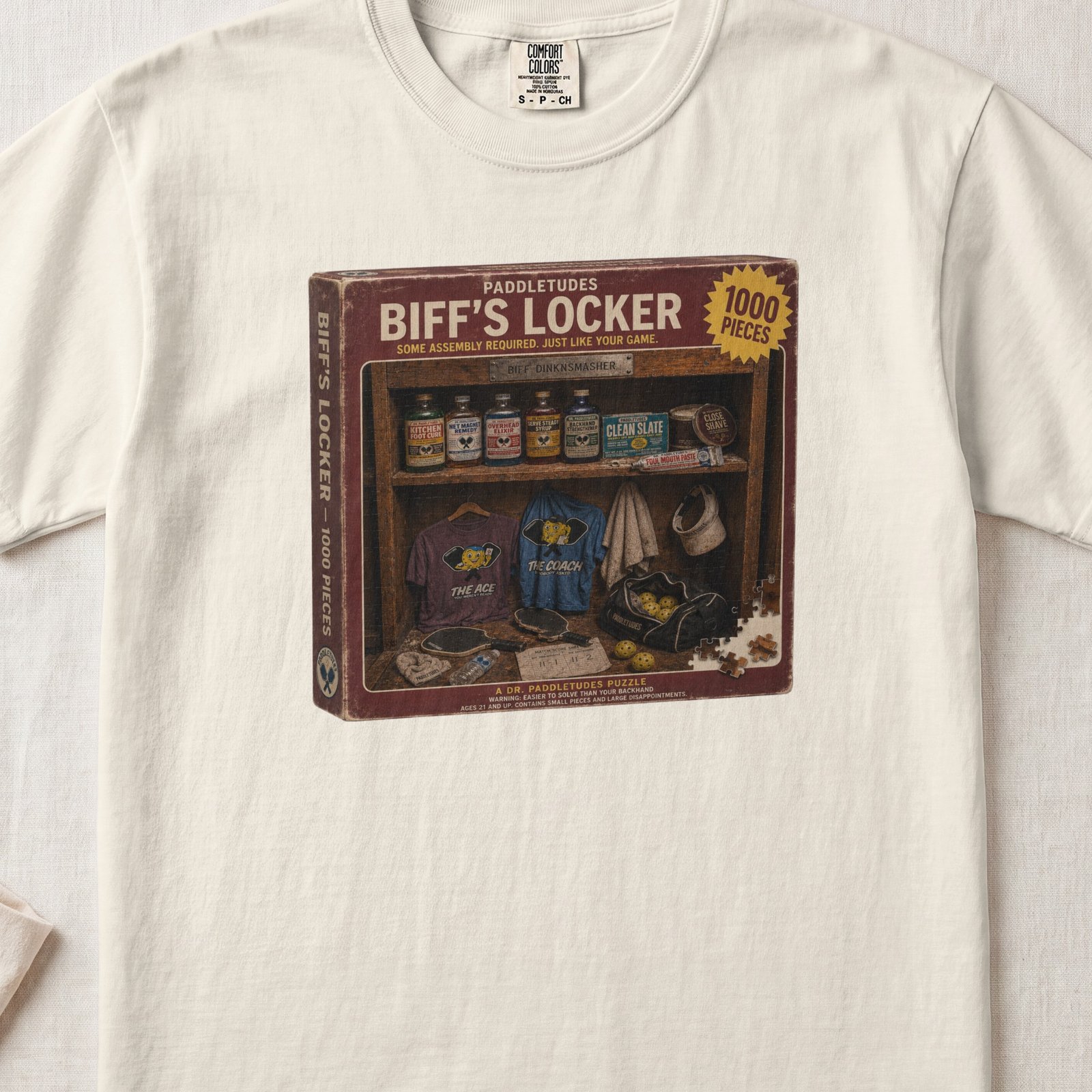
Because the picture on this box is Biff Dinknsmasher’s locker, and Biff Dinknsmasher’s locker is your locker, and you know it the moment you see it.
Top shelf: five Dr. Paddletudes bottles — the entire recovery protocol — green, amber, blue, red, cobalt, lined up like a pharmacy of everything that went wrong today. Kitchen Foot Cure for the feet that don’t listen. Net Magnet Remedy for the hopes that don’t clear. Overhead Elixir for the smashes that aren’t. Serve Steady Syrup for the toss that used to be a weapon. Backhand Strengthener for the backhand that excused itself from the conversation entirely. Next to the bottles: a tin of Close Shave, a box of Clean Slate, a tube of Foul Mouth Paste squeezed from the middle because Biff is a monster. Every piece of that top shelf is a confession you’ll recognize, and placing each piece into the puzzle is the most honest inventory of your game you’ll ever take.
Middle shelf: two t-shirts hanging on the rod. “The Ace — You Weren’t Ready” in faded purple, because Biff had one good serve on a Tuesday in March and he’s been dining out on it ever since. “The Coach Nobody Asked” in blue, because Biff gives unsolicited advice the way other people give handshakes — automatically, without checking whether the other person wants it. A Paddletudes visor, sweat-stained and earned. A towel that has seen things it cannot discuss.
Bottom shelf: the gear. A Paddletudes bag spilling yellow pickleballs onto the locker floor. A paddle — worn grip, scuffed face, the kind that’s been through three hundred games and has the emotional damage to prove it. A water bottle. A scoresheet that reads 11-1, 11-2 — because in Biff’s locker, on Biff’s scoresheet, Biff always wins, even when Biff’s actual game says otherwise. And in the corner, a few puzzle pieces missing from the edge, because the box says 1000 pieces but your game will never be fully complete and both the puzzle and Dr. Paddletudes know it.
Some Assembly Required. Just Like Your Game.
That’s the tagline on the box, and it’s the most accurate thing Paddletudes has ever printed. Your game is some assembly required. It’s a thousand-piece puzzle you’ve been working on since the first time somebody handed you a paddle, and some days you find an edge piece and some days you stare at the pile and nothing fits and you wonder if maybe the factory left a few pieces out of the box on purpose just to keep you humble.
But you keep sitting at the table. That’s the thing about puzzles and pickleball and everything else your grandparents understood about patience — the picture comes together if you stay. Not if you’re talented. Not if you’re lucky. If you stay. If you keep your hands in the pile and trust the process and do the sky first because the sky is the hardest part and hard things done first make everything else easier. Your grandfather knew that. Biff Dinknsmasher knows it too, even if his backhand doesn’t.
The box says “A Dr. Paddletudes Puzzle.” 1000 pieces. Ages 21 and Up. The warning reads Easier to Solve Than Your Backhand, which is both an insult and a comfort, depending on the day. The caution at the bottom — in the fine print, where the truth always hides — says Contains Small Pieces and Large Disappointments. And on the side, in the kind of competitive fine print that only someone who has lived inside a locker like this one would understand: “Some Assembly Required. Just Like Your Game.”
At thirty-nine ninety-nine, Biff’s Locker Puzzle costs less than the foam roller in your trunk and considerably less than the lessons you keep meaning to book. It’s a Saturday afternoon at the kitchen table. It’s your grandfather’s den with better jokes. It’s a thousand pieces of a locker that looks exactly like yours — every bottle, every shirt, every confession — and the slow, patient, rain-on-the-window work of putting yourself together one piece at a time, the way you always have, the way you always will. The picture comes together if you stay. Your grandparents knew. Now sit down, start with the edges, and get to work.
Printed on a Comfort Colors 1717 garment-dyed heavyweight tee with water-based DTG ink — sizing and care details here.
-
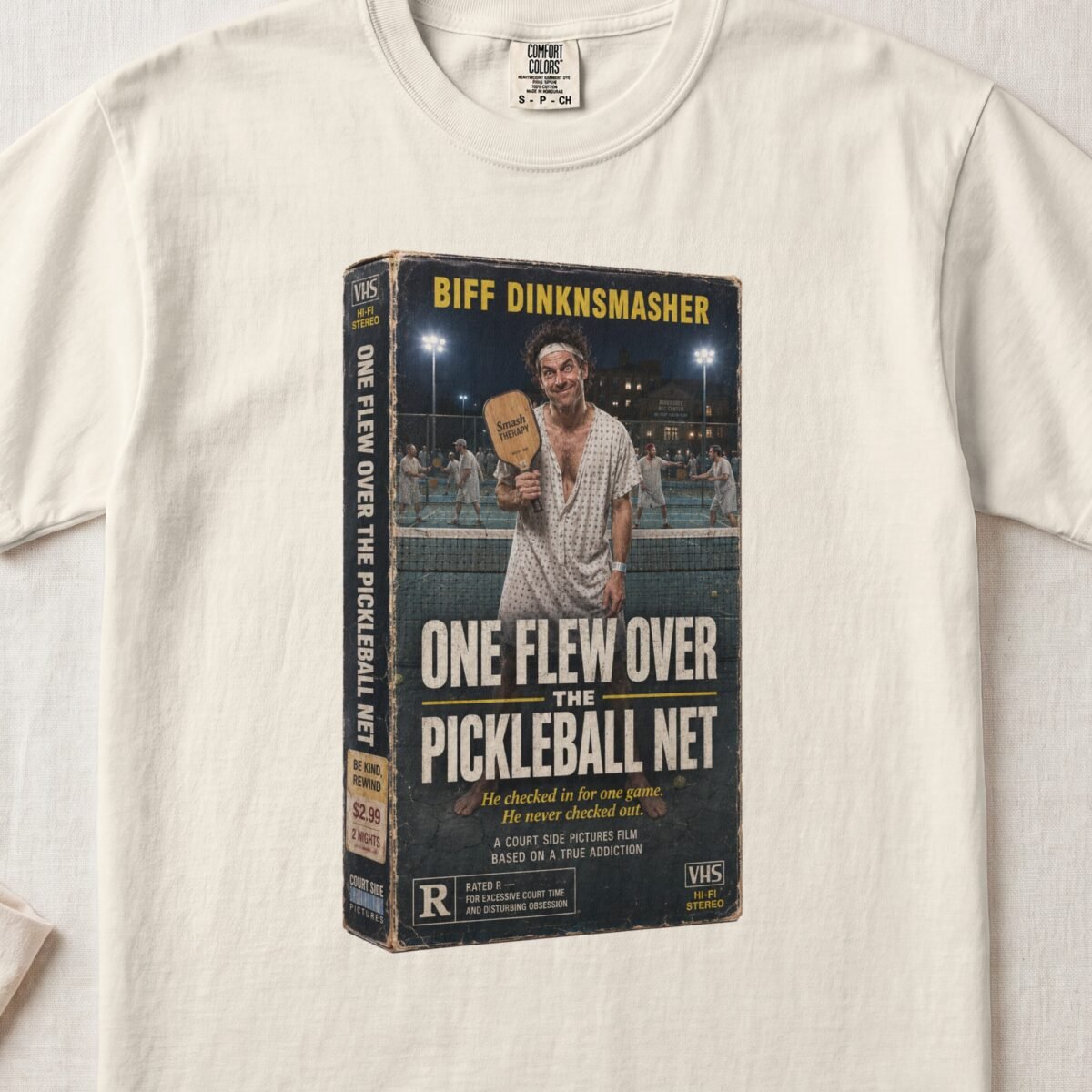
One Flew Over The Pickleball Net
$39.99 Select options This product has multiple variants. The options may be chosen on the product page -
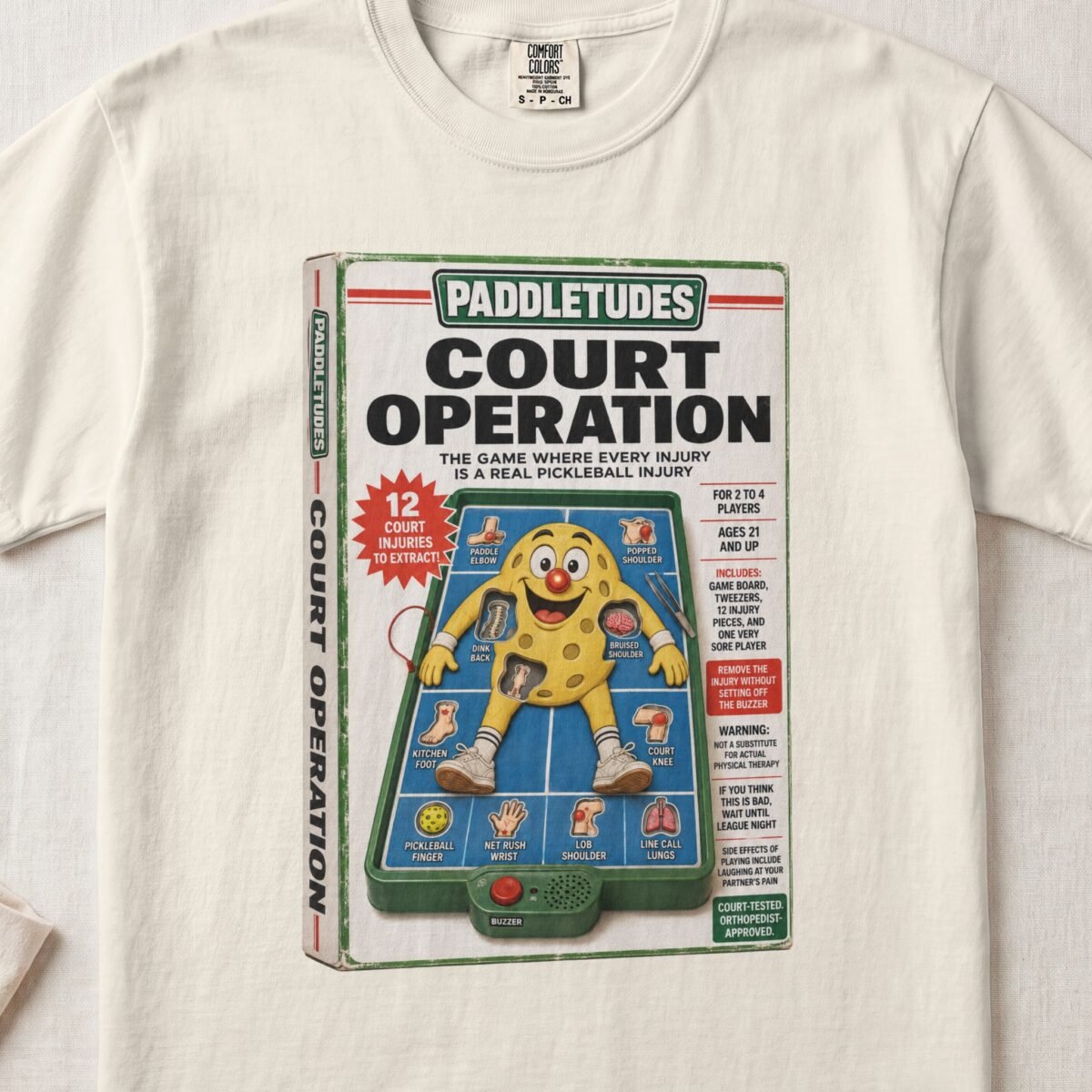
Court Operation
$39.99 Select options This product has multiple variants. The options may be chosen on the product page -
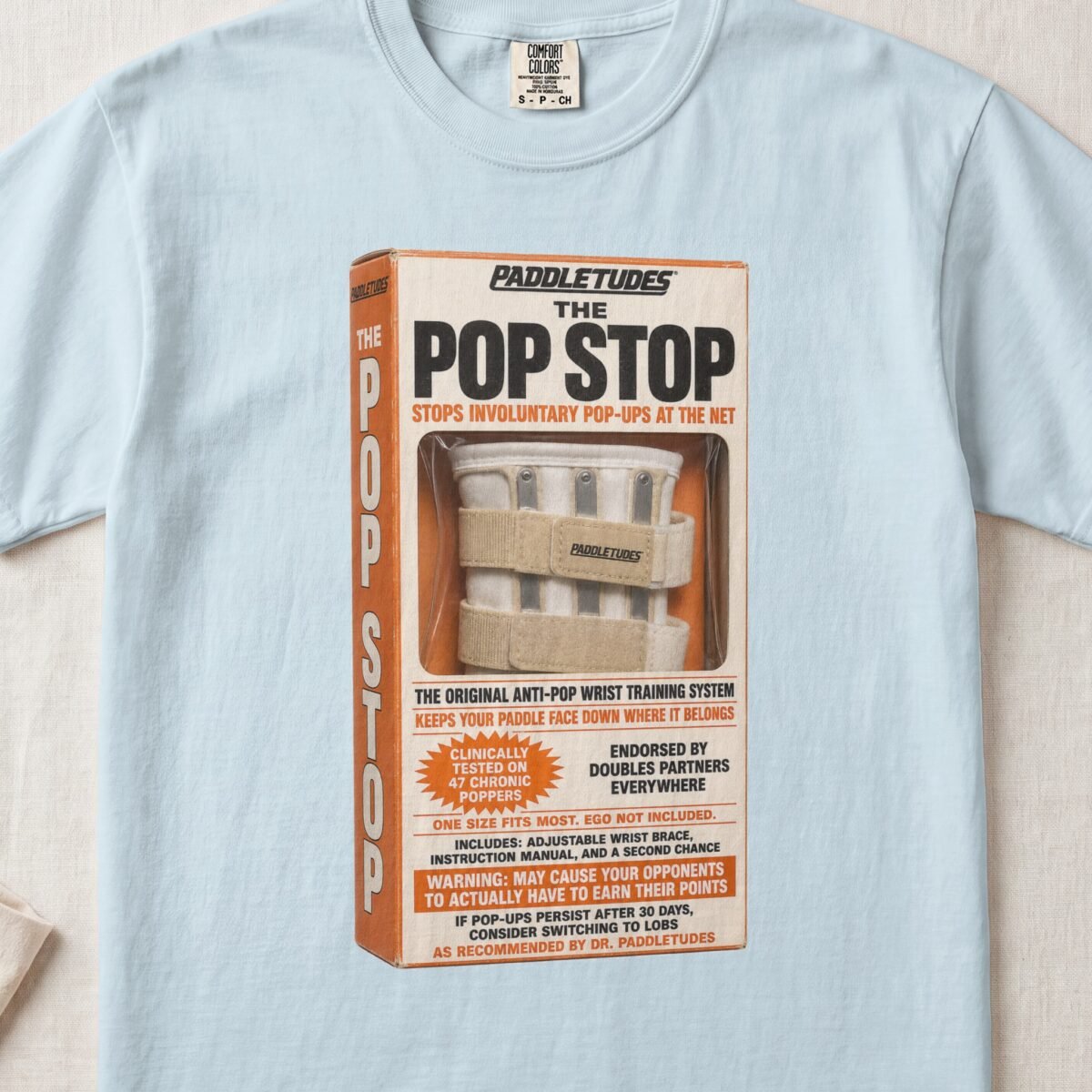
The Pop Stop
$39.99 Select options This product has multiple variants. The options may be chosen on the product page