Retro Comfort Colors 1717
The Pop Stop
$39.99
- Comfort Colors 1717 heavyweight cotton
- Original design · printed to order
- U.S. print partners
The Pop Stop — The Original Anti-Pop Wrist Training System from Dr. Paddletudes
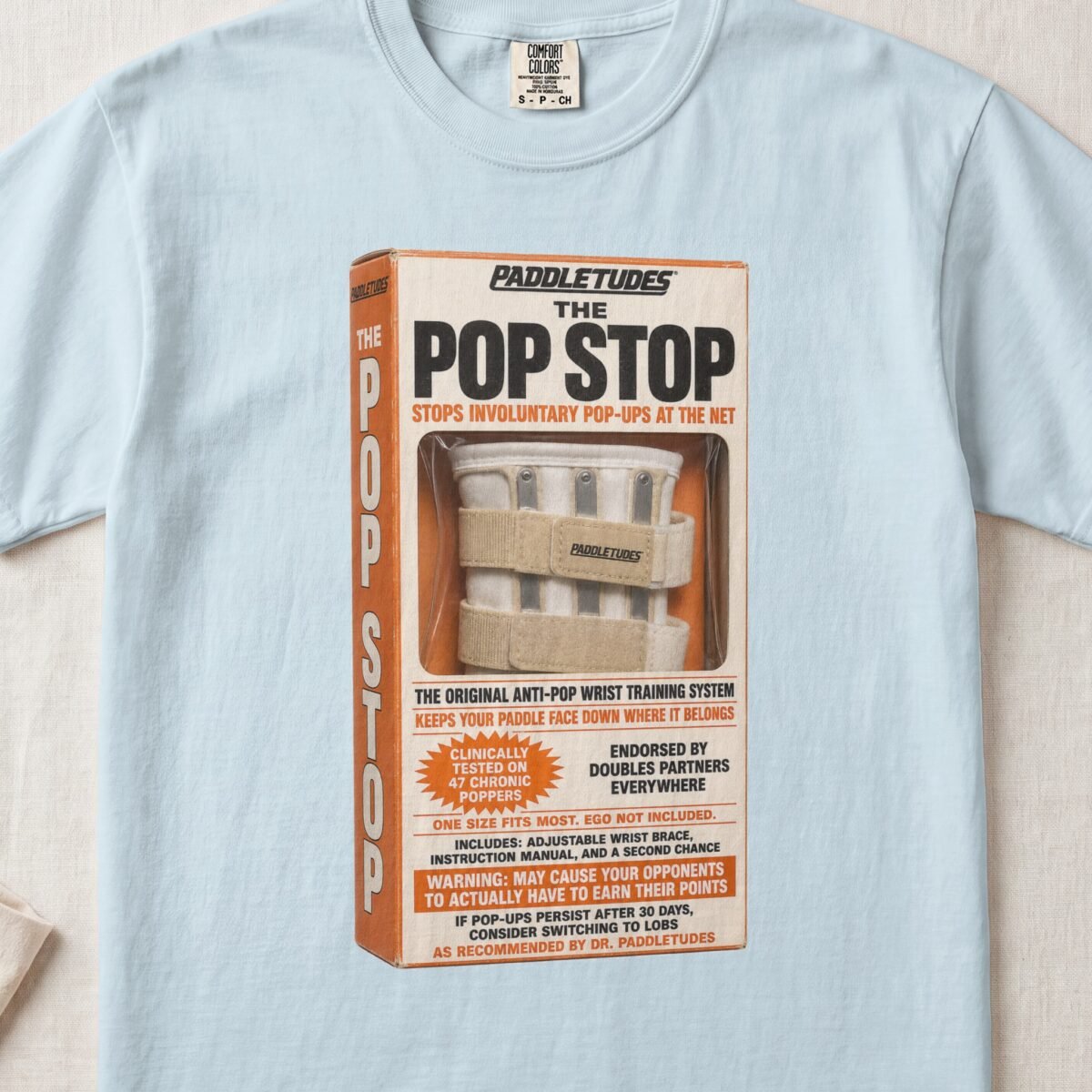
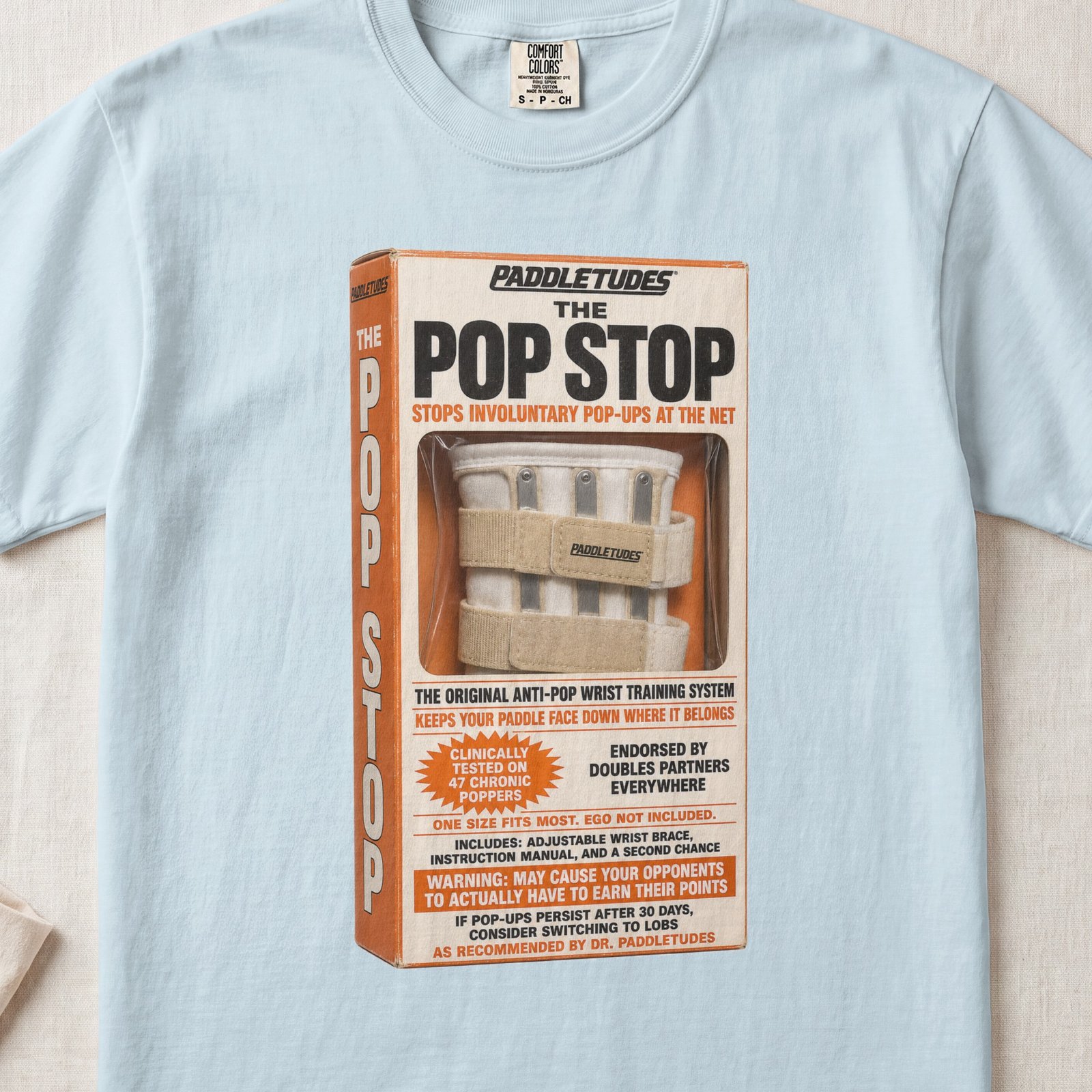
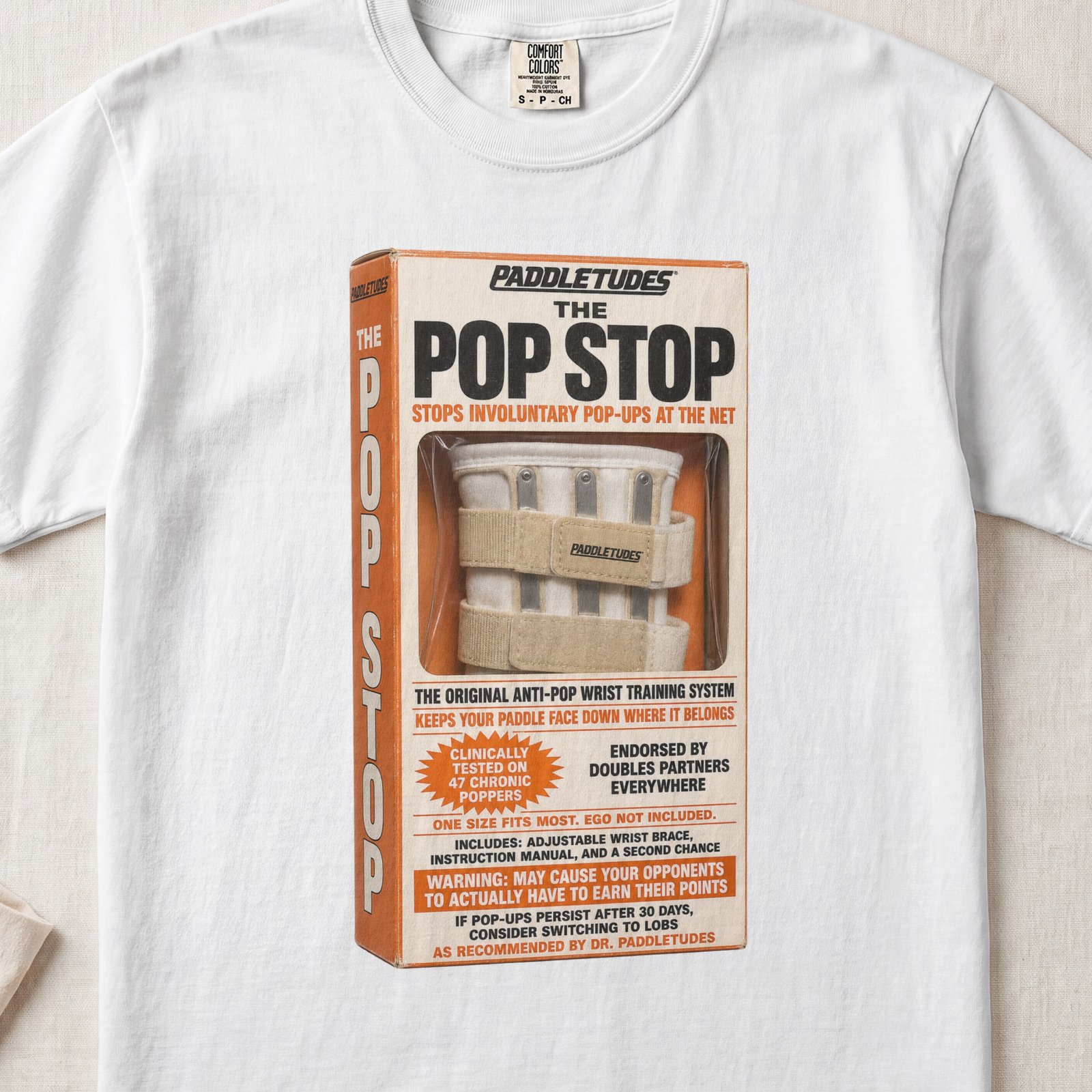
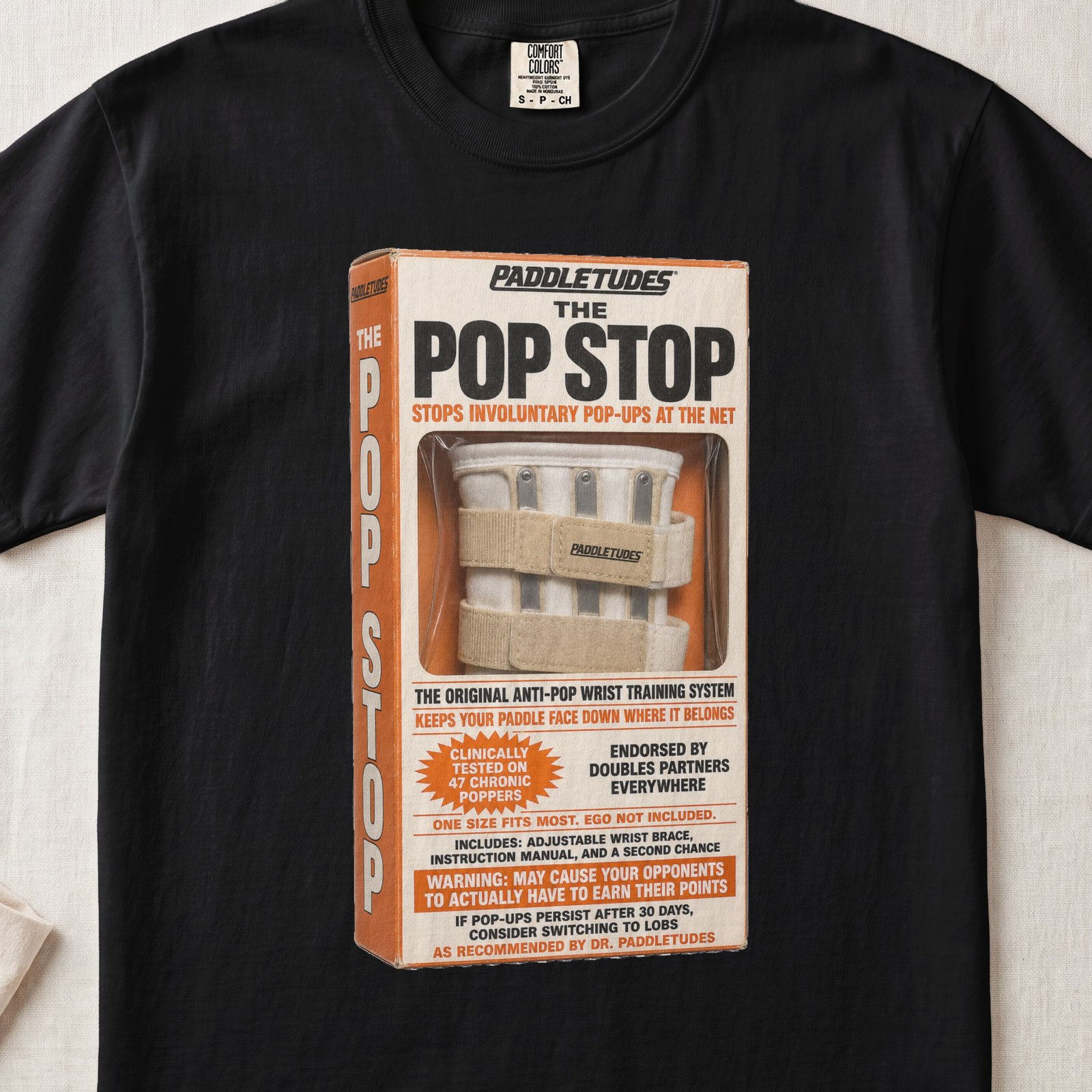
Somewhere in the Paddletudes product catalog, between the tonic bottles and the fake cereal boxes, sits a retro training device graphic tee that every pickleball player’s doubles partner wishes actually existed. The Pop Stop is a fake wrist brace designed to stop involuntary pop-ups at the net — and the box art on this shirt commits to the joke harder than most real products commit to their actual claims.
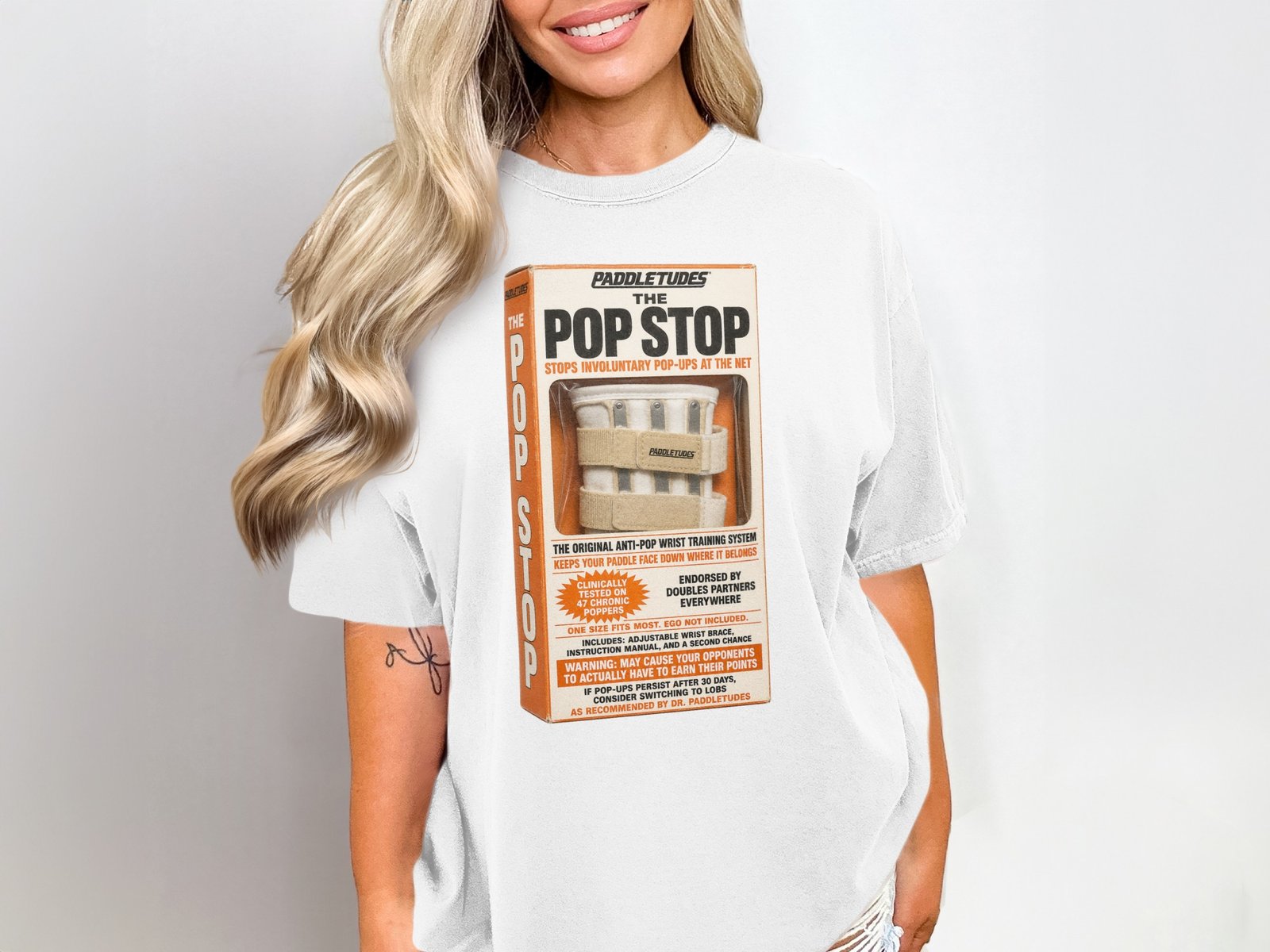
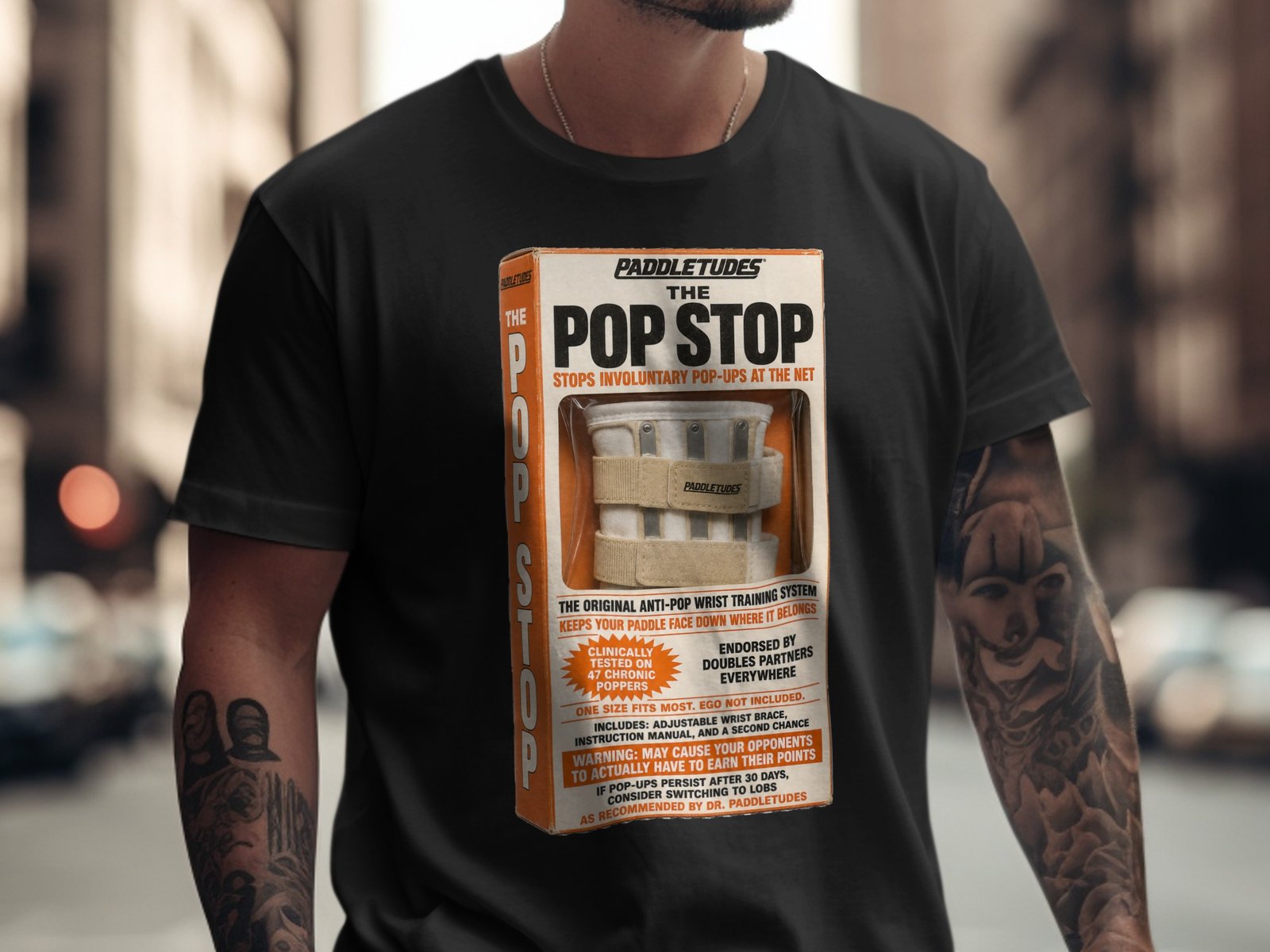
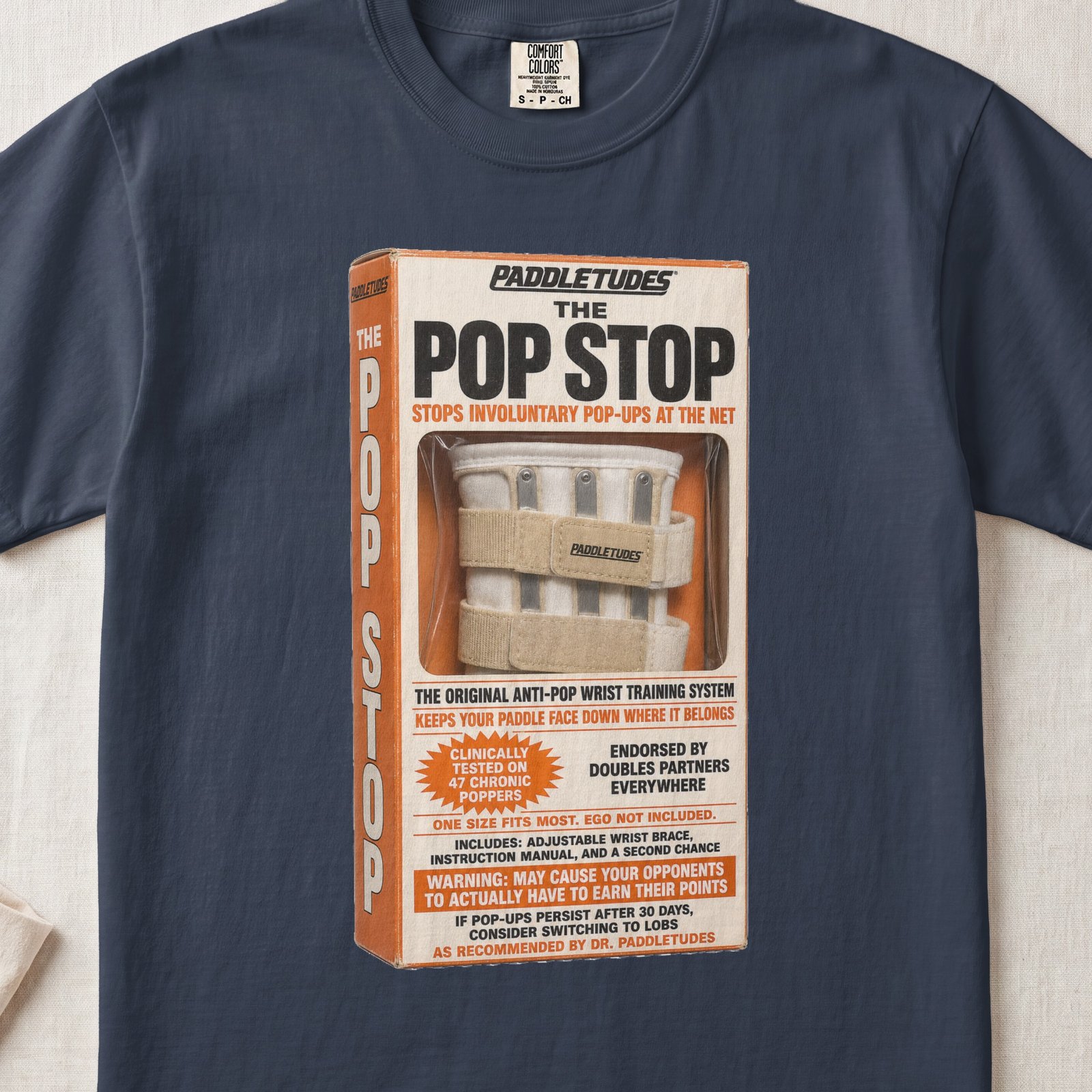
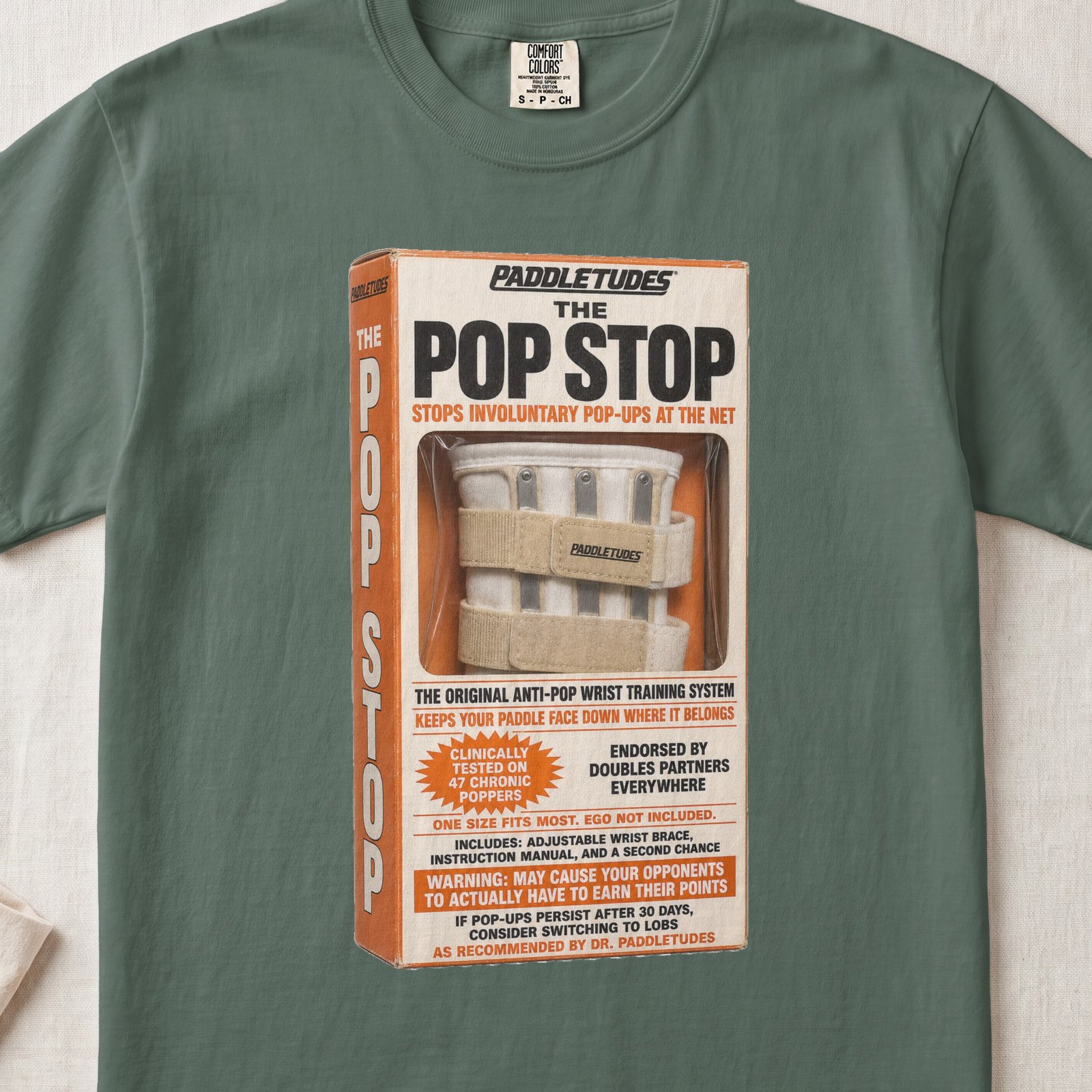
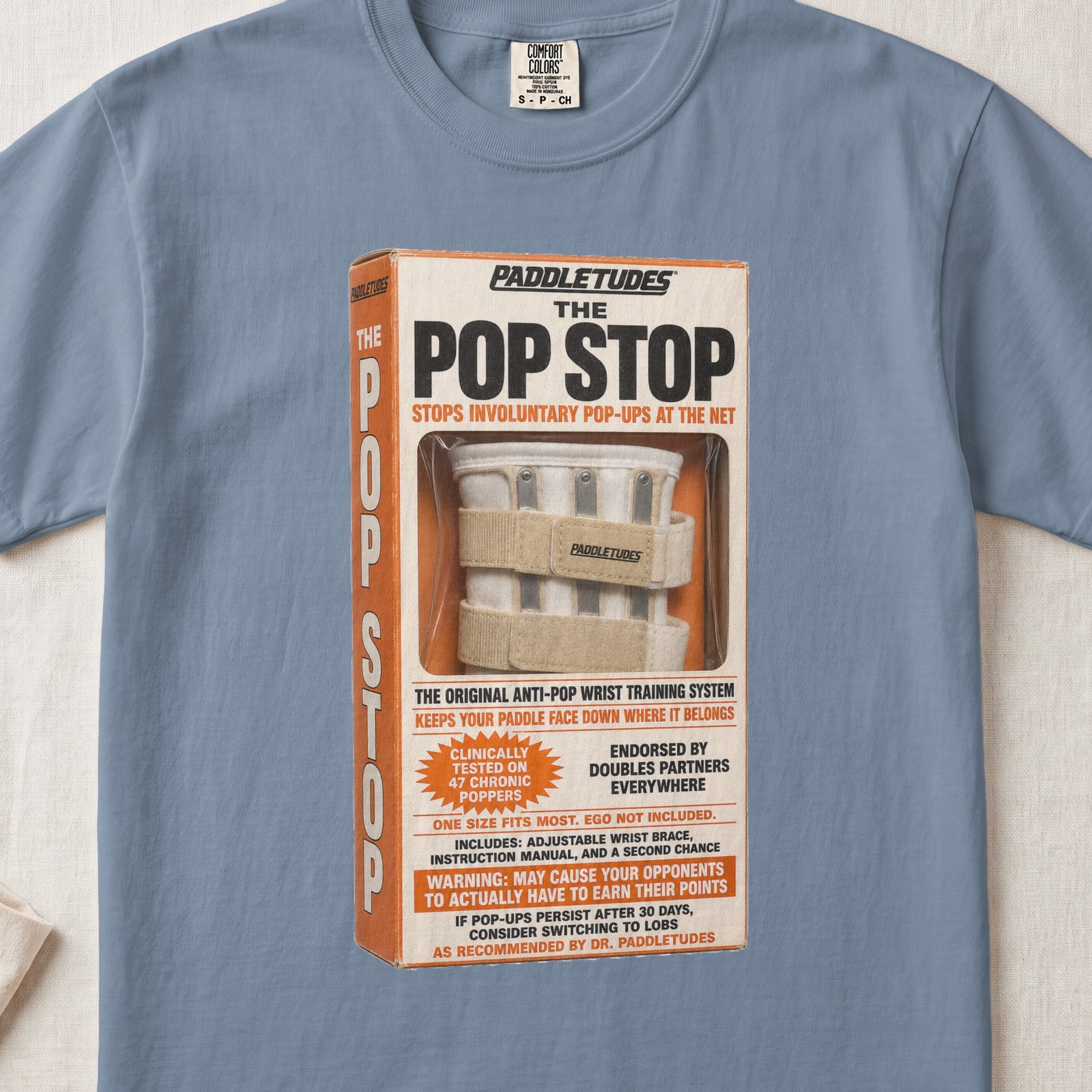
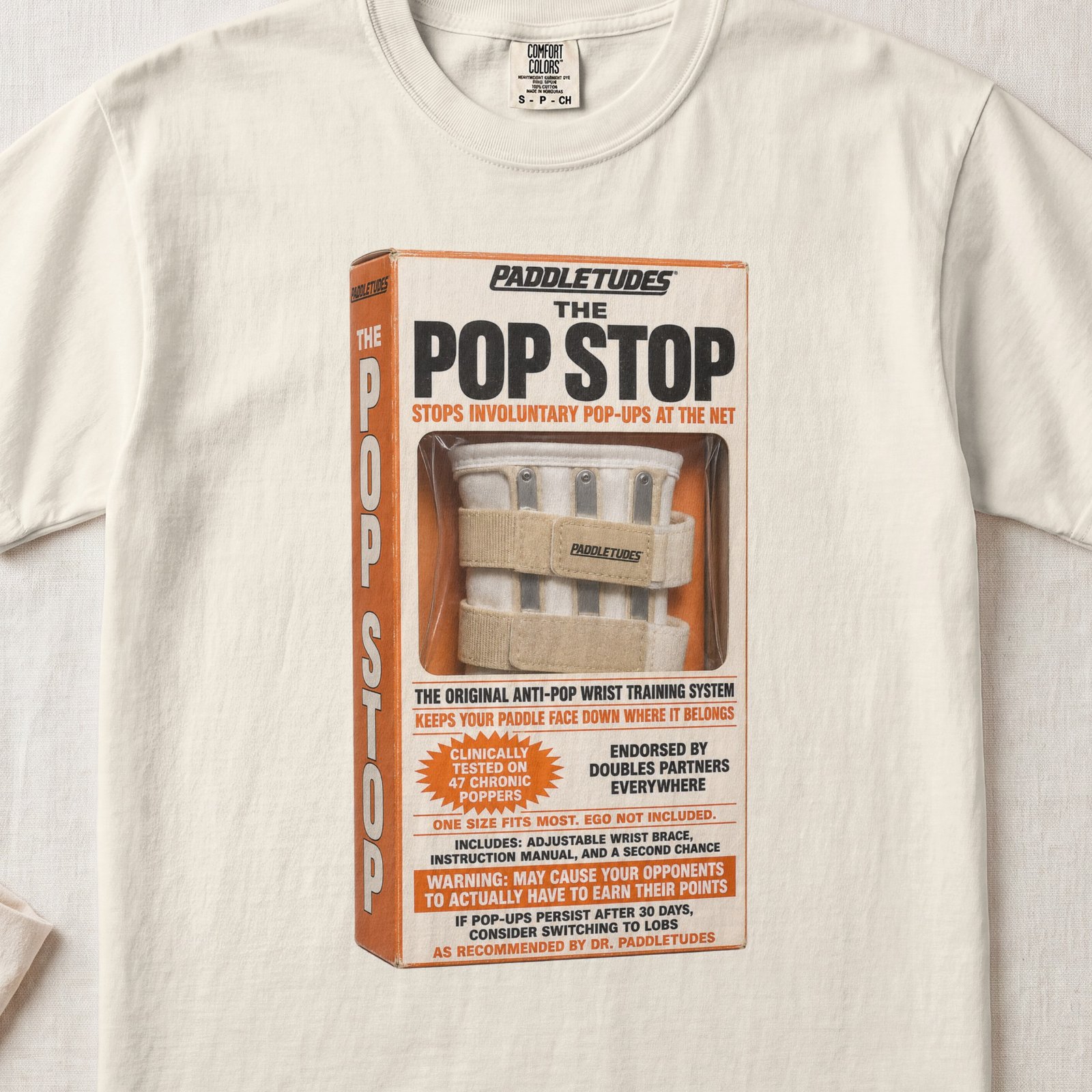
The design is a product box in burnt orange and tan with a clear window showing the device: a wrist brace with velcro straps and the Paddletudes logo stitched across the front. The headline reads “STOPS INVOLUNTARY POP-UPS AT THE NET.” Below the window, the copy gets specific: “THE ORIGINAL ANTI-POP WRIST TRAINING SYSTEM” followed by the promise every recreational player needs to hear — “KEEPS YOUR PADDLE FACE DOWN WHERE IT BELONGS.” Two endorsement blocks sit side by side: “CLINICALLY TESTED ON 47 CHRONIC POPPERS” on the left, “ENDORSED BY DOUBLES PARTNERS EVERYWHERE” on the right. Both of those are funnier if you’ve stood at the kitchen line and watched your partner pop a ball straight up to the other team’s forehand for the third time in a game.
The fine print is where The Pop Stop stops being a shirt and starts being a confessional. “ONE SIZE FITS MOST. EGO NOT INCLUDED.” That’s the line that separates the person who admits they pop up too much from the person who blames the paddle. “INCLUDES: ADJUSTABLE WRIST BRACE, INSTRUCTION MANUAL, AND A SECOND CHANCE.” The second chance is the detail that lands. Because every player who pops up at the net knows the feeling — the ball goes up, the opponent’s eyes light up, and the point is over before anyone breathes. The warning label at the bottom reads: “WARNING: MAY CAUSE YOUR OPPONENTS TO ACTUALLY HAVE TO EARN THEIR POINTS.” And below that, the final prescription: “IF POP-UPS PERSIST AFTER 30 DAYS, CONSIDER SWITCHING TO LOBS. AS RECOMMENDED BY DR. PADDLETUDES.”
The pop-up is the most universal problem in recreational pickleball. It happens when the paddle face opens too much on contact at the kitchen line, sending the ball upward instead of forward. The result is a ball that floats above the net at head height, sitting there like an invitation for the opponent to end the point with an overhead or a sharp volley. Every player between 3.0 and 4.0 has fought this battle. The wrist wants to flip. The paddle face wants to open. And the ball wants to go up instead of staying low. The Pop Stop turns that universal frustration into a fake product that captures something real about the learning curve of the sport — the gap between knowing what to do and getting your hands to actually do it under pressure.
As a gift, this one hits differently than the other Paddletudes products. Love & Dinks celebrates the social player. The Pet Pickleball celebrates the obsession. The Pop Stop calls someone out — gently, lovingly, but specifically. Your doubles partner who pops up three balls a game and groans every time? This is the gift that says you noticed, you still love playing with them, and you’re not above making it funny. It also works as a self-purchase for the player who knows their own weakness and owns it. Browse the full Paddletudes retro collection for more fake products that solve real court problems, or grab Love & Dinks for the partner who doesn’t pop up because she never hits hard enough to pop up in the first place.
Why Do I Keep Popping the Ball Up in Pickleball
You keep popping the ball up in pickleball because your paddle face is opening too much on contact, usually from a wrist that flips upward under pressure instead of staying firm through the shot. The fix is mechanical — a quieter wrist, a more compact swing, and meeting the ball out in front of your body where you can control the angle.
The pop-up happens most often at the kitchen line during dink rallies. A low ball comes in, the player reaches for it, and the wrist instinctively opens the paddle face to lift the ball over the net. That lift is the problem. The ball needs to clear the net by inches, not feet. When the face opens too much, the ball sails upward instead of arcing softly over the net and back down into the kitchen. The opponent reads it immediately — a ball at chest height over the net is an attackable ball, and at the intermediate level and above, it gets punished almost every time.
Three mechanical adjustments solve most pop-up problems. First, meet the ball out in front of your body, not beside it or behind it. Contact in front gives you a natural downward paddle path. Second, use your shoulder and elbow to guide the shot, not your wrist. A firm wrist with a slightly closed paddle face produces a ball that clears the net low and drops into the kitchen. Third, slow down. Pop-ups happen when players rush the contact, jabbing at the ball instead of guiding it. The best paddle in the world won’t fix a pop-up caused by a rushed swing and an open face. The Pop Stop’s box says it best: “Keeps your paddle face down where it belongs.” That’s the whole fix in eight words.
How Do You Keep Your Paddle Face Down at the Kitchen Line in Pickleball
To keep your paddle face down at the kitchen line, hold a continental grip with light pressure, lead with the paddle edge on approach shots, and think about pushing the ball forward instead of lifting it. The paddle face should point slightly downward or neutral at contact — never upward. If you can see the sky in the face of your paddle when you make contact, the ball is going up.
The grip is the foundation. A continental grip — where the V of your thumb and index finger sits on top of the paddle handle — naturally positions the face in a neutral-to-closed angle. Many recreational players hold an eastern or semi-western grip that opens the face, especially on the backhand side. Switching to continental feels awkward for the first few sessions but eliminates the most common mechanical cause of pop-ups within weeks.
The ready position matters too. At the kitchen line, the paddle should be up and slightly forward, at about chest height, with the face tilted slightly downward. Think of it as a shield, not a scoop. When the ball arrives, the motion is a short push forward and through the ball, not a lift underneath it. The wrist stays firm. The elbow guides the angle. And the follow-through stays low — paddle finishes pointing at the net or slightly below it, never at the sky. Players who drill this position for ten minutes before every session see results within a week. The pop-up is a habit, and like all habits, it breaks when you replace it with a better one. The PPA Tour players at the kitchen line look like they’re barely moving the paddle — because they aren’t. Small, controlled movements with a firm face produce low, unattackable dinks. Big, wristy swings produce the ball The Pop Stop was designed to prevent.
Printed on a Comfort Colors 1717 garment-dyed heavyweight tee with water-based DTG ink — sizing and care details here.
-
Mixed Doubles Misery
$39.99 Select options This product has multiple variants. The options may be chosen on the product page -
Soft Hands
$39.99 Select options This product has multiple variants. The options may be chosen on the product page -
Pickle Shack
$39.99 Select options This product has multiple variants. The options may be chosen on the product page